
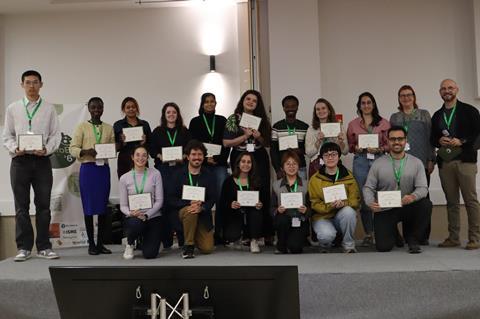
Last month Applied Microbiology International supported the 6th Plant Microbiome Symposium in Antequera, Spain, funding 17 travel grants for early career researchers to attend. Organiser Dr Victor Jose Carrion Bravo reports back on a vibrant exchange of ideas.
There is growing urgency for reliable, scalable microbiome-based solutions as agriculture faces biotic and abiotic stresses such as drought, heat, salinity and declining soil quality.
The science is advancing fast, but still fragmented. Bringing together mechanistic work, field trials, industry and data science helps create a shared roadmap so the field can move from promising concepts to solutions farmers can actually use.
Global event
At the 6th Plant Microbiome Symposium, we had 270 participants from 37 countries and 127 institutes/companies. The largest groups came from the Netherlands (58), Spain (34), Brazil (24), UK (18), Denmark (17) and France (13), but we also had strong representation across Europe, Asia, the Americas, Oceania and the Middle East.
Institutions with the highest participation included Utrecht University (15), NIOO-KNAW (14), University of São Paulo (CENA-USP, 12), University of Málaga / IHSM (11), University of Copenhagen (7) and University of Florida (6), among many others.
Strong outcomes
In my opinion, a few things that really came out of the meeting included:
- Excellent new data on microbiome responses specially to abiotic stresses, with clear implications for crop resilience.
- Strong sessions on multi-omics integration, machine learning and ecosystem modelling.
- Exceptional contributions from early-career researchers.
The atmosphere was genuinely open and collaborative. More than just a gathering of scientists, it felt like a community of colleagues and friends, including a vibrant new generation of PIs and students, coming together to exchange ideas. Many shared unpublished results, and the discussions centred on aligning methods, validating findings across different labs, and building shared resources. It gave a strong sense that the field is moving forward collectively, with real momentum.
Diversity and real interaction
People appreciated the strong balance between basic and applied science, the solid industry participation, and the overall size of the meeting, large enough to offer diversity, yet small enough to allow real, meaningful interaction. The 21 invited speakers, most of them rising young PIs, were consistently highlighted as a major strength of the programme.
Several participants mentioned that it was one of the rare conferences where genuine collaborations started during the coffee breaks. A few even described it as the best congress they’ve ever attended, and others said it was the best PMS to date.
New collaborations
New collaborative projects are already taking shape, involving both academic groups and companies, with plans for joint grant proposals and coordinated experiments. There is strong momentum to develop shared standards for microbiome trials, from protocols to data formats, to make results more comparable across labs.
Perhaps most importantly, a very active group of young PIs has formed strong links during the meeting. They are eager to collaborate, share resources and build long-term partnerships. This growing network will likely become a driving force for future initiatives, including the next edition of the symposium, which we hope will involve an even closer connection to growers and policymakers.
Find out more about AMI’s grants.




No comments yet