
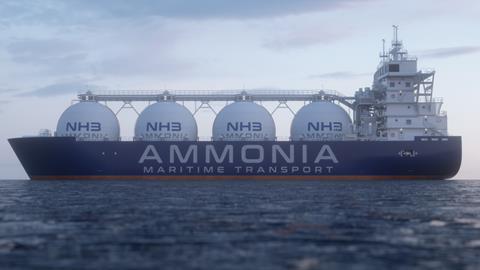
Ammonia is one of the most important chemicals in modern society. It plays a central role in global food production as the key ingredient in fertilizers that sustain nearly half of the world’s population. Beyond agriculture, ammonia has recently attracted growing attention as a potential carbon-free energy carrier and hydrogen storage medium in the global transition toward sustainable energy systems. Despite its enormous importance, however, the current method of ammonia production comes with a significant environmental burden.
Ammonia: essential but environmentally costly
Today, most ammonia is produced through the Haber–Bosch process, an industrial technology developed more than a century ago. This process converts atmospheric nitrogen into ammonia under extremely high temperatures and pressures, requiring substantial energy input primarily derived from fossil fuels. As a result, ammonia manufacturing accounts for a considerable share of global energy consumption and carbon dioxide emissions. With increasing worldwide demand for both fertilizers and clean energy technologies, the environmental impact of ammonia production is becoming increasingly difficult to ignore.
Microorganisms: nature’s hidden workforce for green ammonia
While industrial ammonia production depends on extreme temperatures, high pressures, and fossil-fuel-derived energy, nature has long carried out the same transformation under remarkably mild conditions. At the center of this natural process are nitrogen-fixing microorganisms, a diverse group of bacteria and archaea capable of converting atmospheric nitrogen into biologically usable ammonia. This extraordinary biochemical reaction is driven by nitrogenase, one of the most fascinating and complex enzymes found in nature.
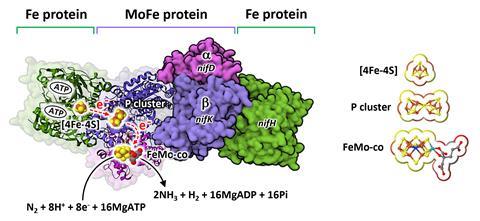
Nitrogen gas (N₂) makes up nearly 78% of Earth’s atmosphere, yet most living organisms cannot directly utilize it because of the strong triple bond between the two nitrogen atoms. Nitrogenase overcomes this challenge by catalyzing the reduction of atmospheric nitrogen into ammonia through the process of biological nitrogen fixation (Figure 1). Powered by electrons and ATP, nitrogenase enables microorganisms to perform a reaction that industrial systems can only achieve under harsh operating conditions.
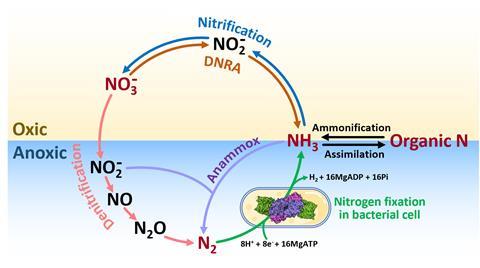
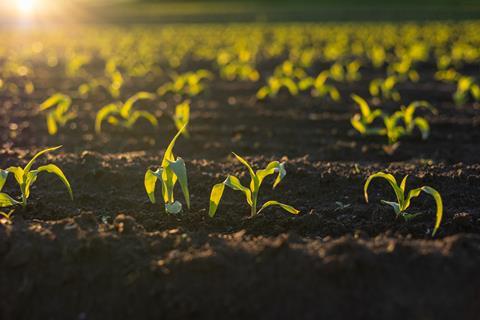
Nitrogenase is a cornerstone of the global nitrogen cycle, sustaining the movement of nitrogen through ecosystems and maintaining soil fertility. Without biological nitrogen fixation, the supply of bioavailable nitrogen required for proteins, nucleic acids, and other essential biomolecules would rapidly become depleted. Nitrogen-fixing microorganisms, therefore, play a quiet but fundamental role in supporting life on Earth (Figure 2).
These microorganisms are widely distributed across nature. Nitrogen-fixing species are found in soils, oceans, freshwater systems, sediments, and even extreme environments. They occur among diverse microbial groups, including free-living bacteria, plant-associated symbiotic bacteria, cyanobacteria, and certain archaea. Some establish highly specialized relationships with plants, while others independently fix nitrogen in the surrounding environments.
Therefore, nitrogenase has attracted increasing interest as a biological foundation for future green ammonia technologies. Unlike the Haber–Bosch process, biological nitrogen fixation operates under ambient temperature and atmospheric pressure, offering inspiration for low-energy and carbon-neutral ammonia production systems. As scientists continue searching for sustainable alternatives to conventional ammonia synthesis, nitrogen-fixing microorganisms and their enzymatic machinery may provide valuable insights for cleaner and more environmentally friendly technologies.
Azotobacter: a microbial powerhouse for green ammonia
Among the many nitrogen-fixing microorganisms found in nature, the genus Azotobacter has emerged as one of the most promising candidates for sustainable ammonia production. Unlike symbiotic diazotrophs that depend on plant hosts, Azotobacter species are free-living bacteria capable of independently fixing atmospheric nitrogen under fully aerobic conditions. This unusual capability has attracted growing interest from researchers seeking environmentally friendly alternatives to conventional ammonia synthesis.
Azotobacter species are commonly found in soils and aquatic environments, where they contribute to natural nitrogen cycling and soil fertility. These bacteria are known for their rapid growth, strong respiratory metabolism, and remarkable adaptability to fluctuating environmental conditions. Although Azotobacter has long been studied for agricultural applications as a plant-growth-promoting microorganism, recent advances in microbiology, synthetic biology, and renewable energy research have expanded its significance toward green ammonia technologies.
One of the most remarkable characteristics of Azotobacter is its ability to maintain nitrogen fixation in the presence of oxygen. Usually, nitrogenase is a highly oxygen-sensitive enzyme and is rapidly inactivated under aerobic conditions. Most nitrogen-fixing microorganisms, therefore, require anaerobic or microaerobic environments to sustain nitrogenase activity. In contrast, Azotobacter has evolved highly efficient protective mechanisms that allow biological nitrogen fixation to proceed even in oxygen-rich environments.
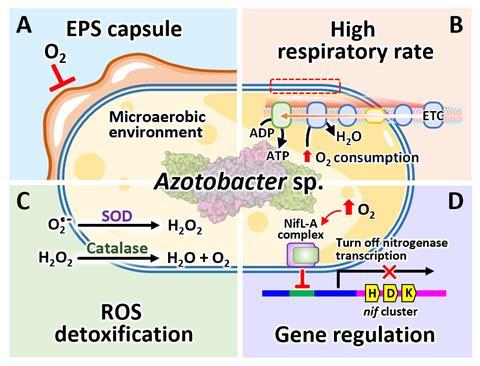
This oxygen protection relies on several coordinated physiological strategies. Azotobacter can produce extracellular polysaccharide layers that help restrict oxygen diffusion into the cell (Figure 3A) and exhibits exceptionally high respiratory activity (Figure 3B), rapidly consuming intracellular oxygen before it can damage nitrogenase. In addition, intracellular antioxidant enzymes, including catalase and superoxide dismutase (Figure 3C), further protect the cell from oxidative stress generated during aerobic metabolism. Furthermore, the NifL–NifA regulatory system controls nitrogenase expression in response to intracellular oxygen levels (Figure 3D). Together, these mechanisms enable Azotobacter to sustain nitrogen fixation under conditions that would inhibit most other diazotrophs.
Among the members of this genus, Azotobacter vinelandii has become the most extensively studied species due to its exceptional physiological and genetic versatility. The organism possesses three distinct nitrogenase systems—Mo-dependent, V-dependent, and Fe-only nitrogenases—allowing nitrogen fixation under different environmental conditions and metal availabilities. This flexibility provides researchers with a valuable platform for studying nitrogenase function and engineering alternative catalytic pathways for ammonia synthesis.
Another major advantage of A. vinelandii is its genetic tractability. The bacterium can be readily manipulated using modern molecular biology techniques, enabling targeted modification of genes involved in nitrogen fixation, ammonia transport, and metabolic regulation. Researchers have successfully engineered mutant strains capable of excreting elevated levels of ammonia by disrupting pathways associated with nitrogenase repression or ammonia reassimilation. Such advances highlight the potential of Azotobacter as a microbial cell factory for sustainable ammonia production.
Beyond its physiological and genetic advantages, Azotobacter also offers practical benefits for industrial biotechnology. The organism grows efficiently in relatively simple culture media and can utilize a wide range of carbon sources, including renewable biomass-derived substrates. Its adaptability to different cultivation conditions makes it attractive for large-scale bioprocesses and continuous fermentation systems. Furthermore, the ability of Azotobacter to form biofilms and resistant cyst structures enhances its stability under environmental and operational stress, which is highly valuable for industrial applications.
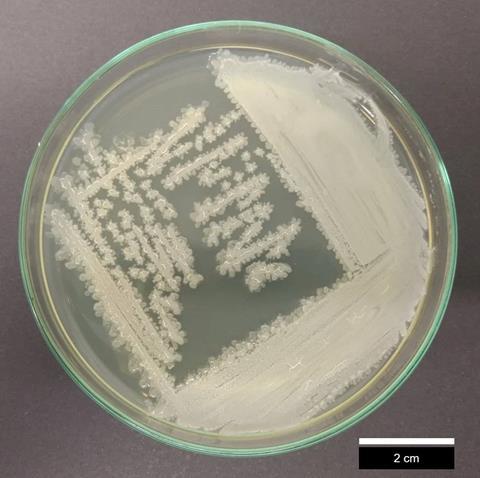
In addition to ammonia production, Azotobacter has long been recognized for its agricultural importance as a biofertilizer that enhances soil fertility and promotes plant growth. Its ability to naturally enrich nitrogen content in soils demonstrates the practical value of biological nitrogen fixation in sustainable agriculture. This long history of agricultural application also provides important knowledge for future industrial development, as researchers can build upon decades of cultivation and physiological studies. As interest in environmentally friendly technologies continues to grow, Azotobacter may become increasingly important not only in agriculture, but also in renewable-energy-driven ammonia production systems.
Interest in Azotobacter also aligns closely with broader efforts to integrate biology with renewable energy technologies. Future systems may combine nitrogen-fixing microorganisms with solar-driven, photocatalytic, or electrochemical platforms to create hybrid processes for sustainable ammonia synthesis under ambient conditions. Such approaches could reduce reliance on fossil-fuel-based Haber–Bosch systems while enabling decentralized ammonia production in regions lacking large industrial infrastructure. In many ways, Azotobacter represents a bridge between natural biological processes and future sustainable technologies. By harnessing its unique nitrogen-fixing capabilities, researchers may move closer to developing environmentally friendly ammonia production systems inspired directly by nature.
Challenges and future perspectives
Despite the tremendous promise of Azotobacter for sustainable ammonia production, several scientific and engineering challenges remain before biological ammonia synthesis can become commercially viable. One of the major limitations is the high energy demand of nitrogen fixation. Nitrogenase requires substantial ATP and reducing power to convert atmospheric nitrogen into ammonia, making biological NH₃ production inherently slower and less efficient than the industrial Haber–Bosch process. In addition, nitrogenase remains highly sensitive to oxygen, temperature fluctuations, and environmental stress, which can reduce enzyme activity and long-term operational stability.
To address these limitations, researchers are increasingly applying synthetic biology and metabolic engineering approaches to improve nitrogenase expression and ammonia productivity. Genetic modifications targeting regulatory systems such as NifL–NifA have demonstrated promising results in enhancing nitrogenase activity and promoting ammonia excretion. Advances in genome engineering may further enable the development of strains with optimized energy metabolism, reduced ammonia assimilation, and improved nitrogen fixation efficiency under industrial conditions.
Another important challenge is maintaining enzyme and cellular stability during long-term cultivation. Emerging technologies such as hydrogel encapsulation, biofilm engineering, and metal–organic framework (MOF)-based immobilization systems are being explored to protect nitrogenase and enhance microbial durability under aerobic conditions. These protective systems may help create stable microenvironments that support continuous ammonia production while minimizing oxidative damage.
Future progress will also depend heavily on advances in bioprocess engineering. The development of efficient bioreactors capable of controlling oxygen gradients, nutrient delivery, and ammonia recovery will be essential for industrial scalability. Integrating biological nitrogen fixation with renewable electricity, solar-driven systems, or hybrid electro-biological platforms may further improve sustainability and reduce dependence on fossil-fuel-derived ammonia synthesis. Although significant challenges remain, the future of biological ammonia production is highly promising. By combining microbiology, synthetic biology, materials science, and renewable energy technologies, researchers are moving closer to developing scalable and carbon-neutral ammonia production systems. In this transition, Azotobacter may serve not only as a model nitrogen-fixing microorganism, but also as a key biological platform for the next generation of sustainable ammonia technologies.
Futher reading
No comments yet