
All Indiana University Bloomington articles
-
 News
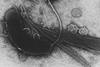
NewsBiologists uncover a molecular mechanism that helps bacteria spread antibiotic resistance genes
A new study reveals the molecular mechanism behind one of the most powerful mechanical actions in all of biology, the reeling in of tiny surface fibers called type IV pili.
-
 News
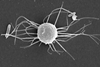
NewsCapacity of certain unicellular organisms to stick together may be key to animal evolution
Researchers have found that after feeding a specific bacteria to a certain unicellular relative of animals, the single cells began to stick to one another, revealing a possible mode by which our ancestors began to evolve into animals billions of years ago.
-
 News
NewsBeyond health: The political effects of infectious disease outbreaks
A new study gives empirical evidence that individuals who experienced an infectious disease outbreak show significantly less trust in the political establishment.
-
 News
NewsBacteria produce molecules that help viruses infect competing bacteria
In a new study, researchers have discovered a new way that bacteria can kill their competitors in complex microbial communities, revealing novel approaches to leverage viruses to kill harmful bacteria.
-
 News
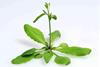
NewsNew study suggests RNA present on surfaces of leaves may shape microbial communities
Biologists have shown that the surfaces of plant leaves are coated with a diverse array of RNA molecules, suggersting this may play a role in shaping the microbial communities that inhabit them, potentially influencing plant health and interactions within their environment.
-
 News
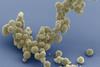
NewsArtificial cells show that ‘life finds a way’
Scientists studying a synthetically constructed minimal cell that has been stripped of all but its essential genes have found it can evolve just as fast as a normal cell.