
At the surface, salt marshes and their windswept grasses can look deceptively simple. But those marshes are teeming with biodiversity, from the insects and migrating birds in the air all the way down to the microbes that live in the soil.
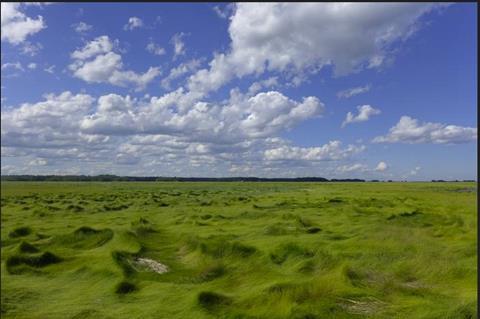
Scientists from the Marine Biological Laboratory (MBL) have discovered that even among the sulfur-cycling microbes that are responsible for the “rotten egg gas” smell in salt marsh air, diversity extends all the way to genomes and even to individual nucleotides.
To study the relationship between saltmarsh cordgrasses and the sulfur-cycling microbes that live in the sediments around their roots, MBL scientists analyzed DNA sequenced datasets of microbes collected from salt marsh sites in Massachusetts and Alabama.
This in-depth analysis of sulfur-cycling microbial diversity in salt marshes—from their entire genomes down to single nucleotides—was published in Applied and Environmental Microbiology.
Carbon cycle
In salt marshes, the sulfur cycle is closely linked with the carbon cycle, and healthy salt marshes store a very large amount of carbon in peat and associated soil minerals.
“We’ve known for decades how incredibly diverse microbial communities are out there in salt marshes,” said MBL Senior Scientist Zoe Cardon. “Thanks to this in-depth sequencing and analysis tools, we can now take a sample of salt marsh sediment and not only do the sequencing necessary to identify what microbes are there, but also construct in computers a representation of their individual genomes.”
These representations are called metagenome assembled genomes (MAGs), and they can be analyzed via computer without the need to culture the individual microbes in a petri dish. That’s important, since very few of the planet’s microbes have been cultured. In this study alone, 29 of the 38 isolated MAGs were from bacteria that had never been cultivated.
Two pathways
“We studied microbial communities in two ways: looking at differences at the single-nucleotide DNA sequence level—at the literal A-T-C-G scale—and comparing them at the pan-genome level. It was fascinating to develop this metagenomic pipeline to analyze this data,” said Sherlynette Pérez Castro, co-lead author of the paper. Pérez Castro was a postdoctoral researcher in the Cardon Lab at the MBL and has since moved on to a position at the University of Georgia.
Cardon described it as looking for a needle in a haystack full of needles. “But because of this relatively deep sequencing and these amazing analytical approaches, you can see things on a different level—instead of being a pile of needles, now you can see a red needle or a blue needle,” she said.
There are two different main types of sulfur-cycling bacteria—sulfate reducers, which help decompose organic matter but release a sulfide that is toxic to the plants, and sulfur oxidizers, which remove that toxic sulfide so support the productivity of the marsh plants. The microbes work together to support the health of these plants and this ecosystem.
Plants and bacteria
“For all organisms, there is a specificity in the way the microorganisms and the host interact. We want to understand how the plants and the sulfur-cycling bacteria work together,” said Elena L. Peredo, co-lead author of the paper. Peredo is an adjunct scientist in the MBL Ecosystems Center and an assistant professor at the Rochester Institute of Technology.
For Peredo, one of the most exciting things was how closely related some of the microbes were to each other. “Two of the bacteria were almost identical until you got down to looking at specific metabolic pathways. Usually, in nature, when you have two organisms that are that closely related, one will outcompete the other,” she said. Much the same way lions and tigers aren’t found in the same ecosystem—there aren’t adequate resources to support them both.
“The microbes have different combinations of genes indicating slightly different variations on the themes of sulfate reduction and sulfur oxidation, and some of that variation may underlie why so many different kinds of sulfur-cycling microbes can all make a living in salt marsh sediment,” said Cardon.
Team effort
The work began as a pandemic project conducted by scientists in the MBL’s Ecosystem Center and Josephine Bay Paul Center for Comparative Molecular Biology and Evolution. The Gordon and Betty Moore Foundation had funded the group to study the symbiosis between the cordgrass and the sulfur-cycling microbes for the summer of 2020, but the pandemic shut down field work. So MBL’s personnel teamed up with scientists who already had very large DNA sequencing datasets from microbes in Massachusetts and Alabama salt marsh sediments, and the project was launched.
The initial data download and preliminary exploration were performed with the help of five summer students from multiple universities supported by two summer undergraduate research programs—the Metcalf Summer Undergraduate Research Program (SURF), and the Woods Hole Partnership Education Program (PEP).
Evolving project
“What started as a pandemic-era project that could be done while scientists worked from home, evolved into an exciting exploration of diverse sulfur-cycling microbes in salt marsh,” said Cardon. And in doing so, the group developed a whole new way to integrate metagenomic analyses from diverse scientific perspectives.
The MBL team working on the project was almost as diverse as the microbes themselves.
“A real strength of the MBL is that it’s a place where all different kinds of [scientists] can work together,” said Cardon. “On this paper we had people interested in the drivers of evolution, people interested in ecological function, people interested in plants —people coming at all of this from different perspectives but with that common interest.”
Supporting documents
Click link to download and view these filescowlicks
Other, Size 79.48 kb


No comments yet