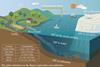
Scientists have long recognised the Arctic as a final sink for many persistent pollutants, but the precise ways in which microplastics influence the region’s fragile climate balance have remained elusive. Their unique physical and chemical properties—light absorption, gas emission potential, and capacity to carry toxic additives—set them apart from conventional contaminants.

Although earlier surveys confirmed the presence of plastics in sea ice and snow, the magnitude and mechanisms of their climatic effects have been hampered by disparate monitoring protocols, limited spatial coverage, and a lack of standardised quality control.
Based on these challenges, an international research team synthesised the available evidence to construct a comprehensive framework that links pollution sources, transport, ecological impacts, and climate feedbacks, providing a much‑needed roadmap for future investigation and policy action.
MICROBIOLOGY NEWS: Register with The Microbiologist for more free articles
Now, a critical review published (DOI: 10.1007/s11783‑026‑2239‑0) in the journal ENGINEERING Environment (Volume 20, Issue 9, 2026;) by researchers from Tongji University (Shanghai, China), the Norwegian Polar Institute, and The Arctic University of Norway delivers the most integrated assessment to date. The study systematically maps the major transport pathways—atmospheric, oceanic, and local—and details how microplastics infiltrate Arctic food webs and interact with physical and biogeochemical processes that govern regional climate.
Striking findings
The review presents several striking findings. Fibrous particles, predominantly polyester from textiles, constitute the overwhelming majority of microplastics, accounting for up to 92% in snow and 73% in sea ice algae. In the ice alga Melosira arctica, concentrations reached 31,000 particles per cubic metre—over ten times higher than in the ambient seawater—making it a potent entry point for pollutants into the pelagic food web.
Beyond biological uptake, the study quantifies how microplastics reduce surface albedo, thereby enhancing solar absorption and accelerating melt, while also emitting carbon dioxide (CO₂) and methane (CH₄) under ultraviolet irradiation and microbial action. These mechanisms directly amplify the “Arctic amplification” effect, where the region warms three to four times faster than the global mean.
The authors also highlight that airborne microplastic fibres can act as cloud condensation nuclei, potentially altering cloud properties and precipitation, adding another layer of climatic influence that has been largely overlooked in current climate models.
Paradigm shift
The authors said, “We are witnessing a paradigm shift: microplastics are no longer just a waste problem—they are geophysical agents. They modify surface energy balance, contribute to greenhouse gas fluxes, and interfere with carbon sequestration. The Arctic, already warming at an alarming rate, is now subject to this additional stressor, which could accelerate feedbacks that are difficult to reverse. Our review underscores the urgent need to treat microplastics as a climate‑relevant pollutant in international negotiations and monitoring programmes.”
MICROBIOLOGY ON TAP: Get full access to all The Microbiologist articles from just £2.17 a month
The implications extend far beyond scientific curiosity. Current governance structures are fragmented and largely non‑binding, lacking specific concentration thresholds or enforceable mechanisms tailored to Arctic conditions. The study proposes a new regulatory model inspired by the European Union’s Registration, Evaluation, Authorization and Restriction of Chemicals (REACH) framework, recommending clear limits on microplastic content in products and discharge caps for ships, research stations, and coastal communities.
It also calls for standardised multi‑matrix monitoring—covering water, ice, snow, sediments, and biota—to enable consistent trend assessments. This research provides the scientific underpinning for a legally binding international plastics treaty, urging policymakers to act decisively before the Arctic’s feedback loops become irreversible and fundamentally destabilise the global climate system.
Topics
- Algae
- Arctic amplification
- Asia & Oceania
- Climate Action
- Ecology
- Healthy Land
- Melosira arctica
- microplastics
- Norwegian Polar Institute
- Ocean Sustainability
- pelagic food web
- Plastic degradation
- Pollution and Remediation
- polyester
- sea ice algae
- surface albedo
- The Arctic University of Norway
- Tongji University
- UK & Rest of Europe
- Waste Management
No comments yet