
“Whether in fish schools, bird flocks or human crowds, moving as a group can offer safety and efficiency, but it can also lead to congestion and jamming,” says Alexandre Persat, Professor at EPFL. “How individuals balance coordinated movement with the need to break away and explore on their own remains a central question across living systems.”
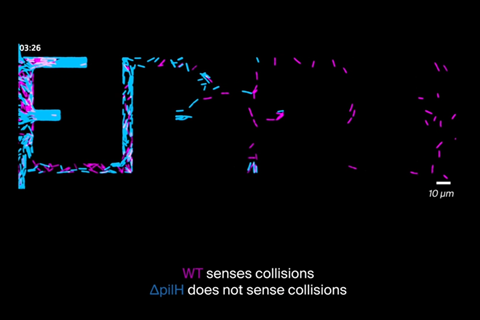
Even bacteria, among the simplest collective movers, may hold clues to this challenge. Bacteria often live and move in dense communities, where physical interactions can make neighboring cells line up and move together in coordinated streams.
This creates a major problem: individuals can get trapped within the group, making it harder for them to disperse and explore new space. This keeps the bacteria from finding new nutrients or escape crowded, complex environments like soil or host tissues.
Persat’s Microbial Mechanics Lab, working with the Mechanics of Soft and Biological Matter Laboratory of Sangwoo Kim, also at EPFL, has found that the bacterium Pseudomonas aeruginosa solves this problem with a simple sensory mechanism that allows the bacteria to actively modulate their collective organization through touch. The study is published in Nature Microbiology.
Bump and reverse
“As they move on surfaces, these bacteria sense when bumping into neighbors,” explains Laure Le Blanc, the paper’s first author. “In response, they reverse direction within seconds. This ability allows the population to break that organization in crowds, while staying organized where it needs to be, like at the edge of a growing colony.”
The researchers combined live microscopy, single-cell tracking, and computer simulations to understand how collision influence group behavior. They compared wild-type bacteria with mutants that do not sense collisions.
They also built micro-mazes to test how these different strains navigated confined, obstacle-filled spaces. By tracking individual bacteria and analyzing the overall group movement, they could see exactly how collisions shaped both individual and group behaviors in real time.
Collisions help bacteria navigate
The scientists tested a mutant species of P. aeruginosa. This mutant lacks a gene, which is critical for the bacterium’s motility pattern: it always moves forward even after colliding other cells and boundaries. They found that the mutant bacteria traveled farther when they were alone but when moving together quickly became trapped in dense clusters.
In contrast, wild-type bacteria—which have all their genes—used collisions with other bacteria as information about their surroundings. In crowded areas, frequent bumps caused reversals that kept the group disordered and mobile. At the colony edge, where cells faced open space, they instead became strongly aligned and moved together towards unexplored territory.
This switch helped wild-type bacteria navigate both crowded and structured, maze-like environments. In the maze, only 1% of the mutant bacteria reached the exit within four hours. In contrast, wild-type cells explored an average of 92% of the maze, with 20% of the cells eventually reaching the exit.
Implications of study
This discovery changes how we understand bacterial navigation by showing that collective order is not just a passive result of physics but an actively regulated state. The bacteria convert physical interactions into sensory information to control group behavior.
MICROBIOLOGY NEWS: Register with The Microbiologist for more free articles
This mechanism may help P. aeruginosa spread through host tissues and contribute to biofilm formation during human infections. This discovery might also inspire new designs for robot swarms that need to navigate crowded or unknown environments without getting stuck.
Other contributors
- EPFL Institute of Bioengineering
- University of California San Diego
- EPFL Institute of Mechanical Engineering


No comments yet