
Mangrove wetlands are unique coastal ecosystems at the tropical and subtropical land-sea interface, characterized by extreme environmental conditions including high salinity, low oxygen, and high organic matter content. Fungi in mangrove sediments contribute to the decomposition of organic matter, particularly lignocellulose, and participate in nutrient cycling. However, despite their ecological importance, the diversity, distribution patterns, and assembly mechanisms of fungal communities in mangrove sediments have remained poorly understood.
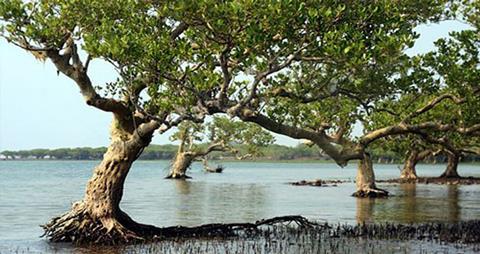
A research team led by Dr. Meng Li at the Institute for Advanced Study, Shenzhen University, systematically collected 300 sediment samples from seven representative mangrove wetlands across six national nature reserves along the southeastern coast of China. The team employed dual-amplicon high-throughput sequencing, targeting the fungal ITS2 region and the prokaryotic 16S rRNA gene, to simultaneously characterize fungal and prokaryotic communities. Co-occurrence network analysis and piecewise structural equation modeling were applied to examine the relationships among environmental variables, biotic interactions, and fungal community structure.
The sequencing data yielded 14,771 fungal operational taxonomic units spanning 15 phyla, 51 classes, and 594 genera. Approximately one-third of the fungal diversity could not be assigned to known phyla, indicating that mangrove sediments contain a substantial amount of unclassified fungal diversity. In addition, early-diverging fungal lineages such as Rozellomycota and Chytridiomycota were found to be relatively diverse and widely distributed across the sampled sites.
Geographical location
The analysis showed that geographic location had a stronger effect on fungal community composition than mangrove plant identity. Fungal communities clustered primarily by sampling site, and mean annual temperature and dispersal limitation were associated with the observed biogeographic patterns. The patchy distribution of mangrove forests along the coast likely restricts long-distance dispersal of fungi, contributing to differences among wetlands.
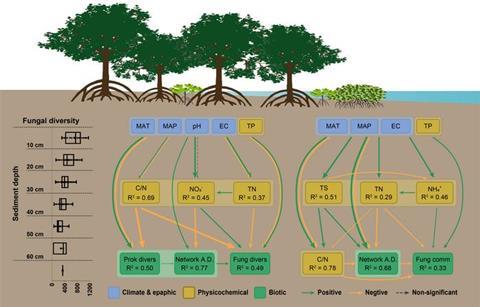
At the local scale, salinity and the carbon-to-nitrogen ratio were identified as the main environmental factors associated with fungal community variation. High salinity limits fungal growth to taxa capable of tolerating osmotic stress, while elevated carbon-to-nitrogen ratios reflect an imbalance between carbon availability and nitrogen supply, which may constrain the range of taxa that can persist. Total phosphorus was found to have an indirect positive association with fungal diversity, likely through its influence on nutrient availability and co-occurrence network connectivity.
Fungal communities
The co-occurrence network constructed from the most abundant fungal and prokaryotic taxa contained 777 nodes and 3,680 edges, of which 99% were positive correlations. Bacteria and archaea had higher average connectivity than fungi, forming the main structural backbone of the network, while certain fungal nodes occupied central positions that may link fungal and prokaryotic community components.
MICROBIOLOGY NEWS: Register with The Microbiologist for more free articles
Using piecewise structural equation modeling, the authors integrated these results into a framework describing fungal community assembly across three scales: regional-scale filtering by temperature and dispersal limitation, local-scale filtering by salinity and nutrient conditions, and micro-scale effects of cross-kingdom interactions. The study provides a basis for further research on how fungal communities in coastal sediments may respond to environmental change.



No comments yet