
Asgard archaea, our closest known microbial relatives, play a key role in current models of the origin of more complex organisms, known as eukaryotes (all animals, plants, protists and fungi). However, their biology has so far been poorly understood.
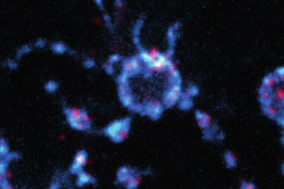
Microbiologists led by the University of Vienna demonstrate in a new study published in the journal Nature that these cells move through their environment in a surprisingly dynamic manner. These new findings enable the empirical testing of models for the origin of complex life for the first time.
The study, conducted by Philipp Radler in the laboratory of Christa Schleper at the University of Vienna, shows that tiny Asgard archaea cells (whose volume is about a thousand times smaller than that of a human cell) undergo significant changes in shape. They extend long cell protrusions, retract them again and use them to actively crawl across surfaces – a behaviour previously known only from eukaryotes.
The results not only provide an unprecedented insight into the behaviour of Asgard archaea, but may also offer important clues as to how complex life arose. Current models suggest that the first eukaryotes emerged around 2 billion years ago from the fusion of a bacterium with an ancestor of today’s Asgard archaea. Asgard archaea are therefore a crucial building block in the evolution of complex cells.
Recent discoveries
It was only recently (in 2020 and 2023) that the first two specimens of these organisms were cultivated at the renowned JAMSTEC Institute in Japan (co-authors of the current study) and in Christa Schleper’s laboratory at the University of Vienna. Most of our knowledge about Asgard archaea is based on DNA sequencing or electron microscopy images. These images revealed impressive cell shapes: a round cell body surrounded by numerous delicate projections that can be up to 20 times longer than the cell body. However, these images provided no insight into the dynamic behaviour of the cells.
Researchers at the University of Vienna have now succeeded in observing these dynamics: they placed Asgard archaea in an oxygen-free environment and filmed the living cells under the microscope. They used two strains of Asgard archaea: a so-called Lokiarchaeon (cultivated in Vienna) and a Heimdallarchaeon (cultivated in Japan). Both organisms drastically change their cell shapes every minute and use their thin, dynamic appendages to attach themselves to surfaces and explore them using a novel crawling motion. Such a movement had not previously been described in microbes and had only been observed in more complex cells, including human immune cells.
MICROBIOLOGY NEWS: Register with The Microbiologist for more free articles
Furthermore, the international team, which beside the Japanese microbiologists also included collaborators from IST Austria and HZI Braunschweig (Germany) demonstrated that actin inhibitors suppress these dynamic behaviours. This suggests a central role for an actin-based cytoskeleton, the fundamental cellular machinery that also controls shape changes and motility in human cells.
An exciting evolutionary perspective opens up
The discovery offers an exciting evolutionary perspective: complex cell motility may have much older origins than previously thought. The unusual crawling behaviour of Asgard archaea will provide insights into cellular innovations that arose even before the first eukaryotes and may have already been relevant in the ancient symbiosis from which mitochondria later emerged. The new findings, in particular oxygen-free live-cell microscopy, now make it possible for the first time to empirically test models of the origin of complex life.
Summary:
- Asgard archaea are regarded as key organisms in models of the origin of complex life. Until now, there have been no recordings of their motility.
- Microbiologists at the University of Vienna have now achieved a breakthrough: they placed Asgard archaea in an oxygen-free environment and filmed the living cells under a microscope.
- This resulted in the first live-cell recordings, which show dynamic changes in shape and a novel crawling movement across surfaces.
- The results reveal a remarkably dynamic, actin-based cytoskeleton, with parallels to that found in human cells, whose origins date back millions of years.
- These new findings are essential for a deeper understanding of fundamental processes in human cells and the evolution of complex life.
Here you will find video clips from the latest study.




No comments yet