
Continuous consumption of foods containing heat-inactivated Lactiplantibacillus pentosus can help reduce gum bleeding, report researchers from Institute of Science Tokyo. These postbiotic foods can improve inflammatory conditions and enhance gum health in adults with mild gingivitis. The study suggested that these postbiotic foods offer a simple and practical way to support oral health in daily life without altering oral care habits. The findings also aid in the prevention of early-stage periodontal disease.
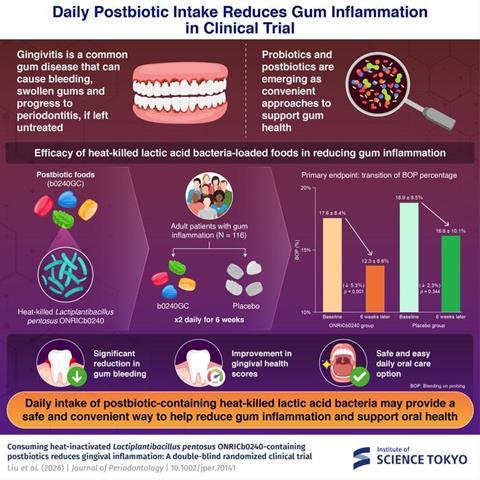
Gum disease, also known as periodontal disease, affects millions of people worldwide. In early stages, known as gingivitis, the gums become swollen and are prone to bleeding. While professional dental care and regular oral hygiene is important for prevention of the disease, researchers are exploring innovative approaches that can support gum health in everyday life.
One promising strategy is the use of probiotic (beneficial bacteria) for maintaining gum health. However, these usually disturb the natural balance of microorganisms in the oral cavity. Also, these probiotics possess a shorter shelf life and are less stable.
Postbiotic foods
Addressing this issue, a research team led by Professor Takanori Iwata along with Assistant Professor Shogo Maekawa, and Visiting Lecturer Anhao Liu from the Department of Periodontology, Institute of Science Tokyo (Science Tokyo), Japan, in collaboration with Associate Professor Megumi Ishiguro of the Health Science Research and Development Center, Science Tokyo, Otsuka Pharmaceutical Co., Ltd., and Tokyo Center Clinic, Japan, investigated if postbiotic foods containing heat-inactivated bacteria (Lactiplantibacillus pentosus ONRICb0240) could help improve gum health and reduce bleeding without disrupting normal oral bacteria. The findings were published online in the Journal of Periodontology on April 19, 2026.
“We conducted a clinical trial on 116 adults who were suffering from mild gingival inflammation,” explains Iwata. The participants were randomly allocated to receive either the gummies containing heat-inactivated bacteria or placebo (non-loaded) gummies. The gummies were consumed twice daily for six weeks. The participants were not given any special instructions regarding tooth brushing or additional oral care, which allowed the researchers to evaluate the effectiveness of the gummies under realistic conditions.
Postbiotic gummies
At the end of the study, the researchers evaluated the gum health and gingival index (a measure of gum inflammation) of the participants. Surprisingly, the participants who had consumed the postbiotic gummies experienced less gum bleeding and their gums appeared healthier and stronger overall, compared to those who received the placebo gummies. For the gingival index, no significant difference was observed between the groups; however, a significant improvement from baseline was observed in the test group.
“By evaluating the gummies under normal daily living conditions, we were able to better understand their practical potential for supporting gum health,” says Iwata.
The significance of the study lies in the use of heat-inactivated bacteria rather than live probiotics strains. Heat-inactivated bacteria are generally more stable during manufacturing and storage, making them easier to convert into consumer products than live bacteria. In addition to this, the researchers believe that the anti-inflammatory effects of the postbiotic gummies might be responsible for the reduction in gum bleeding. Since gum bleeding is one of the earliest warning signs of gingivitis, reducing inflammation at this stage could help prevent the progression to more serious periodontal disease.
Simple and convenient
Overall, the research provides a simple and convenient method that can be added to routine oral care practices. It also highlights the growing potential of functional foods and probiotic-derived ingredients in preventive healthcare. Looking ahead, the researchers plan to investigate the underlying biological mechanisms and evaluate the long-term benefits of these gummies for periodontal health.
Topics
- Anhao Liu
- Asia & Oceania
- Bacteria
- gingivitis
- gum bleeding
- gum health
- Institute of Science Tokyo
- Lactiplantibacillus pentosus
- Lactiplantibacillus pentosus ONRICb0240
- Megumi Ishiguro
- One Health
- Oral Microbiome
- Otsuka Pharmaceutical Co., Ltd
- periodontal disease
- postbiotics
- Probiotics, Prebiotics & Synbiotics
- Research News
- Shogo Maekawa
- Takanori Iwata
- Tokyo Center Clinic





No comments yet