
Researchers at the Department of Energy’s (DOE) Oak Ridge National Laboratory (ORNL) and the University of Tennessee (UT), Knoxville, have made a scientific advance by using a natural substance from fungi, called chitin, to create hydrogels that are both significantly stronger and tougher. This new material could lead to safer medical devices, longer-lasting coatings and other innovations that improve everyday technology and health care.
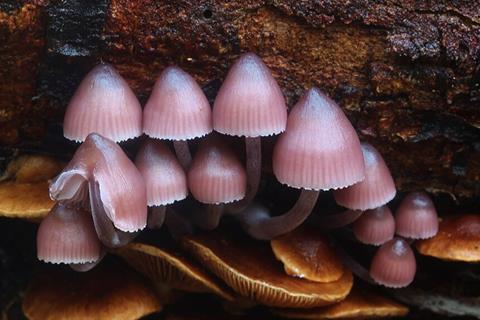
Fungal chitin is a natural, fibrous substance found in the cell walls of fungi. Hydrogels are flexible, water-rich materials used in medical implants and contact lenses, as well as soft robots that can bend, flex and even self-heal in ways that mimic natural, living systems. The study, published in the International Journal of Biological Macromolecules, offers a fresh approach that could transform those types of materials used in medicine and engineering.
Fungal chitin
Yue Yuan of the Center for Nanophase Materials Sciences (CNMS), a DOE Office of Science user facility at ORNL, said this research project built on previous work when she was an intern at ORNL, including a 2021 paper. As an ORNL Laboratory Directed Research Development (LDRD) Distinguished Staff Fellow, Yuan said LDRD funding, early career development programs and the laboratory’s collegial research environment enabled her to convene experts from multiple fields to assess fungal chitin as a promising alternative to traditional crustacean sources.
The researchers extracted chitin from three types of fungi using a gentle treatment that preserves the tiny particles’ structure. Unlike chitin from shrimp or crabs, fungal chitin has a much lower allergenic potential and does not require extensive processing to remove unwanted chemicals and heavy metals. The new method uses a mild alkaline pretreatment and a ball milling process to break down the material into a fine powder. This approach improves the material’s performance without the extra energy use or harsh chemicals typical of traditional techniques.
MICROBIOLOGY NEWS: Register with The Microbiologist for more free articles
Yuan brought together a multidisciplinary team that included Tomás Rush and Yunqiao Pu from the ORNL Biosciences Division; John Lasseter from CNMS; and Toby Nelson, Kehao Ren, Lu Wang and L.P. Tharika Nirmani from UT. Reflecting on the team’s collaborative approach, Rush, an ORNL fungal biologist, said, “Fungi offer an untapped reservoir of bioproduct potential, a perspective that guided our exploration beyond the usual model species.”
Nelson, a key figure in advanced materials design at the UT-Oak Ridge Innovation Institute (UT-ORII), added, “This collaboration integrates biosourced fiber processing with advanced materials design, demonstrating the power of a well-connected research community.”
To validate the material’s structure, the team used advanced electron microscopy techniques. Lasseter said, “Our ability to image these delicate biopolymers at low voltages without metallic coatings has been crucial in capturing their true shape and structure and confirming the chitin’s integrity.”
Mechanochemistry drives material innovations
The research also draws attention to the benefits of mechanochemistry in modern materials engineering. Yuan said that using a ball milling process to produce submicron to nanoscale particles demonstrates how desired material properties can be achieved without relying on severe chemical reactions or high temperatures.
“When materials are designed for applications such as contact lenses, water cleanup systems, or wound dressings, every improvement in durability and functionality is crucial,” Yuan said. The ability to tailor the molecular architecture of fungal chitin by selecting different species opens the door to a vast range of material properties.
Yuan said the choice to pursue fungal sources over traditional crustacean sources was motivated by several factors. The fungi produce unique chemical profiles that provide a platform for designing materials from the ground up. The availability of a variety of fungi enables researchers to tap into a warehouse of molecules to address different engineering and medical challenges. The consistent fermentation process facilitates fundamental research, including sample characterization using ORNL’s unique neutron scattering tools.




No comments yet