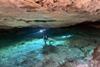
Beneath the lush rainforests of the Yucatan Peninsula lies a hidden, subterranean world: a vast network of flooded sinkholes and anchialine caves. These unique underwater systems, which mix fresh and saltwater and are influenced by the tides, have no open connection to the surface and have served as an evolutionary refuge for millions of years.

When marine biologist Fernando Álvarez first encountered these sinkholes (cenotes), he was captivated. ”My first impression of these incredibly beautiful places was that I had to work there to find out how that rich crustacean fauna had evolved in those exceptionally large cave systems,” he recalls.
A recent study published in Subterranean Biology, reveals that the answer lies with a tiny, fascinating creature: the anchialine cave shrimp of the genus Typhlatya.
In most surface ecosystems, sunlight fuels plants, which then feed the rest of the food chain. In the pitch-black depths of anchialine caves, nature has found other ways. Instead of photosynthesis, this ecosystem relies on a chemosynthetic route.
Food web
Organic matter from the rainforest floor decomposes and percolates through the porous limestone rock, eventually bringing methane into the cave’s waters. Methanotrophic bacteria consume this methane to produce energy and grow. And this is where Typhlatya shrimp comes in. Equipped with specialized, scraping appendages, these shrimps are adapted to graze on these bacterial mats.

Because they convert microbial growth into animal biomass, Typhlatya shrimps act as “keystone species,” introducing essential nutrients into the cave’s food web. They serve as a crucial initial link that larger subterranean predators feed on.
”What we see now is that Typhlatya shrimps are a key component of the anchialine trophic web,” explains Álvarez.
Stable isotopes reveal ecological niches
To better understand how these shrimps survive, Brenda Durán and Fernando Álvarez used stable isotope analysis (looking at carbon and nitrogen signatures in the shrimps’ tissue) to figure out exactly what they are eating.
“Over the years my research has evolved from very descriptive taxonomic studies… to more ecological studies about the interactions among species,” Álvarez notes regarding the motivation behind the study.
Their findings revealed that the different species of Typhlatya living in the Yucatan have carved out their own unique dietary niches, allowing them to peacefully coexist.
For instance, Typhlatya mitchelli relies mostly on decaying vegetation and nitrifying bacteria found in shallower cave sections. While, Typhlatya dzilamensis hangs out deeper in the caves near the halocline (the zone where fresh and saltwater mix), exploiting organic material trapped in that layer. Typhlatya pearsei feeds heavily on the methanotrophic bacterial biomass near the cave ceilings.
Dietary shifts
Interestingly, the study found that the shrimps’ diets remain stable across the rainy and dry seasons. However, their diets do shift based on regional geography, such as the difference between the deep, isolated sinkholes of the “Ring of Cenotes” and the sprawling, highly interconnected tunnels of the “Caribbean Cave Area”.

These remarkable cave shrimps belong to an ancient lineage that has survived since the time of the dinosaurs, with relatives spanning the globe from the Mediterranean to Australia. Yet, they are now facing a modern, unprecedented threat.
The rapid urbanization of the Yucatan Peninsula brings deforestation, pollution, and severe environmental deterioration.Because these caves rely entirely on the organic matter percolating from the rainforest above, any damage to the surface environment directly destroys the “vertical integrity” necessary for the caves to function.
As Álvarez warns: ”We are losing the vertical integrity that these anchialine caves need to function; any changes occurring on the surface within the caves’ area will inevitably affect them.”
Forests and caves
The anchialine caves of the Yucatan Peninsula are complex, unique ecosystems filled with extraordinary biodiversity. To save the remarkable Typhlatya shrimp and the hidden food web it supports, we must protect the forests above ground.
”The Yucatan Peninsula is an area of extraordinary cultural wealth and contains sophisticated and unique ecosystems as the anchialine caves, but sadly all this is disappearing,” Álvarez reflects.
After all, the survival of this dark, subterranean world depends entirely on the health of the sunlit world above.
No comments yet