
It’s recommended that all adolescents get vaccinated against human papillomavirus (HPV), as the infection can cause cancer. HPV causes nearly all cases of cervical cancer and about 70% of some forms of head and neck cancers. While some regions of the United States have relatively high rates of HPV vaccination, there are major vaccine shortages in much of the world.
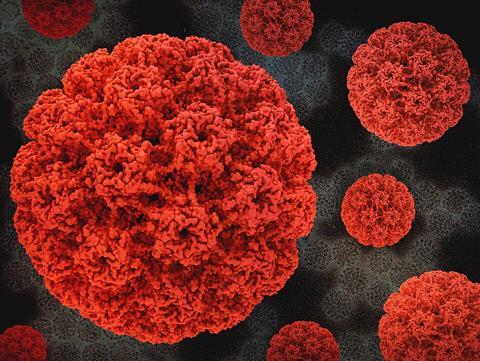
A new Yale study, published Sept. 30 in Science Advances, introduces a genetic platform that could be used to boost future HPV vaccine development.
“The current vaccine is great, there’s just not enough of it,” says Daniel DiMaio, MD PhD, Waldemar Von Zedtwitz Professor of Genetics at Yale School of Medicine (YSM). “There are persistent vaccine shortages that are anticipated to continue for the foreseeable future. Therefore, there would be a real advantage to coming up with ways to make more vaccines or make them more efficiently.”
Growing HPV in bulk
To create a better vaccine, DiMaio and his lab members homed in on a molecule—called the L1 protein—that’s part of the virus-like particle used in the HPV vaccine. They reasoned that they could look for and isolate different versions of the L1 protein that might enable better vaccines. But there was a problem—there were no methods that allowed them to do that. So, they set about to develop a technique to isolate better versions of the L1 protein. The first step was to overcome how difficult HPV is to cultivate.
“For other viruses, like influenza or SARS, we can cultivate a virus stock by letting the viruses reproduce in host cells we grow in the laboratory,” says DiMaio, a member of Yale Cancer Center. “But HPV will not reproduce in these simulated conditions. That has hindered the study of HPV, and that’s one of the barriers we had to overcome.”
To address these challenges, DiMaio and his lab first set out to develop a procedure to cultivate and manipulate large quantities of the HPV virus. Luckily, the researchers had two advantages, says DiMaio: a long-term grant from the National Cancer Institute, which gave them time to explore, and Yuka Takeo, PhD, a postdoctoral researcher and the paper’s first author.
“When we started this project, we didn’t know if it would work,” says Takeo. “As a researcher, it’s risky to have a project that might not produce a result. But we cared about this.”
For several years, DiMaio and Takeo looked for ways to overcome HPV’s unique biology in order to grow it in culture. HPV is composed of DNA packaged in a protein shell consisting of L1 and L2 proteins. When the researchers tried to grow the virus with L1 and L2 expressed from the same piece of DNA, called a plasmid, the plasmid was unstable and could not produce a virus. One of their breakthroughs came when they realized that if they expressed L1 and L2 from different plasmids, the plasmid stabilized and they could grow the virus.
“The size of the plasmid was very important because HPV can only package small pieces of DNA,” says Takeo. “It was a breakthrough for us to have L1 and L2 on their own, small plasmids.”
Developing a library of HPV mutants
Being able to cultivate HPV solved one of the challenges in vaccine development. Having a version of HPV that doesn’t require refrigeration or that assembles more efficiently would solve others. But that would require different HPV variants than those currently used in the vaccine.
To find a virus variant with a particular characteristic, such as being shelf-stable, researchers create thousands of random mutants and put them through a selection process.
HPV mutants are made by adding mutated plasmids to cells. This introduces mutations to the virus population, but it does so randomly; most viruses will contain a mutated piece of DNA that does not match the mutant L1 protein in that same virus. DiMaio and Takeo needed a way to ensure a match between the mutation in the packaged DNA and the mutant L1 protein within the virus particle.
“If the mutant protein and the mutated DNA in the virus particle do not match, you can’t select for that mutant,” explains DiMaio. “We had to partition each one of these thousands or millions of mutations into the appropriate virus so that we could evaluate each mutation separately.”
After close to five years of tests, the team found a way to ensure that each mutant virus contained only the matched mutant DNA. First, they exposed HPV to thousands of pieces of DNA, each with a different mutation, and the viruses took in the mutant DNA randomly. Then, they introduced the virus to cultures of human kidney cells in small enough amounts that each kidney cell could be infected by only a single virus. The virus would then undergo its natural life cycle, reproducing within the kidney cell.
“We infected cells, and we recovered viruses that we hoped were enriched for particular mutants,” says DiMaio.
Pulling one mutant from the library
Through this work, the researchers built a library of mutants. The next step was to demonstrate that they could pull just one mutant out of their library. This test would help them determine if they could someday pull a mutant out to use in a vaccine.
For the test, they aimed to show that they could select a mutant with a specific characteristic, in this case antibiotic resistance. When they modified the HPV plasmids, they attached a gene that would make the virus resistant to specific antibodies. Then they exposed the mutant library to the antibodies and infected cells. Rare mutant viruses survived, and further testing confirmed they were indeed mutants resistant to those specific antibodies. This confirmed to Takeo and DiMaio that they could select mutant with desired properties from their library.
MICROBIOLOGY NEWS: Register with The Microbiologist for more free articles
There is a long way to go before this technology can be used to develop the next HPV vaccine. But this new platform pushes the boundaries of what was previously thought possible and establishes the first system to use genetic selection for HPV. The lab is now working to select mutants that make more stable vaccines.
“We began this work because we wanted to study how the virus grows,” says DiMaio. “Now that we have developed a way to select mutants, this approach could eventually lead to more or better vaccines or even antiviral agents.”
Topics
- adolescent vaccination
- biotech
- cancer
- Cancer Microbiology
- cervical cancer
- Daniel DiMaio
- healthcare access
- HPV vaccination
- Human Papilloma Virus
- Infection Prevention & Control
- Infectious Disease
- Medical Microbiology
- National Cancer Institute
- One Health
- Public Health
- Research News
- USA & Canada
- vaccine development
- Vaccinology
- Virology
- virus cultivation
- Viruses
- women's health
- Yale School of Medicine
- Yuka Takeo





No comments yet