
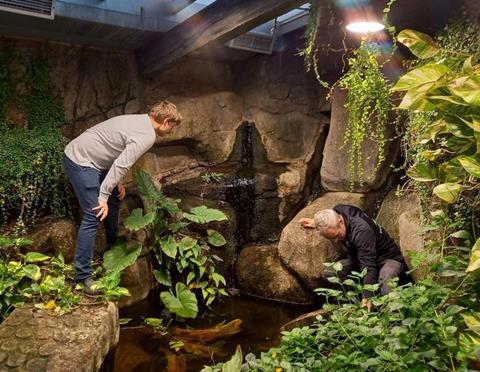
Researchers from Aarhus University and the Danish Technological Institute have taken a new approach in the search for enzymes capable of breaking down some of the most difficult types of plastic to recycle. They collected millions of bacteria from a landfill in Kenya, Randers Regnskov Tropical Zoo, the guts of larvae and a compost heap near Aarhus – and examined their enzymes. They found 12 that work.
The best candidate came from the compost heap, and the researchers are now busy improving the enzyme’s ability to break down polyurethane and nylon.
The new approach chosen by the researchers is known as bioprospecting. It involves searching nature for biological organisms and genetic material that can be used in research and industry. See fact box below the press release.
This is the first time bioprospecting has been carried out on such a large scale and across such a broad range of environments to find enzymes capable of breaking down polyurethane (PUR) and nylon. Both types of plastic are notoriously difficult to degrade.
Like looking under a streetlamp
The conventional approach to finding this kind of plastic-degrading enzyme is to search genome databases. More specifically, researchers look for gene sequences that resemble those found in enzymes already known to be suitable for the task.
And there are not many of those.
Plastic-degrading enzymes have been found using conventional methods. But, to borrow from an old joke, it is a bit like looking for a lost key under a streetlamp because that is where the light is – rather than where you actually dropped it.
The idea of travelling out into the world came to Andreas Møllebjerg when he was about to take up a postdoctoral position at what was then the Interdisciplinary Nano Science Center (iNANO) at Aarhus University – more specifically on a new research project investigating the ability of natural enzymes to break down plastic.
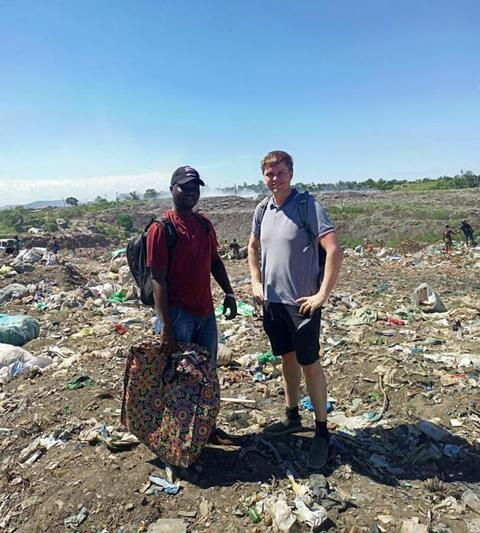
“I suggested looking for suitable enzymes in places where it is warm, because bacteria thrive and grow well there all year round. And preferably somewhere plastic has been present for a long time. A year and a half later, I was on a plane to Kenya, followed by half an hour on the back of a local student’s motorbike on the way to a huge landfill. He helped me collect samples and communicate with the hundreds of people who lived on and off the landfill,” he says.
Searching far and wide
Andreas Møllebjerg is a co-author of the scientific article, which was recently published in the scientific journal Angewandte Chemie.
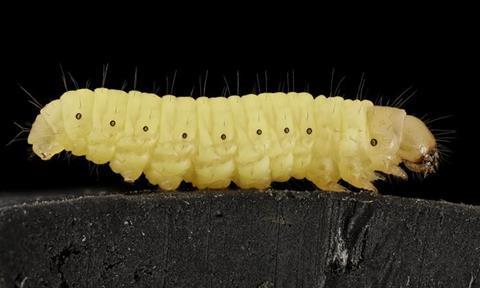
He was responsible for collecting bacteria from different environments. Together with PhD student and co-author Malthe Kjær Bendtsen, he also travelled 34 kilometers to Randers Regnskov Tropical Zoo to collect plastic waste, and he bought a bag of wax moth larvae from a pet food shop so the researchers could investigate the enzymes in their guts.
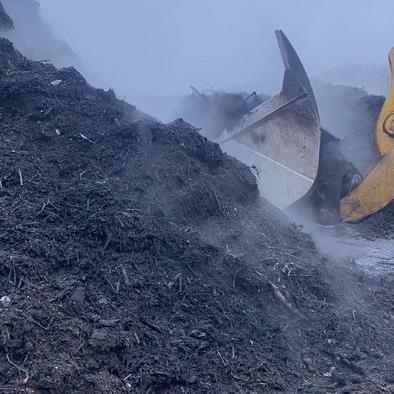
And then he fetched a shovelful of compost from a recycling centre about 10 kilometres from the university.
Back in the laboratory, the researchers began sorting through the many bacteria. They did this using an advanced technique known as fluorescence-activated cell sorting (FACS).
They mixed the bacteria with molecules that mimicked the chemical bonds in polyurethane and nylon – and which lit up when they came into contact with a bacterium containing a suitable enzyme.
In other words, the bacterium switched on its own little neon sign and revealed that it contained something interesting.
Cell-sorting
Using a cell-sorting machine, the researchers could screen millions of bacteria and pick out the glowing cells at a rate of up to 10,000 per second.
“It was like a three-stage rocket, where we gradually narrowed them down. We started by finding bacteria that could break down the fluorescent model material. Then we isolated the enzymes capable of breaking down exactly that fluorescent material. And finally, we tested the enzymes on increasingly realistic materials,” explains Malthe Kjær Bendtsen.
One realistic material was, for example, polyurethane mattress foam – although in powdered form.
The result: 29 plastic-degrading bacteria and 12 enzymes capable, to varying degrees, of breaking down polyurethane and nylon.
All-round enzyme shows the most promise
The most promising candidate was the enzyme the group named CCPUR1.
The ‘CC’ comes from the bacterium Chelatococcus composti, while PUR comes from the term PURase – shorthand for polyurethane hydrolase, an enzyme capable of breaking down polyurethane (PUR).
Its secret? CCPUR1 has a very wide binding cleft, which allows it to accommodate large polymers. It is also particularly stable and can withstand higher temperatures and a range of solvents better than the other enzymes.
Put simply, it is a better all-rounder.
Secret of compost
So why would a bacterium from a compost heap be better at breaking down plastic than bacteria from, say, a landfill?
Because compost heaps contain hard-to-degrade plant polymers such as wax and lignin. To break them down, the bacterium has evolved an enzyme that also happens to be capable of degrading plastic.
Compost can also become very hot – up to 80°C – so the enzymes need to be more stable in order to function there.
The other 11 enzymes are by no means useless. They work best on small pieces of plastic and may therefore complement CCPUR1 in future combinations of processes.
And because enzymes are selective, the researchers envisage something like an enzyme cocktail: first remove the polyurethane and wash it away, then add nylon-degrading enzymes – something chemical methods cannot do in the same way.
Still a long way to go
In three days, CCPUR1 was able to break down just under one per cent of the mattress foam the researchers had “fed” it.
There is therefore still a long way to go before the enzyme can make it possible to recycle PUR and nylon on an industrial scale.
And it may need to be combined with mechanical and chemical degradation to make the plastic more “digestible” for the enzymes.
Chemical degradation of PUR and nylon is also a major field of research – including at Aarhus University.
“But the research highlights the strength of enzymes. Their real advantage when it comes to recycling is that they work under mild conditions, meaning at lower temperatures and pressures than those used in most recycling technologies today,” says postdoc Rosie Graham, who was responsible for testing the enzymes’ appetite for plastic materials in the laboratory.
The research team is far from finished with CCPUR1.
In a new study published today in the journal Chem Catalysis, the researchers have collaborated with University of Porto on improving the enzyme. Using computer simulations and targeted editing of the enzyme’s DNA, they improved it so that, within three days, the modified version broke down around 1.4 per cent of the polyurethane in foam from a real shoe sole – without any pretreatment of the plastic.
Rosie Graham is the first author of that study.
The holy grail
Some types of plastic are relatively easy to recycle. Others are extremely difficult – at least on an industrial scale. Polyurethane and nylon belong to the latter category.
Polyurethane is found in everything from mattress foam and shoe soles to refrigerator insulation, while nylon is used in clothing, bags, cars, ropes, engine components, fishing nets and much, much more.
Both are based on crude oil, which is a finite resource.
Researchers are therefore working hard to find ways to break polyurethane and nylon down into their pure components, which can then be used to produce new polyurethane and nylon instead of relying on more crude oil.
MICROBIOLOGY NEWS: Register with The Microbiologist for more free articles
Broadly speaking, they are pursuing different approaches – chemical and biological – and they are making progress. The solutions emerging from laboratories are simply not ready for industrial scale use yet.
As a result, a very large proportion of the millions of tonnes of PUR produced globally ends up being incinerated or dumped in landfills.
That is one of the reasons the research team compares finding an efficient way to recycle PUR to finding the holy grail.







No comments yet