
Agricultural soils are a major source of anthropogenic N₂O, a powerful greenhouse gas generated largely through microbial nitrogen transformations. During denitrification, microorganisms progressively reduce nitrate to N₂O and ultimately N₂, with the balance between these gases influenced by soil pH, carbon availability, nutrient status and microbial functions.

Previous studies have examined how individual practices, including fertilization, irrigation, nitrification inhibitors and biochar application, affect N₂O emissions. However, farmland soils differ substantially in their physicochemical properties and microbial communities, meaning that identical carbon and nitrogen inputs may produce sharply different outcomes.
Comparative evidence explaining these soil-dependent responses has remained limited, complicating the development of broadly effective agricultural mitigation practices.
A study (DOI: 10.48130/nc-0026-0006) published in Nitrogen Cycling on 21 April 2026 by Xiaojun Zhang’s team, Shanghai Jiao Tong University, reports that physicochemical constraints and microbial functional differences jointly regulate denitrification, causing carbon and nitrogen inputs to alter N₂O and N₂ production differently among soil types.
Fertilization history
The researchers collected black soil, lime concretion black soil, yellow-cinnamon soil, red soil and fluvo-aquic soil from agricultural sites across China. For each type, they examined soils with low- and high-fertilization histories. Samples were aerobically pre-incubated for seven days and then assigned to baseline assessment or one of three anaerobic conditions: no added nitrate, nitrate addition, or combined nitrate and glucose addition. Each treatment was performed in triplicate.
During the seven-day anaerobic incubation, a robotic system measured headspace N₂O and N₂ concentrations every four hours. The team also measured pH, dissolved organic carbon and inorganic nitrogen, sequenced bacterial 16S ribosomal RNA genes, predicted microbial functions and quantified the denitrification genes nirK, nirS and nosZ using quantitative polymerase chain reaction.
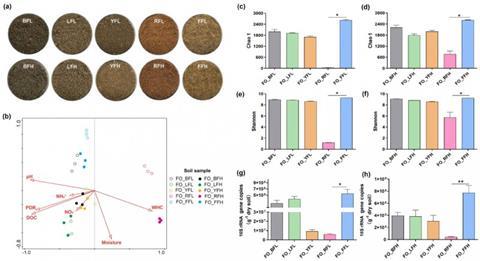
The analyses showed that pH explained 46.1% of the variation in bacterial community structure, while nitrate availability explained another 9.6%. Red soil, characterized by low pH and dissolved organic carbon, had the lowest bacterial richness, abundance of denitrification genes and overall denitrification potential.
Bacterial groups
Although shared bacterial groups were consistently associated with carbon cycling, nitrogen cycling and organic-matter degradation, their abundance was not significantly related to soil-specific N₂O/(N₂O + N₂) ratios. Gas measurements further revealed contrasting functional responses.
Adding nitrate increased N₂O production in all soils, while adding both nitrate and glucose generally stimulated total denitrification and shifted a larger proportion of the products toward N₂. However, this treatment did not reduce N₂O uniformly.
MICROBIOLOGY NEWS: Register with The Microbiologist for more free articles
Fluvo-aquic soil consistently accumulated the least N₂O and exhibited the lowest N₂O/(N₂O + N₂) ratios, alongside comparatively high abundances of denitrification genes, especially nosZ, which encodes nitrous oxide reductase. Black, lime concretion black and yellow-cinnamon soils accumulated considerable N₂O despite relatively high nosZ abundance, demonstrating that gene abundance alone does not guarantee effective N₂O reduction. Microbial identity, gene expression, enzyme activity and environmental sensitivity may also determine actual emissions.
Overall, the study shows that agricultural N₂O emissions arise from interactions between soil chemistry and microbial functional capacity rather than from fertilizer inputs or core microbial composition alone. Carbon supplementation can promote the final reduction of N₂O to N₂, but its effectiveness depends strongly on the receiving soil. The observed mismatch between denitrification-gene abundance and measured gas production also cautions against using genetic potential alone to predict emissions. By combining microbial profiling with direct, high-frequency measurements of N₂O and N₂, the research offers a mechanistic foundation for tailoring nitrogen management to specific soils and for designing more precise approaches to limiting agricultural greenhouse gas emissions.





No comments yet