
“We were waiting to capture the vultures when suddenly a swarm of bees appeared. We had to run, leaving all our equipment behind, and come back that night to retrieve it,” recalled Dr. Antoni Margalida, a researcher at the Pyrenean Institute of Ecology and first author of a new study on vulture microbiomes. It was just one of the unexpected challenges of studying these elusive birds in the wild; a pursuit that has kept Margalida and his colleagues busy for nearly 30 years.
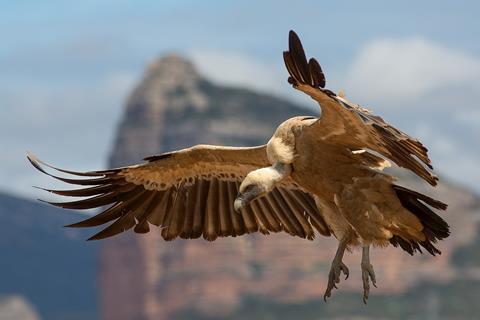
Vultures are highly specialized scavengers. By consuming animal remains, they encounter complex microbial communities, including bacteria associated with decomposition and potential pathogens. This made Margalida and his collaborators curious as to whether the vulture’s microbiome might further explain their resilience against these constant exposures.
Their new study, published in PNAS, examined five scavenging Old World species in the Spanish Pyrenees: four obligate scavengers (the griffon, cinereous, bearded and Egyptian vultures) and the facultative scavenger red kite. Between 2017 and 2022, they collected samples from 155 free-living birds, examining bacterial communities across four anatomical regions: facial, oral, tracheal and cloacal.
The researchers initially expected that species feeding on the same carcasses would have relatively similar microbiomes. Instead, they found substantial differences. Host species explained 18.1% of the variation in composition, compared with 8.9% explained by anatomical region. For example, cloacal samples were enriched in anaerobic, gut-associated bacteria, while facial samples contained more environmental and skin-associated microorganisms. Age also influenced microbiome composition; nestlings generally harbored less diverse and compositionally distinct communities than older birds.
As Margalida summarized, “Sharing food does not mean sharing the same bacterial communities.” Rather, species-specific behavior appears to help shape their microbiomes.
Feeding patterns
In particular, feeding patterns may explain why species exposed to the same carcasses maintain distinct microbiomes. Griffon vultures primarily consume soft tissues, while bearded vultures specialize in bones. Exploiting particular portions of carcasses or arriving at different stages of decomposition could create varied microbial exposure.
Interestingly, the facultative scavenger also displayed anatomical differences in its microbiome, but had fewer carrion-associated anaerobic bacteria and more environmental bacteria than the obligate scavengers.
For Margalida, the findings help reveal how these birds are adapted to their ecological niches.
“Each species maintains a very characteristic microbiome, likely reflecting their specific roles in nature. That’s why we included a facultative scavenger, to compare a diet based exclusively on carrion with one in which carrion is consumed occasionally,” he said.
Although his work has traditionally focused on animal behavior and conservation, studying the microbiome has expanded the questions he can ask.
“We have always been focused on the big things, on the larger picture. Looking at things from a microscopic perspective opens the door to so many more research opportunities,” he added.
Why vultures matter for health and economy
Vultures provide an essential ecosystem service by preventing decomposing remains from accumulating in the environment. Margalida described them as “an important natural regulator of carcass consumption”, a service with potential implications for disease management.
Their movements across countries make this role especially relevant to One Health, which recognizes the connections between human, animal and environmental health. Ongoing GPS tracking studies by Margalida’s group have documented substantial differences in the spatial behavior of vulture species, with some individuals traveling hundreds of kilometers. These movements can connect diverse habitats and regions, meaning conservation and disease-management strategies cannot always stop at political boundaries.
The study does not demonstrate that vultures transmit pathogens or directly reduce disease in people or livestock. However, characterizing the microorganisms they encounter and carry is an important first step toward investigating those possibilities.
Vulture tourism
Vultures also provide other nontraditional services, such as boosting the tourism economy.
“Spain hosts 90% of the vulture population in Europe. It makes this a great place to study them, but it also means they attract a lot of tourist attention,” Margalida added.
MICROBIOLOGY NEWS: Register with The Microbiologist for more free articles
Margalida’s previous work in Aragón y Cataluña has calculated that approximately 4 million euros a year are generated by vulture photography tourism alone.
In the future, Margalida hopes to incorporate metatranscriptomics and longitudinal sampling to determine whether these communities contribute to carrion processing, detoxification or pathogen resistance. He is also interested in extending the research to New World vultures and exploring how their microbiomes compare with those of European species.
Allies of humans and ecosystems
Reflecting on his work, Margalida hopes to change how people perceive these birds.
“They are allies of ecosystems and of humans, and they are not harmful species,” he said. He believes that understanding their biology can help make the case for their conservation.
Finally, Margalida credits the collaboration between researchers, forest rangers and veterinarians for making the project possible. “In the end, it is like a family,” he said. “We have a very good relationship, not only professionally but personally.”




No comments yet