
All Saccharomyces cerevisiae articles
-
 News
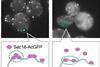
NewsHow stressed cells put the brakes on protein shipping
A study in budding yeast suggests that changes in membrane lipids trigger a braking system that slows internal protein transport when the endoplasmic reticulum comes under stress.
-
 News
NewsCreating yeast strains that aren’t picky eaters
Scientists have engineered yeasts that can simultaneously use different sugars in biomass crops.
-
 News
NewsYeast‑derived universal flu vaccine could someday replace yearly injections
Engineered baker’s yeast produces virus-like particles that protect mice against multiple influenza strains.
-
 News
NewsIndustrial-scale biotech production of proteins and vitamins economically viable
Researchers are developing biotechnological methods called “power-to-protein” and “power-to-vitamin” processes which use microbes to produce proteins and vitamins for human consumption using basic chemical ingredients – entirely bypassing livestock farming and agriculture.
-
 News
NewsWild yeast discovery enables non-GM brewing of ornithine-enriched craft beer
Researchers have uncovered a naturally derived yeast mutation that boosts ornithine production while preserving brewing performance for value-added fermentation.
-
 News
NewsFermentation science may offer new route to better lower-alcohol wine
In addition to finding ways to ferment grape juice without producing as much alcohol, one scientist is exploring novel yeasts and methods to overproduce aromas to compensate for their eventual loss when reducing alcohol through grape juice dilution.
-
 News
NewsDolichol biosynthesis conserved across eukaryotes, not limited just to humans
Researchers say a newly proposed three-step “detour” pathway for making dolichol may be more universal than scientists realized. Experiments in yeast suggest eukaryotes may rely on overlapping biochemical pathways, including the evolutionarily conserved “detour” and evidence of a possible “backup route,” to produce a molecule essential to life.
-
 News
NewsMass mating event reveals how yeast find the perfect match
When choosing mates, yeast organisms tend to pick partners that may increase the chances of their offspring’s success, according to a new study which revealed a link between the success of the parents and the genetic distance between them, and the success of their offspring.
-
 News
NewsScientists synthesize medicarpin in baker’s yeast
Scientists have developed a way to synthesize medicarpin in yeast. Like palitaxel in the 1990s, this tumor-attacking sustance has only limited natural quantitites and is considered difficult to synthesize.
-
 News
NewsBrewing a rare medicine: yeast engineered to produce a valuable astragalus isoflavonoid
By reconstructing the complete biosynthetic pathway inside Saccharomyces cerevisiae and systematically removing metabolic bottlenecks, researchers created the first yeast platform capable of producing calycosin-7-glucoside from simple carbon sources.
-
 News
NewsEngineering yeast to make rare anticancer saponins: reconstructing the complete biosynthesis of polyphyllin II
By combining plant transcriptomics, enzyme engineering, and synthetic biology, a new study demonstrates, for the first time, the full heterologous production of polyphyllin II in Saccharomyces cerevisiae.
-
 News
NewsMutated baker’s yeast at the forefront of petroleum substitute tech
Researchers engineering Saccharomyces cerevisiae to produce 2,3-butanediol (2,3-BDO) introduced mutations into the genomic DNA. The researchers engineered four altered strains and subjected them to ethanol, heat, and low pH stressors.
-
 News
NewsFestive cheer: Soaked raisins ferment to turn water into wine
Scientists have discovered that soaking sun-dried raisins in water is a successful method of creating wine. It was thought that ancient wine production relied on the natural fermentation process of storing crushed grapes in jars, but Saccharomyces cerevisiae rarely colonizes grape skins.
-
 News
NewsResearchers screen microbial strains to reduce H2S and CH4 emissions from wastewater
A new study demonstrates that S. cerevisiae and B. subtilis effectively reduce H2S and CH4 emissions from wastewater by altering microbial community composition and metabolic pathways, offering a sustainable approach for wastewater treatment.
-
 News
NewsYeast survives Martian conditions, study shows
Life on Mars would have to contend with challenging conditions including shock waves from meteorite impacts and soil perchlorates. Scientists subjected Saccharomyces cerevisiae to these conditions, finding those that survived had assembled RNP condensates.
-
 News
NewsMetabolic modeling unlocks diversity of yeast for industrial biotechnology
Scientists uncovered how yeast adapts to different environments at a systems level through strain-specific metabolic modeling.
-
 News
NewsBrewed chicken protein made by precision fermentation tested in pet food
In a groundbreaking new project, scientists used precision fermentation to produce brewed chicken protein and evaluated it for use in pet food. Dogs that consumed the protein in their kibble during a six-month study had beneficial digestive effects, they found.
-
 News
NewsResearchers achieve de novo biosynthesis of plant lignans using synthetic yeast consortia
Researchers have achieved the biosynthesis of the antiviral ingredient lignan glycoside in yeast Saccharomyces cerevisiae. By mimicking the spatial and temporal regulation of plant biosynthesis, they designed a system with obligated mutualism, enabling metabolic division of labor among different yeast strains.
-
 News
NewsFinal synthetic yeast chromosome unlocks new era in biotechnology
A team of researchers has successfully synthesised the very first yeast chromosome using specialised genome-editing technique that provides insights for synthetic biology and biomanufacturing fields.
-
 News
NewsResearchers undercover how macronucleophagy ensures survival in nitrogen-starved yeast
Scientists sought to shed light on how macronucleophagy ensures the survival of nitrogen-starved S. cerevisiae and revealed that uncontrolled micronucleophagy due to the lack of normal macronucleophagy causes cell death.