
All Ludwig-Maximilians-Universität München articles
-
 News
NewsBiologist will use €1.63m grant to investigate how microorganisms reactivate their metabolism after prolonged dormancy.
Dr. Sofia Doello has been awarded a grant of around 1.63 million euros for her research through the Emmy Noether program. In her project ’Metabolic foundation of developmental transitions’, she will investigate how microorganisms reactivate their metabolism after a prolonged period of dormancy.
-
 News
NewsYeast study uncovers how cells identify and silence unwanted jumping genes
Yeast cells sense abnormal RNA patterns produced by invading transposons and respond by activating pathways to silence them, a study shows. This process extends to any invasive DNA, provided it produces enough RNA disturbance for cells to detect.
-
 News
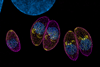
NewsToxoplasmosis: How a deadly parasite infects its host cells
Researchers have discovered how the parasite Toxoplasma gondii builds a specialised structure that allows it to move and invade host cells. They identified two proteins that control how the conoid complex is assembled - this acts like an engine for movement and cell-invasion.
-
 News
NewsBiological patterns: Stability through protein reservoirs
Biophysicists have figured out how bacteria form robust patterns despite changing environmental conditions and fluctuating protein concentrations.
-
 News
NewsHuman clinical study launched using phage lysin to eliminate staph in the nasal microbiome
A “first-in-human” study with the novel drug candidate HY-133 began on 10 July with the recruitment of clinically healthy volunteers who tested positive for Staphylococcus aureus colonisation of the nose.
-
 News
NewsRetreating glaciers: fungi enhance carbon storage in young Arctic soils
Melting Arctic glaciers are in rapid recession, and microscopic pioneers colonize the new exposed landscapes. A new study has revealed that yeasts play an important role in soil formation in the Arctic.
-
 News
NewsAchilles heel is uncovered in Helicobacter pylori
Researchers have discovered a weakness in the bacterium Helicobacter pylori, which could be exploited to develop new drugs.