
Persistent herbicide residues can remain in agricultural soils long after application, disrupting microbial communities, nutrient cycling, crop productivity, and the long-term resilience of farmland. A new review highlights how carefully designed teams of microorganisms could offer a more effective way to break down these contaminants than relying on individual microbial strains.

“Instead of asking one microorganism to perform every step of herbicide degradation, synthetic microbial communities allow different members to share the work,” said corresponding author Xueling Yang of Zhejiang University. “By combining complementary metabolic abilities, these communities may achieve faster and more complete contaminant removal while remaining more resilient in complex soil environments.”
The study, published in Agricultural Ecology and Environment, examines recent progress in the use of synthetic microbial communities, known as SynComs, to degrade persistent herbicides such as atrazine, metolachlor, and fomesafen. These chemicals are widely used in crop production but may persist in soil, interfere with beneficial microorganisms, alter nutrient cycling, and move into groundwater.
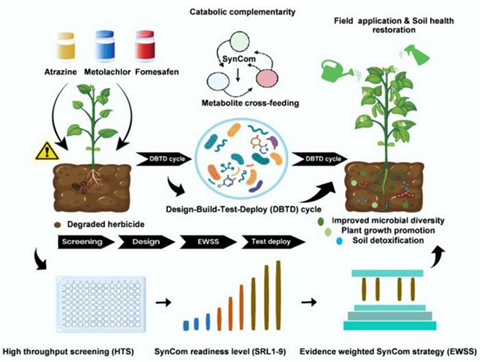
Traditional microbial remediation often introduces a single herbicide-degrading strain into contaminated soil. Although individual strains can perform well under controlled laboratory conditions, their effectiveness frequently declines in real soils. A single microorganism may lack all the enzymes needed to complete the degradation pathway, allowing partially transformed and sometimes toxic compounds to accumulate. Introduced strains may also struggle with changes in moisture, pH, oxygen availability, competition from native microorganisms, and other environmental stresses.
Microbial partners
SynComs address these limitations by distributing different stages of herbicide degradation among multiple microbial partners. One member may begin breaking down the original herbicide, while another consumes the intermediate products. Additional helper organisms may support the community by forming protective biofilms, supplying nutrients, reducing oxidative stress, or improving survival under changing soil conditions.
MICROBIOLOGY NEWS: Register with The Microbiologist for more free articles
This cooperative process, described as metabolic division of labor and cross-feeding, can prevent bottlenecks and promote more complete mineralization of pollutants. Across the studies reviewed, rationally designed microbial communities generally improved herbicide degradation by approximately 1.5 to 3 times compared with single strains or natural attenuation, although performance varied according to the herbicide, community design, soil properties, and experimental conditions.
Emerging technologies
The researchers also describe how emerging technologies could make SynCom development more predictable. High-throughput microbial screening can rapidly identify strains with useful degradation and stress-tolerance traits. Multi-omics methods can reveal which genes, enzymes, proteins, and metabolites are active within a community.
Genome-scale metabolic models can then predict beneficial partnerships, intermediate accumulation, nutrient exchanges, and suitable proportions of different community members. Machine learning may further help identify combinations likely to remain effective under realistic environmental conditions.
To guide future development, the authors propose two complementary frameworks. The Evidence-Weighted SynCom Strategy, or EWSS, links the chemical structure and degradation pathway of a herbicide to the microbial traits required for its removal. The SynCom Readiness Level, or SRL, provides a nine-level scale for tracking progress from initial mechanistic discovery and laboratory testing to non-sterile soil experiments, field trials, biosafety evaluation, and regulatory approval.
Study limitations
The review cautions that most current evidence comes from laboratory studies and soil microcosms. Field-scale validation remains limited, and important questions remain about long-term community stability, interactions with native soil microbiomes, ecological side effects, delivery methods, and regulatory oversight.
With continued integration of microbiology, ecological engineering, multi-omics, and predictive modeling, SynCom-based remediation could become a practical tool for restoring herbicide-contaminated soils and supporting more sustainable agriculture.






No comments yet