
Scientists studying leatherback sea turtles in Puerto Rico have uncovered distinct microbial communities on the animals, their eggs, and the sand surrounding their nests. The findings published recently at ISME Host-Microbe offer one of the first integrated microbiome baselines for Caribbean leatherbacks, opening a new window onto the microscopic ecosystems associated with the world’s largest sea turtle.
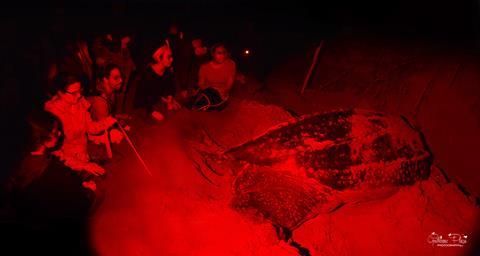
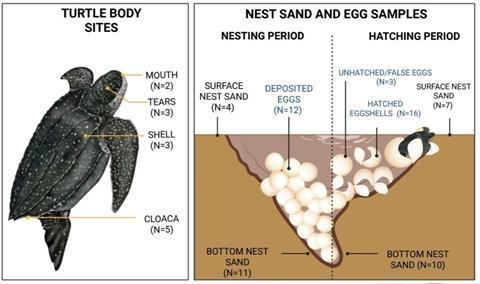
Published September 24 in ISME Host Microbe, the study brings together habitats usually examined separately. A team led by Puerto Rico AMI Global Ambassador Dr. Filipa Godoy-Vitorino at the University of Puerto Rico, working with local conservation partners, analyzed 76 samples from five nesting females and seven nests at Playa Grande–El Paraíso in Dorado. Samples collected during 2017 and 2018 covered the mouth, tear film, carapace, and cloacal fluid, alongside eggs and sand from different nest depths.
Using 16S ribosomal RNA gene sequencing, the researchers found that turtle-associated bacterial communities differed clearly from those on eggs and in nest sand. Eggs and sand, however, shared substantial microbial overlap, suggesting that developing eggs inhabit a microbial environment closely connected to their surroundings. The data cannot establish whether bacteria moved from sand to eggs or in the opposite direction.
The animals themselves also hosted contrasting microbial habitats. Only two bacterial sequence variants (ASVs) were shared across all four body sites. Tear samples, collected from just three females, contained the greatest number of unique variants among the sampled body sites and shared the most with nest sand. These findings suggest that the ocular surface deserves further investigation.
Life in the nest
Inside the nests, microbial communities changed with depth, collection year, and the transition from nesting to hatching. Bacterial diversity increased after hatching, particularly in sand from the bottom of the nest. The researchers suggest that eggshell fragments, unhatched material, and other organic residues may supply nutrients that support microbial succession. Such activity could influence oxygen availability and temperature, both relevant to embryo development, but those effects were not measured.
The team also detected genera, including Pseudomonas and Bacillus, that contain species associated with disease in turtles or humans. Their presence does not demonstrate infection: the sequencing approach cannot establish whether pathogenic species or strains were present.
For conservation, the immediate value is a regional starting point against which future changes can be assessed. The work also addresses gaps in Caribbean microbial biodiversity data. Larger studies combining microbiome surveys with temperature, oxygen, moisture, and hatching outcomes could test whether these communities provide useful indicators of nest conditions.
MICROBIOLOGY NEWS: Register with The Microbiologist for more free articles
Comparisons with non-nesting sand and other beaches will also be essential before drawing management conclusions.By connecting the turtle’s microbial habitats with those of its eggs and nesting environment, the study expands the biological picture of leatherback conservation. Protecting these ocean giants may eventually require understanding the invisible communities surrounding their earliest stages of life.

No comments yet