
Antibiotic resistance is a growing global public-health concern, and aquatic environments can act as reservoirs and transmission routes for ARGs. Hospital wastewater is considered especially important because it may contain antibiotics, resistant bacteria, and resistance genes of clinical relevance.

Previous studies have reported elevated ARG levels downstream of hospitals, particularly where untreated or insufficiently treated effluent enters rivers. However, wastewater infrastructure and regulations differ greatly among regions.
China has strengthened requirements for the separate collection, treatment, and regulated discharge of medical wastewater, but whether these measures consistently prevent hospitals from altering surrounding surface-water resistomes has remained unclear.
A study (DOI: 10.48130/biocontam-0026-0008) published in Biocontaminant on 26 June 2026 by Rong Zhang’s & Liguan Li’s team, The Second Affiliated Hospital of Zhejiang University & The Education University of Hong Kong, reports that geography, rather than hospital proximity, primarily shaped resistance-gene profiles where wastewater controls were well established.
Surface water samples
The researchers collected 100 surface-water samples from rivers and lakes near hospitals in 11 Chinese cities, including locations within 500 meters and those 500–2,000 meters downstream. The dataset included 11 lake samples and 89 river samples, supplemented by five upstream samples from Suzhou, 24 waters not adjacent to hospitals, and two untreated hospital-wastewater samples from Hefei.
For international comparison, the team collected 21 samples in Nepal, including 17 hospital-adjacent waters and four untreated hospital-wastewater samples. They also incorporated previously published metagenomic datasets from rivers in mainland China, Hong Kong, South Korea, and Switzerland.
MICROBIOLOGY NEWS: Register with The Microbiologist for more free articles
Each 500-milliliter water sample was filtered, and its DNA was extracted for shotgun metagenomic sequencing on an Illumina NovaSeq 6000 platform, generating approximately 10 gigabases of data per sample. Bioinformatic pipelines quantified ARGs against the Structured Antibiotic Resistance Gene database, assessed mobile genetic elements, characterized microbial communities, assembled genomic fragments, and reconstructed high-quality metagenome-assembled genomes.
Statistical analyses then compared resistome composition by city, hospital type, distance, water-body type, and geographic region.
The findings
Across hospital-adjacent waters in China, the mean ARG abundance was 0.47 copies per microbial cell, while samples contained an average of 389 ARG subtypes. Shenzhen recorded the highest mean abundance at 1.11 copies per cell—nearly eight times the lowest level detected in Wuhan—whereas Kunming exhibited the greatest average ARG diversity.
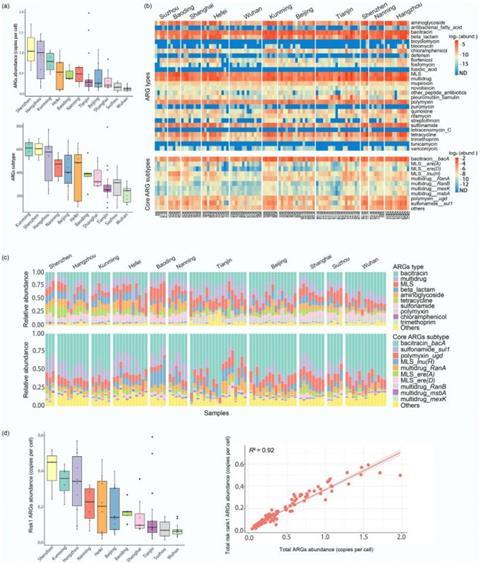
Despite these differences, a shared group of core ARGs accounted for more than 96% of total ARG abundance within individual samples. Sampling distance from hospitals did not produce a significant shift in resistome profiles, and hospital type likewise showed limited explanatory power. Instead, location was the strongest factor shaping both resistance genes and bacterial communities.
Chinese hospital-adjacent waters broadly resembled typical rivers from China and other regions. By contrast, hospital-adjacent rivers in Nepal showed substantially elevated resistance-gene burdens, consistent with weaker wastewater-treatment capacity.
Separating medical wastewater
Overall, the study indicates that hospitals do not inevitably become dominant sources of antibiotic resistance in surrounding waters. Their environmental impact can be substantially reduced when medical wastewater is separately collected, effectively treated, and discharged under enforceable standards.
MICROBIOLOGY ON TAP: Get full access to all The Microbiologist articles from just £2.17 a month
The contrast between China and Nepal also suggests that wastewater infrastructure, implementation capacity, and regulatory oversight may matter more than hospital proximity alone.
By connecting environmental resistome surveillance with wastewater-management conditions, the research provides a practical framework for identifying vulnerable regions, evaluating treatment policies, and prioritizing investment to interrupt the movement of clinically relevant resistance genes from healthcare facilities into aquatic ecosystems.






No comments yet