
Jin Maneekul and Krista Freeman, joint first authors working with Graham F. Hatfull at the University of Pittsburgh, have characterized a set of phage-encoded enzymes that can rapidly kill a broad range of Mycobacterium abscessus clinical strains when administered on their own in laboratory tests. The study was published on October 13 in the Journal of Bacteriology. These enzymes, called lysterases, help phages disrupt mycobacterial cells by cleaving ester bonds involving mycolic acids in the cell envelope.This is a potential new approach to a bacterium that has high levels of antibiotic resistance.
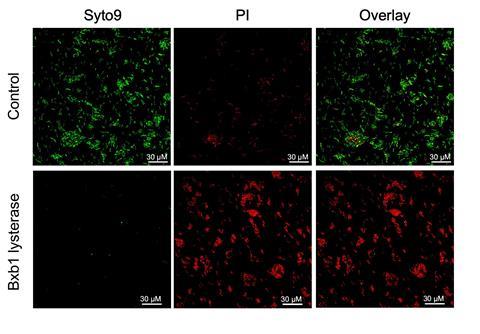
Mycobacterium abscessus is a non-tuberculous mycobacterium (NTM) associated with respiratory infections in people with cystic fibrosis. The use of mycobacteriophages, which are bacteriophages that infect bacteria in the Mycobacterium genus, for phage therapy has been previously attempted.
The problem is that most mycobacteriophages have very narrow host specificity, which essentially means that only specific mycobacteriophages can be used for specific strains of M. abscessus. This is the problem that the team looked to address through their characterization of these enzymes.
Steps to successful phage therapy
Hatfull explained that whole phages must bind to the bacterial surface, inject their DNA, and complete a growth cycle involving genome replication, gene expression, and assembly of new virus particles. Interruption of any of these steps can prevent successful phage activity, whereas isolated lysterases do not require this complete cycle. This helps explain the key finding that strains that resist whole phages were still killed by the isolated enzymes.
“The lysterases are much simpler, so it is not a complete surprise that some strains that are not efficiently infected and killed by phages are nonetheless sensitive to the lysterases,” Hatfull said.
The work draws on a wider collection of approximately 15,000 mycobacteriophages, built with contributions from undergraduate researchers from 180 institutions through the SEA-PHAGES program.
Breaking down the bacterial envelope
The team analyzed 2,127 lysterase proteins encoded by 2,803 phages to identify diverse candidates for antibacterial testing. Ultimately, the researchers selected six phylogenetically distinct lysterases for detailed assessment and tested their activity against a panel of 24 M. abscessus clinical strains.
Seventeen of these strains exhibited poor or no susceptibility to a panel of phages used therapeutically. The results of these experiments showed that the lysterases varied in both their activity and the range of strains they killed. The authors reported reductions in bacterial viability of up to six orders of magnitude within four hours.
Coverage and use with antibiotics
In regards to how broad the coverage is, two lysterases, MissWhite and D29, killed 23/24 and 24/24 of the bacterial strains, respectively, on their own under the experimental conditions.
Additionally, in separate experiments using the related laboratory model Mycobacterium smegmatis, the researchers found that the lysterases were able to kill both growing and non-growing bacteria. This is of interest because non-growing bacteria can be less susceptible to antibiotics, so activity against this state could be valuable. Despite finding this effect in M. smegmatis, these experiments did not establish the same effect against dormant M. abscessus.
In terms of use in combination with antibiotics, the researchers found a synergistic effect when combining D29 or Bxb1 lysterase with amikacin, an antibiotic used to treat NTM infections. Specifically, at concentrations where either agent alone had little antibacterial activity, using them in combination was effective. These combination experiments were performed using one M. abscessus reference strain.
From laboratory tests to treatment
This work matters because treatment options for M. abscessus are limited, with success rates of only 40 to 50 per cent, as noted in the study. The authors suggest that lysterases could eventually be used therapeutically both independently and alongside antibiotics. There are potential limitations, such as the possibility that the lysterases may not be suitable for intravenous administration, but local application or inhalation are proposed alternatives that remain to be tested.
MICROBIOLOGY NEWS: Register with The Microbiologist for more free articles
“A great [deal] of work has been done with other phage-derived lysins (in particular by Vince Fischetti, and the company Contrafect) and these experiences illustrate the challenges in commercialization of biologics such as lysins, in spite of the evident opportunities and promise,” Hatfull said. “More experimental work is needed to determine if the lysterases might have utility in controlling Mycobacterium infections using animal models.”
This work was supported by the National Institutes of Health and the Howard Hughes Medical Institute.
Topics
- Jin Maneekul
- Antimicrobials
- Bacteria
- Bacteriophages
- cystic fibrosis
- Graham F. Hatfull
- Infection Prevention & Control
- Infectious Disease
- Krista Freeman
- lysterases
- mycobacteria
- mycobacteriophages
- Mycobacterium abscessus
- Mycobacterium smegmatis
- mycolic acids
- Non-tuberculous mycobacterium
- One Health
- Phage Therapy
- Proteomics & Enzymology
- Research News
- University of Pittsburgh
- USA & Canada
- Viruses


No comments yet