
Global climate goals demand that wastewater treatment plants—historically energy-intensive and a major source of potent greenhouse gases—transform their operations. A new review reveals that quorum sensing (QS), the chemical communication system bacteria use to coordinate behavior, could be the key.

The study shows that by manipulating these microbial social networks, plants can simultaneously cut direct emissions of nitrous oxide and methane, reduce energy-hungry aeration processes, and boost methane recovery for fuel. This approach offers a biological shortcut to turn waste treatment from a carbon source into a carbon-neutral or even carbon-positive facility.
Wastewater treatment is a hidden climate challenge. Plants consume massive amounts of electricity—with aeration alone using up to 75% of total energy—while also emitting nitrous oxide and methane, greenhouse gases dozens of times more potent than carbon dioxide.
Traditional solutions focus on hardware upgrades, like better pumps. But these miss the root of the problem: the efficiency of the microbes doing the work. QS controls everything from biofilm formation to how microbes exchange electrons. However, its effects can be contradictory, sometimes reducing emissions while other times making them worse.
Researchers from the Harbin Institute of Technology (Shenzhen), KU Leuven, and Beijing Normal University have published (DOI: 10.1016/j.ese.2026.100701) a comprehensive analysis in the journal Environmental Science and Ecotechnology (available online April 2026). The team, led by Professor Xiao-Chi Feng, reviewed hundreds of studies to map how QS—bacterial “talk”—governs greenhouse gas emissions and energy use. Their findings reveal that targeted QS manipulation can reduce nitrous oxide release by nearly 50%, cut aeration energy by over 60%, and dramatically improve methane production, offering a roadmap for turning wastewater plants into energy producers.
Nuanced control system
The review uncovers a nuanced microbial control system. For nitrous oxide (N₂O), the same signal molecule can have opposite effects depending on its dose. For example, a low concentration of a specific signaling molecule (C12-HSL) cut N₂O emissions by nearly half, while a higher dose of another (C12-HSL) boosted emissions by over 40% by disrupting key enzymes. This means precision is everything.
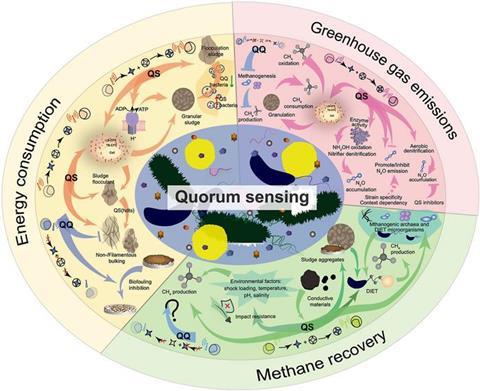
On energy savings, the study highlights how QS can be a game-changer. By promoting the formation of dense, fast-settling granular sludge, QS reduces the need for prolonged aeration—the plant’s biggest energy drain. In membrane bioreactors, the team found that “quorum quenching” (disrupting bacterial chatter) could slash fouling and reduce filtration energy by over 80%.
Most exciting is the potential for energy recovery. The review shows that quorum sensing (QS) enhances the expression of genes related to direct interspecies electron transfer (DIET)—essentially a microbial power grid. This QS-enhanced gene expression increased DIET-related activity 12-fold, turning more organic waste into methane, which can be captured and burned for electricity, directly offsetting the plant’s energy debt.
Tuning like an instrument
The authors explained that the goal is not to simply boost or block bacterial communication, but to tune it like an instrument.
“We found that QS is neither a universal hero nor a villain. Its impact depends entirely on the context—the specific microbial community, the signal molecule, and even the time of day,” they said.
“For aeration, we want to promote granulation, but for membrane filters, we want to stop biofilms. The real breakthrough is learning to switch between these modes. By precisely managing this microbial social network, we believe wastewater plants can fundamentally rewire their internal energy budget and move from a cost center to a power station.”
Technological pathway
This research provides a clear technological pathway for plant operators. Instead of expensive chemical additives or energy-intensive cleaning, facilities could house “quorum sensing” or “quorum quenching” bacteria in specialized beads to control fouling at reduced costs and energy consumption.
For new plants, the findings support designs that promote granular sludge from day one, shrinking physical footprints and energy needs. The biggest economic win likely comes from anaerobic digesters, where regulating QS could boost methane output by over 30%, turning sludge into a steady revenue stream.
The authors are now calling for pilot-scale trials to establish precise dosing protocols, as the next step is moving from lab-scale promise to real-world, carbon-neutral operation.
Topics
- aeration
- anaerobic digesters
- Asia & Oceania
- Bacteria
- Beijing Normal University
- Biofilms
- Clean Water
- Climate Action
- energy recovery
- fouling
- granular sludge
- Harbin Institute of Technology
- KU Leuven
- methane
- quorum quenching
- quorum sensing
- Research News
- UK & Rest of Europe
- Wastewater & Sanitation
- wastewater treatment plants
- Xiao-Chi Feng






No comments yet