
What happens inside a citrus tree long before leaves turn yellow, roots decline, and fruit quality suffers? Researchers from the University of Florida Citrus Research and Education Center, Diann S. Achor, Camila Ribeiro, Jinyun Li, and Nian Wang, have created a detailed microscopic atlas that provides one of the clearest pictures to date of how citrus huanglongbing (HLB), also known as citrus greening disease, develops over time and affects different parts of a tree.
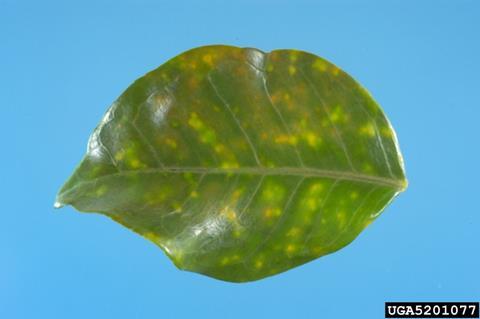
”Microscopic Atlas of Citrus Huanglongbing Unravels Its Sequential Disease Development Mechanism,” published in Phytopathology, describes how the HLB pathogen damages different citrus tissues in distinctly different ways. These findings help explain the sequence of biological events that ultimately lead to tree decline and death.
HLB is caused by ’Candidatus Liberibacter asiaticus’ (CLas), which infects the plant’s phloem—the tissue responsible for transporting nutrients throughout the tree. Although HLB is known to affect all phloem-containing organs, the mechanisms behind disease development in different tissues have remained poorly understood.
Citrus tissues
To better understand the disease, the researchers conducted extensive microscopic analyses of citrus tissues collected from infected and healthy trees grown in both grove and greenhouse conditions. Over the course of a year, samples were collected at four different times and examined using transmission electron microscopy and light microscopy.
The study included leaves, roots, stem bark, trunk bark, fruit albedo, pedicels, columella tissues, and seed coats. The resulting collection of images serves as a comprehensive microscopic atlas of HLB, offering an unprecedented view of how the disease progresses throughout the plant.
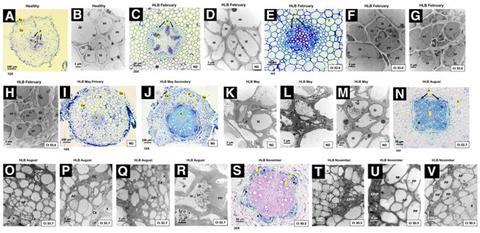
The researchers found that CLas infection causes significant increases in phloem cell death and callose deposition—a plant response that can block nutrient transport—in leaves, fruit tissues, and bark tissues of branches and trunks. In contrast, roots and seed coat tissues showed little or no such damage.
Tissue differences
These observations revealed an important distinction: The pathogen affects photosynthetic tissues differently from nonphotosynthetic tissues.
MICROBIOLOGY NEWS: Register with The Microbiologist for more free articles
By examining multiple citrus tissues over four time points, the researchers uncovered a step-by-step pathway of HLB development. CLas infection triggers phloem cell death and callose deposition, restricting nutrient transport and causing starch to accumulate in leaves and branch bark. This buildup contributes to chloroplast degeneration and the characteristic blotchy mottling and yellowing symptoms of HLB. In contrast, roots experience starch depletion, suggesting that carbon starvation drives root decay and further contributes to nutrient deficiencies, tree decline, and eventual death.
“What excites us most about this research is that we found the HLB pathogen affects different tissues differently in terms of its damage,” author Nian Wang noted.
Microscopic atlas
The authors hope the microscopic atlas will serve as a valuable resource for researchers seeking to better understand HLB. As they describe it, the atlas “guides readers through the HLB maze,” while also providing clues for identifying sieve elements in citrus phloem tissue at the ultrastructural level.
By revealing how disease effects unfold across different tissues and over time, this work provides a clearer framework for understanding the progression of HLB and the biological processes that drive one of the citrus industry’s greatest challenges.
To learn more, read ”Microscopic Atlas of Citrus Huanglongbing Unravels Its Sequential Disease Development Mechanism,” published open access in Phytopathology.

No comments yet