
The distinct foot odor that comes with the skin disorder Nagashima-type palmoplantar keratosis (NPPK) is caused by the overgrowth of a specific bacterial strain. The Kobe University result also shows that topical application of benzoyl peroxide restores balance in the bacterial skin flora, reducing the odor.
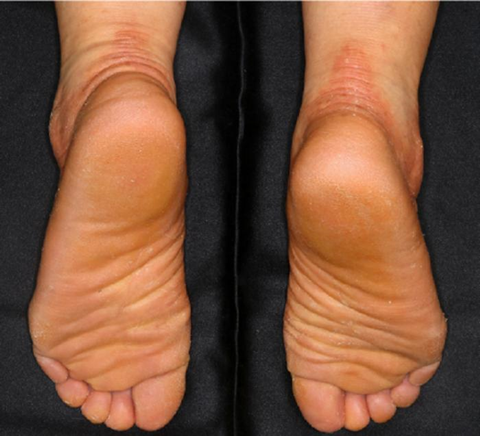
Affecting some 10,000 individuals in Japan and several hundreds of thousands more across East Asia, Nagashima-type palmoplantar keratosis (NPPK) is a condition that causes several symptoms, including redness on the palms and soles of sufferers as well as a distinct foot odor. However, the cause of this odor was not well understood.
Kobe University dermatologist Kubo Akiharu explains: “In 2013, our group identified SERPINB7 as the causative gene for NPPK. Since then, more patients have come to our clinic and we have learned that many of them are distressed by foot odor. This made us determined to find a way to help.”
Overgrowth of bacteria
Kubo noticed that when the hands and feet of NPPK patients were soaked in water, the outermost layer of skin quickly absorbed water and turned white. He hypothesized that this poor water repellant function was causing an overgrowth of bacteria, and that this overgrowth might be producing the odor.
To test this hypothesis, Kubo and his team collected and tested bacteria from a total of 7 skin sites, including the palms and soles, of both healthy individuals and those with NPPK, extracting DNA and analyzing the 16S rRNA gene sequences. Since each bacteria species possesses a unique rRNA gene sequence, the team was able to decipher and quantify both the type and abundance of the bacteria found on each sample.
In the Journal of Investigative Dermatology, the team reports that in foot skin of NPPK patients, bacterial abundance was significantly higher than in the skin of healthy individuals, particularly that of Staphylococcus epidermidis and Corynebacterium tuberculostearicum.
To combat this bacterial abundance, the team treated NPPK patients in this study with benzoyl peroxide, which was shown to be particularly effective in decreasing levels of C. tuberculostearicum, though there was no significant decrease in S. epidermidis. The treatment also resulted in a decrease in foot odor, revealing the cause of the odor to be a proliferation of C. tuberculostearicum.
Source of odor
While these results have revealed the cause of the foot odor associated with NPPK, the underlying source of the odor itself remains unclear. One hypothesis points to isovaleric acid, an odor-producing byproduct of the metabolism of the two bacteria.
READ MORE: New hydrogel-based treatment accelerates infected wound healing and balances skin microbiota
READ MORE: Scientists develop breakthrough culture system to unlock secrets of skin microbiome
Kubo explains: “If the actual malodorous metabolites can be identified, it may become possible to develop more specific treatments, for example by inhibiting the production of those metabolites.” Moving forward, the results of this study could even extend to treatment of foot odor associated with other forms of PPK.
This research was supported by a Takagi Award from the Maruho Takagi Dermatology Foundation and the Japan Society for the Promotion of Science (grant JP24K11504). It was conducted in collaboration with researchers from Keio University and the RIKEN Center for Integrative Medical Sciences.






No comments yet