
The Southern Ocean may seem far removed from the North Pacific or the Gulf of Maine, but its waters are linked to all the world’s major ocean basins through a vast circulation system.
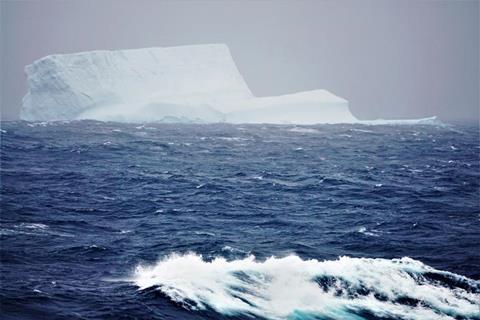
Driven by powerful winds and currents, deep waters in the Southern Ocean rise toward the surface, where winter mixing helps form distinct water masses. Some of this water is then drawn back beneath the surface, or subducted, beginning a multidecade journey northward toward the equator and beyond. Along the way, these waters carry and recycle essential nutrients, helping shape phytoplankton communities across the global ocean.
A new study led by scientists at Bigelow Laboratory for Ocean Sciences examines how two major Southern Ocean water masses recycle nutrients during this decades-long journey. Published in the Journal of Geophysical Research: Oceans, the study tracks changes in the physical, biogeochemical, and optical properties of Subantarctic Mode Water (SAMW) and Antarctic Intermediate Water (AAIW).
The findings offer a closer look at an enormous global circulation system and reveal how the two water masses follow distinct nutrient recycling pathways, potentially influencing the composition and productivity of far-reaching phytoplankton communities.
Global windmill
“When you integrate this water around the globe, the nutrient regeneration in Subantarctic Mode Water and Antarctic Intermediate Water supports about three-quarters of the primary production on Earth north of the 30th parallel south,” said Barney Balch, the study’s lead author and senior research scientist emeritus at Bigelow Laboratory for Ocean Sciences. “This paper offers an in-depth glance at a very large global ‘windmill’.”
To investigate how these water masses change during their journey, researchers sailed aboard the R/V Roger Revelle from Hawaii to waters as far as the 60th parallel south.
One of the biggest challenges in studying these water masses is determining how quickly water changes over time. The research team addressed this challenge using chlorofluorocarbons (CFCs), inert compounds that entered the atmosphere through human activities, particularly the widespread use of refrigeration and air-conditioning systems beginning in the mid-20th century.
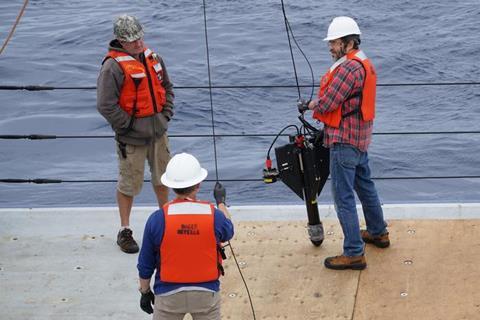
As the production and use of different refrigerants changed over time, so did the atmospheric concentrations and relative proportions of different CFC compounds. When water forms at the ocean surface and is subsequently pulled beneath it, it carries the CFC signature of the atmosphere at that time, allowing scientists to estimate the water’s age.
“What makes this paper unique is that we are combining the biological or chemical measurements with the time clock, the CFC-derived age of the water, which allows you to talk about rates,” Balch said.
Different characteristics
Although both SAMW and AAIW originate in the Southern Ocean, they have different physical and chemical characteristics. As they travel, organic matter breaks down through a process called remineralization, returning nutrients to the water in simpler inorganic forms, including nitrate, phosphate, and silicate, which act as the fundamental plant fertilizers of the sea.
The rate of remineralization determines how much of each nutrient accumulates in a water mass during its long journey and, ultimately, what combination of nutrients it delivers when it eventually returns to the surface elsewhere in the global ocean.
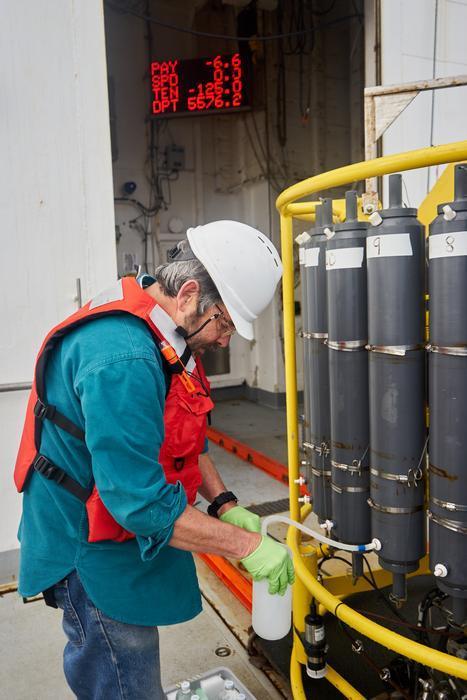
The researchers found distinct differences in nutrient regeneration between the two water masses. SAMW showed faster rates of nitrate and phosphate remineralization than AAIW. Both nutrients are essential for marine primary production, and nitrogen, in the form of nitrate, is often a limiting nutrient for phytoplankton growth.
In contrast, silicate remineralization occurred more rapidly in AAIW. Silicate is essential for diatoms, a major group of phytoplankton that use it to build their glass-like cell walls.
Impact on phytoplankton communities
These differences could have important consequences for phytoplankton communities around the world. The faster regeneration of nitrogen and phosphorus in SAMW could support the growth of phytoplankton that do not require silica, including coccolithophores and dinoflagellates. Meanwhile, the greater regeneration of silicate in AAIW could favor diatoms.
The study also found significant changes in temperature and salinity associated with the age of the water masses. These patterns may reflect changes in the conditions of the Southern Ocean when the waters originally formed, potentially preserving a record of how ocean properties have shifted over several decades.
“The biggest takeaway for me from this project was that it brought together so many different disciplines in oceanography to address a fundamental question: how the physics and chemistry of the Southern Ocean may affect the biology of the global ocean,” said David Drapeau, senior research associate at Bigelow Laboratory and co-author of the study.
MICROBIOLOGY NEWS: Register with The Microbiologist for more free articles
The study featured several other Bigelow Laboratory scientists, including Research Associate Sunny Pinkham and former Senior Research Associate Bruce Bowler, in collaboration with researchers from Woods Hole Oceanographic Institution, Arizona State University, the Bermuda Institute of Ocean Sciences, Texas A&M University, and the University of Miami. The research was supported by the U.S. National Science Foundation.
Topics
- Antarctic Intermediate Water
- Arizona State University
- Barney Balch
- Bermuda Institute of Ocean Sciences
- Bigelow Laboratory for Ocean Sciences
- Bruce Bowler
- chlorofluorocarbons
- David Drapeau
- Ecology
- Ocean Sustainability
- phytoplankton
- Research News
- Subantarctic Mode Water
- Sunny Pinkham
- Texas A&M University
- University of Miami
- USA & Canada
- Woods Hole Oceanographic Institution



No comments yet