
Sulfur-reducing bacteria of the phylum Desulfobacterota play a crucial role in the global biogeochemical sulfur cycle. Species such as Geobacter sulfurreducens use elemental sulfur as a terminal electron acceptor during anaerobic respiration, producing sulfide that participates in the global sulfur cycle.
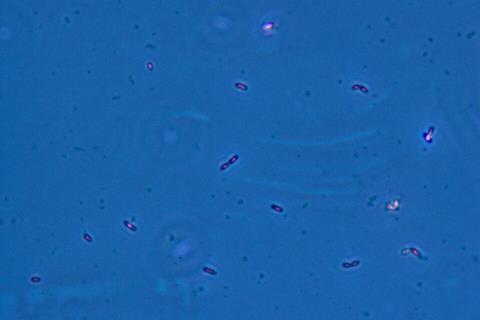
Crucially, G. sulfurreducens uses elemental sulfur but cannot use oxidized sulfur compounds such as sulfate, thiosulfate, or sulfite as terminal electron acceptors, making it an important model organism for understanding elemental sulfur respiration.
Little is known about the enzymes involved in the sulfur reduction process. Multiheme cytochrome c (MCC) proteins are a class of iron-containing proteins that are involved in many aspects of respiration and energy generation.
“The G. sulfurreducens genome encodes 111 c-type cytochromes, whereas Desulfuromonas acetoxidans—the first sulfur-reducing bacterium discovered—contains 47 putative MCC proteins,” notes Professor Hisaaki Mihara, the lead author from the College of Life Sciences, Ritsumeikan University, Japan. The paper is published in Science Advances.
Elemental sulfur respiration
Prof. Mihara’s lab had previously identified an unusual MCC in G. sulfurreducens that was predicted to contain selenocysteine, the 21st amino acid, and later named it MccSep. Selenocysteine resembles cysteine but contains selenium instead of sulfur and is present in many redox enzymes across diverse organisms.
Prof. Mihara hypothesized that MccSep may be involved in sulfur reduction. His team investigated its catalytic activity and physiological role, while his colleague Professor Hiroyoshi Matsumura from Ritsumeikan University led the structural analysis. Together, these studies revealed how MccSep contributes to elemental sulfur respiration. Their findings were published in Volume 12, Issue 35 of the journal Science Advances on August 26, 2026.
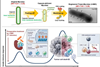
Unlike the 20 standard amino acids that have clearly defined three-letter codons in DNA and RNA, selenocysteine is encoded when UGA, normally a stop codon, is recoded. The research team found this recoded codon in the genetic sequence for MccSep. They also found that MccSep contains five iron-containing heme groups. Crystallographic analysis revealed an unusual histidine–cysteine ligation at the active-site heme (heme 2), with selenocysteine positioned nearby.
Could this unusual structure around heme 2 play a role in sulfur reduction?
The team created mutant versions of MccSep with amino acid substitutions at residues around heme 2. Substitution of either the cysteine coordinating heme 2 or the nearby selenocysteine markedly reduced the enzyme’s ability to reduce polysulfide.
Based on these findings, the team has proposed a model for MccSep’s catalytic reaction. According to this model, selenocysteine may initiate polysulfide reduction at the enzyme’s active site, working together with the neighboring cysteine residue and the heme group through a unique selenium–sulfur–heme catalytic mechanism. Electron transfer through the multiheme protein is proposed to complete the reduction reaction, allowing the catalytic cycle to continue.
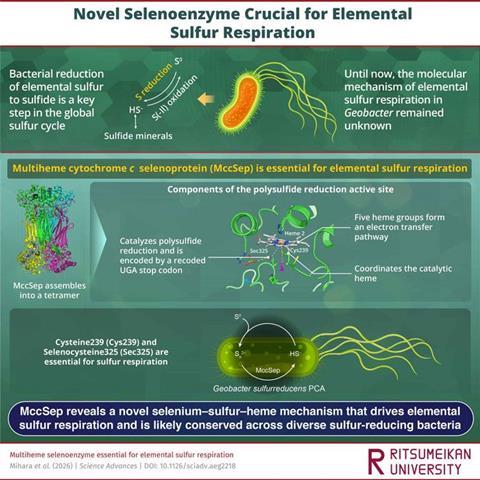
Prof. Mihara’s team has found MccSep-like proteins containing corresponding selenocysteine or cysteine residues in more than 600 bacterial genomes, including those from diverse aquatic environments. These findings suggest that related enzymes may be widespread among environmental bacteria and could have similar functions, although this remains to be tested experimentally.
Multidisciplinary approach
Prof. Mihara is pleased with the multidisciplinary approach that has helped uncover MccSep’s role in sulfur respiration. “The study connects three seemingly separate areas—selenium biology, heme-containing proteins, and microbial sulfur respiration—and reveals a previously unknown molecular mechanism that may operate in diverse environmental bacteria,” he says, adding, “More broadly, the work highlights how proteins overlooked or misannotated in genome databases can lead to the discovery of unexpected biological functions.”
MICROBIOLOGY NEWS: Register with The Microbiologist for more free articles
Prof. Mihara believes that further research into Geobacter and related microbes can help us understand how sulfur, selenium, iron, and other inorganic elements are processed in natural environments. A better understanding of the enzymes involved in sulfur respiration may provide a basis for environmental monitoring, biogeochemical modeling, and the future development of biocatalysts for sulfur- and selenium-related redox reactions.
Finally, the existence of “recoded” codons shows that we have much to learn about bacterial enzymes. “Our discovery shows that reanalyzing stop codons in the rapidly expanding bacterial genome and metagenome databases could uncover other overlooked enzymes with useful biochemical properties,” concludes Prof. Mihara.



No comments yet