
Plastic pollution does more than choke ecosystems; it may also be accelerating one of public health’s greatest threats: antibiotic resistance. New research shows that chemicals leaching from everyday polyvinyl chloride (PVC) plastic—especially after exposure to sunlight—can dramatically speed up the spread of resistance genes between bacteria.
In experiments, these leachates boosted gene transfer efficiency by as much as 44.6 times. The effect was strongest at low to moderate concentrations, where the leachate triggered bacterial stress responses without killing the microbes.
Rather than just being passive waste, plastic leachates appear to act as active chemical drivers that help resistance genes move through bacterial communities in lakes, rivers, and other waterways.
Antibiotic resistance genes
Antibiotic resistance genes are already everywhere—in soil, tap water, coastal seas, and even the Arctic. They spread largely through a process called conjugation, where bacteria pass resistance genes to one another like trading cards. Scientists have known that microplastic particles can act as rafts, bringing bacteria together and encouraging gene swapping.
But the soluble chemicals that leach from degrading plastics have received far less attention. Unlike solid particles, these leachates travel freely through water, releasing complex mixtures of carbon compounds and industrial additives. Because they can both feed and poison bacteria at the same time, their real-world impact on resistance spread has remained a blind spot. Based on these challenges, a deeper look into how plastic leachates influence gene transfer is urgently needed.
A study published (DOI: 10.1016/j.ese.2026.100705) May 9, 2026, in Environmental Science and Ecotechnology now provides the first clear evidence that plastic leachates are potent facilitators of antibiotic resistance spread. The team focused on polyvinyl chloride—a material widely used in water pipes—and found that even highly diluted leachates from sunlight-aged polyvinyl chloride (PVC) made bacteria transfer resistance genes far more efficiently, both in controlled lab conditions and in real microbial communities taken from lakes and wastewater-impacted waters.
Natural aging
To mimic natural aging, the researchers soaked ground PVC pipe material in water and left it under real sunlight for 17 days. After exposure, the water had turned into a chemically rich brew: dissolved organic carbon jumped from 1.2 to 33.0 mg·L⁻¹, and the number of detectable molecular compounds increased more than tenfold. Over 60% of these compounds were biologically labile—meaning bacteria could easily use them as nutrients. The leachate also contained at least 15 plastic additives, including phthalates and potential endocrine disruptors.
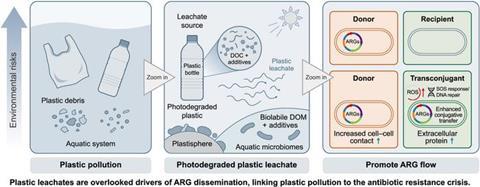
When the team added this leachate to bacterial mating experiments, the results were striking. In both natural water microbiomes and the controlled RP4 plasmid system, undiluted leachate consistently enhanced conjugative transfer of antibiotic resistance genes. Specifically, conjugation efficiency was increased up to 44.6‑fold by undiluted leachate relative to untreated controls, with gains as high as 26.4‑fold also observed in natural water microbiomes. These findings highlight that plastic leachates can potently facilitate resistance gene spread across different bacterial communities.
Digging in
Digging into the mechanics, the researchers found that the leachate boosted intracellular reactive oxygen species (ROS) by 21%, switching on bacterial SOS repair systems and DNA repair genes such as recN and uvrB. It also nearly tripled extracellular protein production, which helps bacteria stick together and swap DNA. Notably, the effect was not a simple dose-response: low to moderate concentrations enhanced gene transfer, while very high concentrations suppressed it—especially in less diverse microbial communities.
“People have focused on microplastic particles as physical carriers, but the chemicals that leach from plastics are far more mobile and biologically active,” the authors explained.
“What really surprised us was how consistently these leachates promoted resistance gene transfer—not just in simplified lab strains but in real lake water and wastewater communities. Bacteria don’t just sit there and take the stress; they actively adjust their energy metabolism to keep swapping plasmids. That makes plastic leachates a genuine threat multiplier. Even if the plastic itself is just sitting in a pipe or washing up on a shore, its chemical footprint is out there helping resistance genes travel.”
Risks beyond waste footprint
The findings suggest that PVC—chemically unstable and packed with leachable additives—may pose risks beyond its physical waste footprint.
The researchers call for regulators to rethink how plastics are assessed, moving from single-additive tests to whole-leachate toxicity evaluations. They also recommend replacing PVC with more stable alternatives like polypropylene or polyethylene in water infrastructure.
Wastewater treatment plants and coastal plastic accumulation zones may become hotspots where leachates and resistant bacteria mix, accelerating the spread of resistance genes into the environment. Long-term field studies are now needed to measure how much of this lab-observed transfer actually happens in rivers and oceans.
Until then, the message is clear: plastic pollution and antibiotic resistance—two of the biggest environmental and public health crises—may be feeding each other in ways we are only beginning to understand.



No comments yet