
The Great Salt Lake is separated by a 20-mile causeway into a super-salty north arm and a less-salty south arm, with each hosting distinct communities of extremophiles. These organisms mingle at a gap in the causeway, designed to regulate salinity, that has provided microbiologists with an unusual and rich opportunity to study how human activities and weather disturbances affect microbial communities in extreme environments.
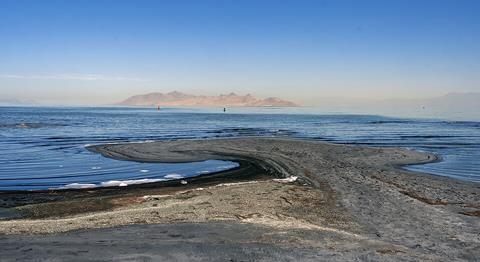
Scientists began observing microbial communities near the breach in the fall of 2022, when water levels hit a record low after years of extreme drought. In the spring, as snow melted in the surrounding mountains, flood waters poured in. As water levels fell and rose, government agencies installed a berm in the channel to regulate water flow. The height of the berm could be changed to manage the salinity in the less saline south arm.
This week in Applied and Environmental Microbiology, the researchers report results from the first year of seasonal sampling. They found that weather- and human-driven changes directly impacted the mixing of the microbes, not only in the immediate vicinity of the breach but at large distances from the causeway as well. An analysis of the system using hydrodynamic modeling showed that the flow of the water largely drove the community changes.
MICROBIOLOGY NEWS: Register with The Microbiologist for more free articles
“This is the first study conducted in every season across 1 year in the Great Salt Lake,” said Amy Schmid, Ph.D., a molecular biologist at Duke University who led the study. Her work focuses on how biological networks from molecules to microbes interact and develop resilience to stress.
Microbial diversity
Their analysis showed that during the 2022 drought, microbial diversity in the north arm remained mostly unchanged but dropped significantly in the south arm, likely due to the shifts in water flow around the underwater berm.
“It really seems to go in one direction,” said Alex Phillips, Ph.D., a microbial ecologist at Duke and first author on the study. “We’re seeing the extreme, north arm hypersaline microbes mixing into the less dense water column from the south arm, but not really the other way.” In future analysis, he says, the researchers plan to investigate why the microbes respond in the ways they do.
The Great Salt Lake is a terminal lake, which means water flows in from rivers and only leaves by evaporation. It’s one of the largest in the world, and it’s also in peril: decades of redirecting rivers for agricultural use, combined with prolonged droughts, have driven water levels to persistent lows. The 2 arms of the lake represent different stages of drying, Schmid said, and added that the saltier north arm may be at its final stage before becoming a fully terrestrial environment.
Response to stressors
Studies of the microbial responses to stressors like human intervention and extreme weather may help inform policy to protect the ecosystem.
“If we understand how the lake would die, we can save it,” Schmid said. “We have the opportunity to understand that tipping point for the south arm. The microbes are the fundamental base of a huge food web. If the microbes die, the food web dies.”
MICROBIOLOGY ON TAP: Get full access to all The Microbiologist articles from just £2.17 a month
The microbes feed invertebrates like brine shrimp and flies, which in turn feed an estimated 10 million birds that depend on the lake.
Nutrient cycles
Molecular biologist Bonnie Baxter, Ph.D., who runs the Great Salt Lake Institute at Westminster and helped facilitate the new study, has spent decades studying the microbes in the Great Salt Lake.
“This study is so important in examining how the berm works for microbiology,” she said. The baseline data they’ve collected so far, she said, have led to actions in support of the lake and are driving conversations with state managers and policymakers about how changing the channel impacts nutrient cycles in the south arm’s ecosystem.






No comments yet