
Cement manufacturing is one of the largest sources of CO2 emissions in the construction industry. At the Department of Architecture, Karen Antorveza Paez, who has just completed her doctorate at ETH Zurich, is researching an alternative that works in a totally different way: instead of firing rocks at over 1,000°C, she is getting bacteria to bond grains of sand together into solid architectural elements.
“We’re using bacteria to produce a sort of mineral glue,” explains Antorveza Paez. When certain types of bacteria are combined with sand or other solid grains, they join the particles together into a solid structure made of interlocking, microscopic calcite crystals.
The process is called microbiologically induced calcite precipitation (MICP), or simply biocementation. It’s nothing new: the bacteria used for this, Sporosarcina pasteurii, have been under research for many years, such as for stabilising loose subsoil. They have also been used in concrete research for “self-healing” concrete, where the introduction of bacterial spores causes cracks to seal over on their own.
Antorveza Paez’s innovation is how the process is controlled: not as an addition to existing building materials, but as an architectural material in its own right. To achieve this, she combined two research fields that had until then been largely separate: biocementation and digital manufacturing. While it has long been known that bacteria can bond sand together into solid objects under certain conditions, Antorveza Paez explains that “What was missing were manufacturing processes whereby these biological processes can be controlled as required and used to make architectural elements.”
Two ways of making biogenic building materials
In the course of writing her doctoral thesis, three scientific studies were conducted that describe two different manufacturing methods. For the first method, 3D biocement printing, the team developed a “bio-ink” made of a gel based on water and the natural substances alginate and xanthan, as well as sand and live bacteria. As with a traditional 3D printing paste, the bio-ink can be printed into a given desired structure. The printed object is then immersed in a bath containing urea and calcium chloride.
This is where the bacteria start their work by breaking down the urea with an enzyme called urease. This reaction releases carbonate ions and, as a by-product, ammonium. The carbonate and calcium chloride in the solution bond together to form calcium carbonate, also known as limestone – the same mineral that makes up mussel shells and chalk.
The limestone forms wherever the bacteria are located within the printed object. Microscopic crystals form between the grains of sand and “interlock” with each other. This is what gives the process its gluing property: rather than being glue in the traditional sense, it is made up of interlinked mineral crystals that mechanically hold the grains together.
Like baking a cake
The entire process takes two to five days, depending on the desired strength of the architectural component. This involves providing a fresh mineralisation bath every day, so that the bacteria do not deplete the substances required to form the limestone. The object is then left to dry. Once this is done, the process is complete. The structure has turned to solid mineral and the bacteria are no longer active.
Antorveza Paez says, “It’s a bit like baking a cake. You’ve got the dough, which is still very malleable and delicate. Only the oven can turn it into something solid.” In her process, the bacteria play the role of the oven: they slowly set the printed structure until it is solid, bonded and dry at room temperature. No heat sources are used.
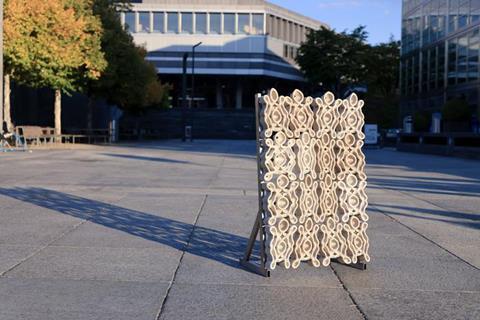
This process has been used to create a facade element, among other things. It can be used to provide protection from the sun or as a partition wall, for example.
Fully digital manufacturing
A second approach to applying biocement for architectural purposes is robotic spraying. In this technique, the researchers removed the intermediate stage of the immersion bath. A robotic arm applies bacteria, the mineralisation substances for limestone formation and sand to a surface repeatedly and one after the other, building it up in height layer by layer. This process is inspired by stromatolites, layered sedimentary rock formations that occur in nature when microorganisms deposit minerals over long periods of time.
At the 2025 Biennale Architettura in Venice, the process was left running uninterrupted for six months, letting visitors see the results for themselves. “We have proven that the entire process of biocementation can be automated,” says Antorveza Paez.
The two processes are complementary: “The printing is geared more towards architectural elements, while the spray process is more designed for surfaces,” explains Antorveza Paez. Where the focus of the printing process was on materials science – which bio-ink works and how it can be printed – the spray process was chiefly concerned with the machine itself and how to control three streams of materials. Accordingly, the two processes are at different stages of development. Antorveza Paez reports that the spray process still requires significantly more research into its mechanical properties, such as in terms of how the grains and bonding medium are arranged inside the object.
Fascinated by nature’s ingenuity
For Antorveza Paez, working with microorganisms means one thing above all else: forging a new relationship with building materials. “As an architect, you don’t normally know anything about what went into making a material – it’s manufactured somewhere else,” she says. “I’m fascinated by the fact that nature has found ways of manufacturing very sophisticated materials and that we can make these applicable to the problems we face today.”
MICROBIOLOGY NEWS: Register with The Microbiologist for more free articles
The architect is currently working on a third study concerned with the environmental impact of biocementation and finding relevant solutions. The reason for this is that ammonium, which is produced during the reaction involving the bacteria and mineralisation bath, is very damaging to the environment. As Antorveza Paez explains: “If we don’t factor the disposal of this chemical by-product into our designs, then unfortunately using biocement for construction won’t be such a sustainable practice.”
Load-bearing structures still a long way off
The researcher admits that, as things currently stand, biocementation is more along the lines of mortar than concrete. Her comparison with concrete makes it clear how much research is still needed. The formula for concrete– specifying how many grains of each size are combined and in what proportions – has been refined for over a century and continues to be fine-tuned to this day.
In the case of biocementation, this work is only just getting started: while we know that bacteria can, in principle, be combined with certain grain sizes, the question of how to use this to produce a long-lasting material that is as stable as possible is yet to be answered by research. “The big question is no longer whether biocement works, but rather how well its properties can be managed,” concludes Antorveza Paez.
References
Antorveza Paez KA, Kindler RO, Terzis D, Dutto A, Pleij T, Zorzetto G, Studart AR, Dillenburger B: 3D biocement printing: scaling up living mineral structures. NPJ Materials Sustainability 2026, 4: 20, DOI: 10.1038/s44296-026-00110-1
Antorveza Paez KA, Kindler RO, Terzis D, Lin CW, Coulter FB, Dillenburger B: Robotic biocementation spraying: a bioinspired fabrication method for architectural surfaces. Architectural Intelligence 2026, 5: 11, DOI: 10.1007/s44223-026-00120-y
Antorveza Paez KA, Huang S, Yeh KH, Seav K, Dillenburger B. Design workflow for porous 3D-printed biocement geometries. Biotechnology Design. 2026, 4: 40, DOI: 10.1017/s2977905726100286




No comments yet