
Plants interact closely with the microbes living around their roots—a zone known as the rhizosphere. Through root exudates, they can attract beneficial bacteria that help them take up essential nutrients. One such group of natural compounds is phytosiderophores, like 2’-deoxymugineic acid (DMA), which are mainly secreted by grass species to acquire iron. But can a synthetic version of these compounds do more than feed plants—can it actively shape the microbial communities that support plant growth?

A study published in Frontiers of Agricultural Science and Engineering has explored this question (DOI: 10.15302/J-FASE-2023531). Researchers examined how a DMA analog called proline-2’-deoxymugineic acid (PDMA) influences the rhizosphere microbiome of peanut plants. While previous studies confirmed that PDMA improves iron nutrition, its effect on the composition and function of soil bacteria remained unclear.
The research showed that PDMA significantly altered the bacterial community structure in the peanut rhizosphere. It specifically increased the abundance of beneficial microbes, particularly those within the phylum Actinobacteria. Six bacterial genera were enriched under PDMA treatment, including Cellulosimicrobium and Marmoricola, both known to enhance the availability of micronutrients like iron and zinc.
Nutrient levels
Notably, these changes were linked to improved nutrient levels. Peanut plants treated with PDMA had higher concentrations of nitrogen, calcium, boron, and zinc. The soil also showed increased levels of zinc and copper. This suggests PDMA works both by directly activating soil nutrients and by recruiting microbes that further support nutrient uptake.
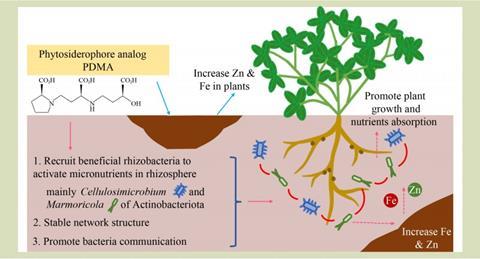
The study also revealed that PDMA promoted a more connected and stable microbial network. The bacterial community under PDMA treatment formed more interactions and contained a greater number of keystone taxa—species that play critical roles in maintaining network structure. Functional predictions indicated that PDMA enhanced processes related to environmental information processing and cellular communication.
This work provides early evidence that a phytosiderophore analog can positively reshape the rhizosphere microbiome in a non-grass crop. By demonstrating how PDMA enriches beneficial Actinobacteria and fosters a stable microbial network, the study offers insights into how synthetic biology could contribute to sustainable agriculture. These findings support further investigation into PDMA-based fertilizers that work in concert with soil microbes to improve crop nutrition.







No comments yet