
Letters in Applied Microbiology sponsored the best oral presentation award at the 29th Brazilian Congress of Food Science and Technology (CBCTA 2024). Winner Isabella Bassoto Xavier and runner-up Lia Mariano Aquino take a dive into their research.
Isabella Bassoto Xavier (25), from Brazil
Winner: Behaviour of Salmonella enterica serovar Enteritidis in a mustard microgreen cultivation system
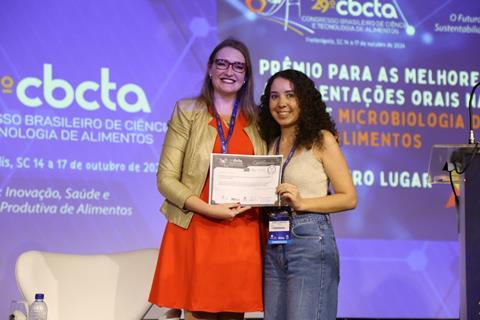
I am a student in the Food Science program at the Faculty of Pharmacy, Universidade Federal de Minas Gerais (UFMG). During my master’s degree, my research focused on the behavior of Salmonella in microgreens, particularly sunflower and mustard microgreens. Now, in my Ph.D., I am focusing on the application of emerging technologies for postbiotic production.
Microgreens are gaining popularity due to their high nutritional value, but their cultivation conditions (warm, humid environments) favor microbial growth. Salmonella is a major foodborne pathogen linked to fresh produce outbreaks. My research aimed to understand Salmonella’s ability to grow in microgreen cultivation systems, transfer to the plants, and persist post-harvest.
My work addresses the microbial risks in microgreen cultivation, particularly the behavior of Salmonella enterica. I aimed to understand how Salmonella behaves in both the substrate and microgreens under controlled conditions and how mathematical models can predict these behaviors to optimize food safety strategies.
Microbial risks
I evaluated microbial risks in microgreens by first analyzing commercial samples from local producers. The microbiological assessment included counting Enterobacteriaceae and detecting Salmonella presence. The results showed variability in contamination levels both between species and within the same species, with some microgreens testing positive for Salmonella, highlighting the need for strict food safety measures.
Next, I conducted a controlled study to simulate Salmonella Enteritidis contamination in sunflower and mustard microgreens. S. Enteritidis was inoculated into the substrate, and its dynamics were monitored in both the substrate and microgreens over time using predictive microbiology models. The results revealed that S. Enteritidis grew unexpectedly in the substrate, reaching high levels. For sunflower microgreens, the S. Enteritidis population declined. In mustard microgreens, the S. Enteritidis population remained constant until the last day, when a slight reduction was observed. After cultivation, storage at 5°C showed that S. Enteritidis persisted for 7 days in mustard, whereas in sunflower, a more significant reduction was observed over 14 days of storage. These findings suggest that pathogen persistence varies between plant species and storage conditions, underscoring the importance of monitoring microbial risks in microgreens.
Unexpected differences
Two aspects of the study were particularly surprising. First, the differences between mustard and sunflower microgreens in terms of Salmonella persistence were unexpected. While Salmonella remained for longer periods in mustard, sunflower microgreens exhibited a more defined decay pattern, suggesting that microgreen type influences bacterial survival. Second, I was surprised by the high population levels that Salmonella reached in the substrate. Despite an initial inoculation of 3.6 Log CFU/g, the bacterial population grew significantly, demonstrating the substrate’s capacity to support Salmonella proliferation under cultivation conditions.
Understanding microbial risks in fresh produce is crucial for ensuring food safety. This study provides valuable insights into pathogen behavior in different microgreens, supporting the development of more effective contamination control strategies and enhancing consumer protection. By applying predictive microbiology, this research demonstrates its potential as a powerful tool for assessing and managing microbial risks. A deeper understanding of pathogen dynamics in microgreens can significantly improve food safety measures, which is especially important as their popularity continues to grow worldwide.
Next steps
Future studies should investigate a broader range of microgreen varieties, contamination pathways, and environmental conditions to refine predictive models and enhance risk assessments. Expanding the application of these models to other pathogens will further improve their reliability. Additionally, developing and evaluating postharvest treatments and antimicrobial interventions will be essential for effectively reducing Salmonella contamination and ensuring the safety of microgreens in real-world production systems.
I would like to express my deepest gratitude to the UFMG and Graduate Program in Food Science for providing the academic environment and resources that made this research possible. I sincerely thank my advisor, Verônica Ortiz Alvarenga, and my co-advisor, Inayara Cristina Alves Lacerda, for their invaluable guidance, support, and encouragement throughout this study. I am also grateful to my colleagues and collaborators who contributed to this work: Ana Clara Viana and Priscyla Kim (undergraduate research assistants), Maísa Perim, Marciane Magnani, and Jerffeson Tavares for their scientific contributions and insights. This research was financially supported by the Conselho Nacional de Desenvolvimento Científico e Tecnológico (CNPq, Grants #402745/2021-3, #303384/2022-0, #404506/2023-2, and #311863/2022-1), the Coordenação de Aperfeiçoamento de Pessoal de Nível Superior (CAPES-Brazil; Finance Code 001), and the Fundação de Amparo à Pesquisa de Minas Gerais (FAPEMIG, Grants #APQ-01044-24 and “PAPG - Ciência de Alimentos”). Finally, I extend my appreciation to Kenia, Daniel, and Alysson, microgreen producers who provided essential guidance on cultivation and generously supplied microgreen samples for the enumeration of Enterobacteriaceae and the presence/absence analysis of Salmonella in commercial microgreens, greatly enriching this study.
Lia Mariano Aquino (24), from Morada Nova, Ceará, Brasil
Runner-up: Optimization and enhancement of extracellular cellulase induction medium from sugarcane bagasse-derived cellulose
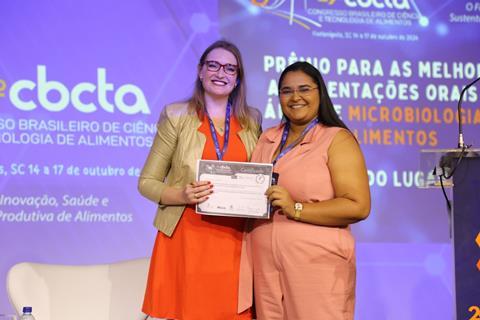
I’m a nutritionist and a master’s student in Food Technology - IFCE campus Limoeiro do Norte).
In this study, we discovered that bacteria isolated from fermented milk can degrade cellulose even in the presence of lignin, which was what made access to cellulose difficult.
The study was conducted with cellulose derived from sugarcane, which contains lignin, and even with the presence of lignin, two of the 16 bacteria isolated from fermented milk were able to degrade cellulose derived from sugarcane.
The study was initiated with industrial sustainability in mind. The sugar and alcohol industries in particular generate a lot of sugarcane residue, which is considered waste.
However, sugarcane contains cellulose, which, if degraded, can result in fermentable sugars that can be used in the food industry, such as in fermentation. In addition, these sugars can also be used in the development of biofuels.
Food waste to sugars
Thus, our study revealed that two bacteria isolated from fermented milk were able to degrade cellulose, even in the presence of lignin, which reveals the potential for using these bacteria in various industrial environments, such as using them in waste rich in cellulose, resulting in fermentable sugars, which can be used for fermentation in the food industry or for developing biofuels from waste that would otherwise be discarded.
Industries can also use these bacteria, as well as the fact that they reuse the waste with a view to sustainability, to create a competitive advantage among industrial companies, improving marketing by showing that they are concerned about sustainability and use compounds that would otherwise be discarded.
This study was developed at IFCE campus Limoeiro do Norte with professor Dr. Yago Queiroz dos Santos and students Lia Mariano Aquino, Creuza Cristiana Bezerra and Monique Melo.
We developed work focused on Food Microbiology, aiming to understand and collaborate with food and nutritional security, also focused on public health, evaluating bacterial resistance to antimicrobials, of bacteria isolated from food.


No comments yet