
Biodegradable plastics hold potential for reducing marine plastic pollution, but degrade too quickly, limiting their practical use. Researchers from Gunma University now show that crab shell by-products can reduce the breakdown rate of biodegradable plastics in seawater by altering the microbial communities that colonize their surfaces, known as the plastisphere. These findings could help design plastics that stay durable during use and then degrade at an appropriate time once in the ocean.
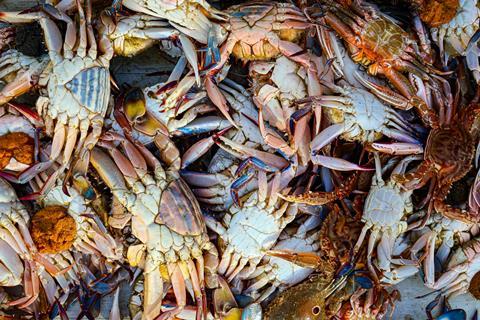
Marine pollution is one of the most pressing global concerns today, with plastic waste being a leading contributor. Biodegradable plastics are often seen as a potential solution, but their limited durability in marine environments presents a major practical challenge.
While some plastics degrade too slowly in seawater, others break down too quickly and cannot maintain sufficient strength during use. This is particularly problematic for products like fishing nets, lines, and other marine equipment that must remain functional for a certain period before safely decomposing.
To address these challenges, researchers from Gunma University, Japan, in collaboration with the Japan Agency for Marine-Earth Science and Technology (JAMSTEC), have discovered an innovative way to regulate the degradation of biodegradable plastics using crab shells, a by-product of the seafood industry.
Led by Professor Ken-ichi Kasuya from the Graduate School of Food and Population Health Sciences, Gunma University, along with Assistant Professor Phouvilay Soulenthone and Associate Professor Miwa Suzuki from the same school and institution, the study focuses on poly(3-hydroxybutyrate-co-3-hydroxyvalerate) or PHBV, a type of biodegradable plastic that is naturally broken down by microorganisms in seawater. Their study was made available online on March 24, 2026, and will be published in Volume 249 of Polymer Degradation and Stability on July 1, 2026.
“We found that seawater containing crab shell by-products reduced the rate of plastic degradation in this environment,” says Prof. Kasuya.
Sea water study
In this vein, the researchers conducted a comparative study exposing three types of PHBV samples to sea water: PHBV film alone, PHBV sandwiched directly between crab shells (PHBVSrCh), and PHBV films and crab shells added separately to a tank for indirect contact (PHBVAddSrCh). After 4 weeks, the mass loss of PHBV exposed to crab shells was 20% lower than that of PHBV alone. Even after 8 weeks, the rate of degradation remained significantly reduced.
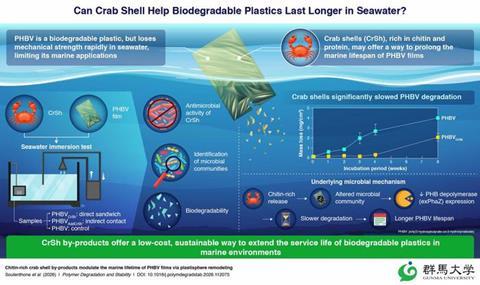
Remarkably, the effect persisted even when the crab shells were not in direct contact with the PHBV film. This demonstrates that the reduced rate of degradation was not simply due to physical shielding, but rather due to changes in the plastisphere—the microbial community formed on the plastic’s surface—that plays a key role in plastic degradation. These changes were likely triggered by the biochemical compounds released from the crab shells.
Different microbe group
Under normal circumstances, bacteria such as Oceanospirillum and Bowmanella quickly colonized the PHBV surface. However, in the presence of crab shell by-products, a different group of microbes, including Marinobacter, became dominant. This microbial shift reduced the early expression of exPhaZ, a gene encoding an extracellular depolymerase associated with PHBV degradation, thereby slowing the breakdown process.
The researchers report that this effect is triggered by the presence of chitin, a natural substance abundantly found in crab shells. Chitin serves as an easily accessible nutrient for the microbes, causing them to degrade and consume shell-derived compounds before degrading the PHBV films.
Prof. Kasuya explains, “Rather than simply making plastics degrade faster, we can now begin designing materials that last for the required period and then degrade appropriately.”
Engineering lifespan
This study introduces a new concept in sustainable material design by engineering the lifespan of biodegradable plastics to match their intended use. In the future, this approach could expand the application of biodegradable plastics in marine areas where rapid degradation has previously been a limitation.
This study also highlights a useful purpose for seafood-processing waste, turning discarded crab shells into a low-cost, sustainable resource for environmental technology—offering a novel and promising strategy aiding marine plastic pollution management with application-specific plastic designs.
Topics
- Asia & Oceania
- biodegradable plastic
- Bowmanella
- chitin
- crab shells
- exPhaZ
- Gunma University
- Japan
- Japan Agency for Marine-Earth Science and Technology
- Ken-ichi Kasuya
- Marine Science
- Marinobacter
- Miwa Suzuki
- Ocean Sustainability
- Oceanospirillum
- Phouvilay Soulenthone
- Plastic degradation
- plastisphere
- Pollution and Remediation
- poly(3-hydroxybutyrate-co-3-hydroxyvalerate)
- Research News
- Waste Management






No comments yet