
Mycorrhizal fungi form underground networks that sustain plant life and help regulate Earth’s climate by drawing carbon into soils. In a study published in Science, an international team of researchers produced the first global maps estimating the distribution and mass of the Earth’s arbuscular mycorrhizal fungal networks. Published alongside an interactive visualization that helps reveal the scale of this underground fungal infrastructure, the research will help scientists and decision makers understand where these vital fungal systems are thriving and where they are threatened.

Arbuscular mycorrhizal fungi (known as AM fungi) form symbiotic trade relationships with ~70% of plant species on Earth. The fungi provide nutrients and water in exchange for carbon produced by plants. As ecosystem engineers, these networks form a critical living infrastructure that draws carbon into soils and supports much of life on Earth.
Earlier work
Last year, in Nature, the same researchers published global analyses of the diversity patterns of underground mycorrhizal fungal communities accompanied by a digital tool, the Underground Atlas, to help decision-makers locate predicted underground biodiversity hotspots. But until now, no-one has attempted to predict and visualize the physical density and global distribution of AM fungal networks.
In addition, last year several of the same authors published a cover story in Nature in which they described how mycorrhizal fungal networks and their plant partners build hyper-efficient supply chains to trade carbon and nutrients, measuring carbon flows inside these living transport systems that can reach speeds of up to 120 um/sec. The current study is a critical step towards understanding how carbon and nutrient flows unfold on a global scale.
Fungal networks
The researchers assembled data on the density of AM networks from over 16,000 soil-cores collected across Earth. They developed machine-learning models that incorporated data layers from deserts and tundra to forests to predict network density in unsampled ecosystems. In collaboration with the Physics of Behavior group at research institute AMOLF, the team calibrated their model with robotic imaging of over 300,000 living AM fungal hyphae grown in the lab. Using these datasets, they estimate that AM fungal networks have a total length of ~110 quadrillion kilometers and a mass of ~300 megatons of carbon.
“It is hard to overstate the importance and enormity of these fungi” said lead author Dr. Justin Stewart, with the Society for the Protection of Underground Networks (SPUN). “There could be up to 10 meters of mycorrhizal network in just a teaspoon of soil.”
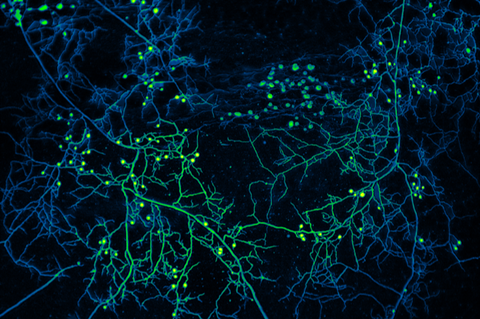
Often called one of the Earth’s circulatory systems, mycorrhizal networks move carbon, water, and nutrients across underground ecosystems. In healthy soils, mycorrhizal networks can increase the foraging area of plant roots by up to 100 times, while providing > 80 percent of a plant’s phosphorous.
“With the emergence of new technologies in high-resolution imaging, machine-learning and robotics, we are starting to reveal what has long been hidden under our feet” said co-lead author, Dr. Corentin Bisot, an AMOLF biophysicist. “We are learning how the complex bodies of network-forming fungi transport nutrients and help regulate the climate.”
The team worked with award-winning data visualization designer Moritz Stefaner to build the Mycorrhizal Infrastructure Map. It is the first time the Earth’s fungal infrastructure has been seen at this scale and resolution. The underlying data are available to download for governments and decision-makers to begin monitoring the health of critical underground fungal communities.
Climate and conservation
The study also documented potential threats. Mycorrhizal densities across croplands are predicted to be roughly half those in wild ecosystems. Wild grassland ecosystems were found to contain ~40% of the world’s arbuscular mycorrhizal biomass. Yet grasslands are among Earth’s least protected ecosystems and are being transformed into farmlands four times faster than forests. This reinforces a the researchers previous publications that show that 95% of the biodiversity hotspots for arbuscular mycorrhizal fungi are located outside protected areas.
For evolutionary biologist Dr. Toby Kiers, Executive Director of SPUN, this growing body of research is critical in developing more precise climate policies. “Fungi have been ignored in climate and conservation for too long. Now is the time to change that trajectory.”
“Mycorrhizal fungi have shaped life on earth for hundreds of millions of years, but we still understand too little about how the infrastructure of these living transport systems is distributed across the planet,” added co-author and biologist Dr. Merlin Sheldrake. “This study is an exciting step towards understanding how this planetary circulatory system operates and suggests ways that we can better work with fungi to help address many of the unfolding challenges of our times, from food security to climate change.”
This study helps quantify the extraordinary extent of AM fungal networks, but it also reveals how much remains unknown by pinpointing many regions of the planet which remain unsampled.
Topics
- AMOLF
- arbuscular mycorrhizal fungi (AMF)
- Artificial Intelligence & Machine Learning
- Corentin Bisot
- Environmental Microbiology
- Food Security & Safety
- Fungi
- Justin Stewart
- machine learning
- Merlin Sheldrake
- Moritz Stefaner
- Mycology
- Research News
- Society for the Protection of Underground Networks
- Soil & Plant Science
- soil chemistry
- soil microbial communities
- Toby Kiers
- USA & Canada







No comments yet