
Tiny plantlike organisms called phytoplankton that form the base of marine food webs topped by orcas, whales, and sharks usually get eaten or slowly sink to the seafloor, carrying carbon as they go.
Across most of the ocean, the descent from sunlit surface layers takes weeks. But in the Arctic’s Chukchi Sea, scientists have found that a convergence of currents pushes phytoplankton from under the ice to the seafloor at four times the usual speed.
Two new papers led by researchers in the lab of Stanford biological oceanographer Kevin Arrigo detail this unusual descent and reveal that blooms of phytoplankton, which use energy from the sun to grow, can be 10 times denser in the darker waters below thick sea ice than out in the open water.
Measurements gathered in the Chukchi Sea in the summer of 2023 suggest sunlight filtering in through cracks in the ice was sufficient to power photosynthesis. “We’re observing phytoplankton in huge populations underneath substantial sea ice,” said Earth system science PhD student Claudette Proctor, lead author of one of the papers published Sep. 23 in the Journal of Geophysical Research: Oceans. “They are growing in an environment that we previously thought was inhospitable.”
Microalgae making a living below ice
In a 2011 mission, Arrigo and collaborators discovered phytoplankton were blooming under Arctic ice, which has thinned and cracked over the past few decades as air and sea surface temperatures have climbed, allowing more light through.
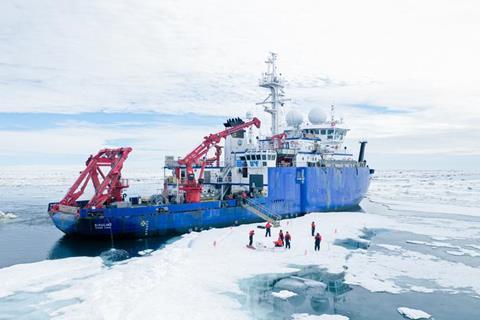
Arrigo and his team returned to the Chukchi Sea in 2023 to study the density of phytoplankton blooms and what happens to them when they die. While other research missions have sampled phytoplankton, few efforts have sampled the tiny organisms under the ice, let alone documented them across almost their entire season of growth.
“We got to see the bloom come up, peak, and then start to come down,” said Arrigo, senior author of the two papers and the Donald and Donald M. Steel Professor in the Stanford Doerr School of Sustainability. “You almost never get a chance to do that.”
Seawater samples
To study the blooms, the team took seawater samples to measure nutrients and two indicators of phytoplankton density: carbon and chlorophyll. They also placed floating sediment traps in seawater, both in open water and holes within the ice, to catch sinking phytoplankton.
Beneath the ice, the researchers observed one of the densest phytoplankton blooms ever recorded, even in areas where the ice was up to 2 meters thick. These under-ice blooms were up to 10 times more concentrated than those sampled a month later in open water, after the ice had begun to recede due to seasonal melting. The data show blooms withered and began to sink as they used up most of the nutrients, especially nitrate.
Sinking phytoplankton
Over several days, the researchers estimated how much phytoplankton by weight sank beneath the ice and in open water, and how quickly. They also compared these findings to chlorophyll and carbon in sediment samples hauled up from the seafloor to understand the connection between sinking phytoplankton and organic remains below.
Across much of the sea, the scientists found that phytoplankton sank after their blooms peaked at a rate of about half a meter a day. But in other locations, swift waters pushed the plankton down about four times faster on average due to a confluence of ocean currents called a front.
According to the authors, when plankton in cold water just below the ice drifted south with the current, they hit warmer opposing currents in the open water. The collision of currents sent them careening downward.
“That cold, salty water mass takes a dive, and the warmer, fresher water mass rides up on top,” said Earth system science PhD student James Lauer, lead author on a second paper, also published in the Journal of Geophysical Research: Oceans, focused on how currents affect the blooms.
Arctic ecosystems amid climate change
The new details of Arctic phytoplankton’s life cycle help answer questions about marine ecosystems. In previous research, scientists observed areas of the Arctic seafloor with unexpectedly high populations of clams and brittle stars, and the walruses and whales that feed on them. “The discovery that this front is rapidly enhancing rates of sinking helps to explain where the food sources to support that benthic biomass might be coming from,” said Lauer.
It’s unclear how the under-ice blooms may affect marine life closer to the surface. The blooms are a major food source for tiny drifting animals called zooplankton and species like bowhead whales that feed on them, but blooms that peak too early in summer may be gone by the time seasonal predators arrive. As the Arctic warms, “you might have bottom feeder organisms become more successful, whereas pelagic organisms might have less food,” said Proctor.
Rapid pace of warming
Researchers also have wondered how the rapid pace of warming in the Arctic – four times the global average – will affect the rate at which phytoplankton pull carbon from the atmosphere as they grow and the fate of that carbon. “Where does all that carbon go?” said Arrigo. “Does it get eaten? Does it sink to the bottom?”
MICROBIOLOGY NEWS: Register with The Microbiologist for more free articles
The findings suggest an overall increase in carbon absorbed by phytoplankton and eventually stowed away in sediments, said Arrigo. But many unknowns about the region remain. For example, warmer freshwater from ice melt could form a layer at the sea surface, blocking nutrient-rich waters below from mixing and feeding plankton, thereby limiting their growth.
The findings show how relatively small-scale occurrences like phytoplankton blooms and fronts can shape global ecology and climate. Fronts created by winds, river outflows, or currents are found throughout the oceans and may play an important role in transporting carbon to the seafloor. “We really have to consider these relatively small-scale physics when we think about the carbon cycle across the global ocean,” said Lauer.





No comments yet