
Researchers who carried out the first comprehensive study of the microbial communities living in symbiosis with deep-sea corals in one of Brazil’s most active oil- and gas-producing regions discovered that each species hosts a distinct, and sometimes highly specialised, community of microorganisms.
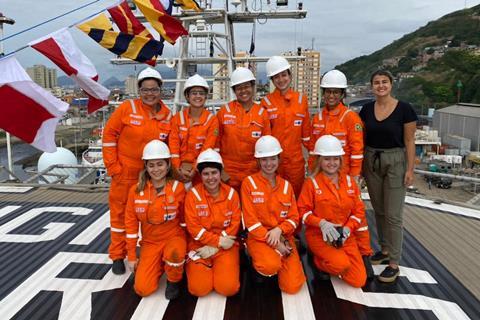
A collaborative team with researchers from Brazil (Federal University of Rio de Janeiro), and Australia (University of New South Wales), carried out the first comprehensive study of the microbial communities living in symbiosis with deep-sea corals in the South Atlantic Ocean. The study, ‘Contrasting microbiomes in deep-sea scleractinian and octocoral species from the South Atlantic Ocean’, was published in Sustainable Microbiology, an Applied Microbiology International publication.
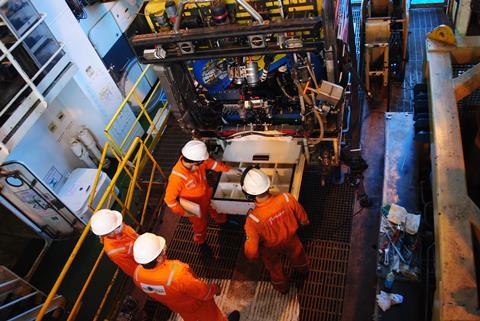
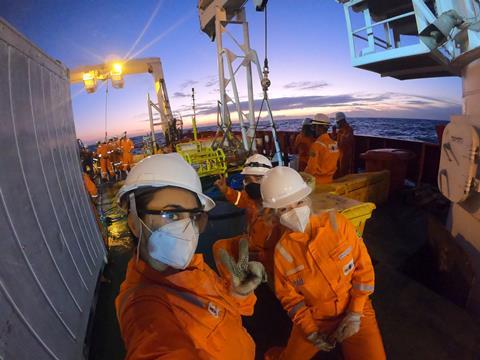
During a 10-day expedition in 2021 using a remotely operated vehicle (ROV), the team sampled six coral species at ~710 m depth in Brazil’s Campos Basin, which is one of the country’s most active oil- and gas-producing regions, and discovered that each species hosts a distinct, and sometimes highly specialised, community of microorganisms.
Prokaryote partners
Deep-sea corals create important habitat for marine life and help cycle carbon and nutrients on the seafloor, but unlike shallow-water corals, they don’t have photosynthetic algae to help them meet their energy requirements, said corresponding author Dr Lilian Hill.
Instead, scientists think their prokaryote partners (i.e., Bacteria and Archaea) play a key role in their nutrition and health.
“Despite this, almost nothing was known about the microbiomes of deep-sea corals in the South Atlantic, and octocorals (a major group of soft corals) had never been studied in this context and in this region at all. We wanted to find out whether each coral species has its own “signature” microbiome, or whether these communities are simply shaped by the surrounding seawater and sediment, and to establish the first baseline data for a region facing active oil and gas exploration,” she said.
Plunging to the depths
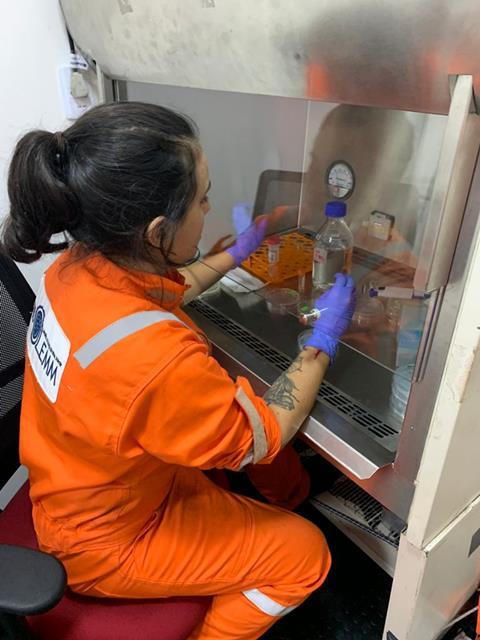
The team used an ROV fitted with custom-built sampling equipment to collect 36 coral specimens belonging to six species (two reef-building stony corals and four octocoral species), along with seawater and sediment samples from the same site. Back in the lab, they identified each coral species genetically and sequenced the microbial DNA (16S rRNA gene) present in every sample to characterise their microbial communities.
“We found that every coral species carried a microbiome clearly different from the surrounding water and sediment. But the degree of “host control” over these communities varied enormously,” Dr Hill said.
“At one extreme, the octocoral Candidella imbricata had a highly specialised microbiome, dominated by a single bacterial family (Endozoicomonadaceae) in over 70% of its community on average, and the lowest diversity of any sample type. At the other extreme, the widespread stony coral Desmophyllum pertusum had a microbiome that overlapped broadly with that of the surrounding environment (though it did selectively favour one bacterial family known to include hydrocarbon-degrading species, the Haliaceae family).
“The other two coral groups fell in between these two extremes, essentially forming a continuum, from “specialist” to “generalist” microbiomes, across coral species living side by side in the same environment.”
Sheer contrast
The team were surprised by the sheer contrast between coral species living in exactly the same patch of seafloor, yet differing so strongly in how tightly they control their microbial partners, from specialisation to overlap with the environment.
“We were also intrigued that D. pertusum selectively enriched a bacterial family with known hydrocarbon-degrading members, raising the hypothesis — still to be tested — that its microbiome may help it cope with the hydrocarbon-rich conditions typical of an active oil and gas basin,” said Dr Hill.
“The Campos Basin is both an ecologically important deep-sea coral habitat and one of Brazil’s busiest oil and gas production zones. By establishing the first microbial baseline for these corals, our data gives environmental managers and regulators a reference point against which to detect future shifts in coral health or ecosystem disturbance.
“Whether from oil and gas activities, climate change, or other human pressures. This is a first step toward evidence-based stewardship of a deep-sea ecosystem that is otherwise very difficult to monitor.”
Next steps
Future work should use metagenomic, functional (not just DNA-identity-based) analyses to directly test, for example, whether the hydrocarbon-associated bacteria found in D. pertusum are actually degrading hydrocarbons.
Because some of the octocoral species could only be told apart using genetic methods (they look almost identical to each other on the seafloor), the researchers also recommend future studies with larger, targeted sample sizes per species to pin down how specific their microbiomes really are. Finally, broader sampling across the South Atlantic would help confirm whether the patterns found hold up across the wider region, not just in the Campos Basin.
MICROBIOLOGY NEWS: Register with The Microbiologist for more free articles
The study was led by Dr Lilian J. Hill, affiliated to the Federal University of Rio de Janeiro, Brazil, at the time of the study, and now affiliated to the Oceanographic Institute of the University of São Paulo, Brazil; and Dr. Taissa Damasceno, Federal University of Rio de Janeiro, Brazil; now affiliated to the University of Perpignan, France; together with Prof. Raquel Silva Peixoto, Federal University of Rio de Janeiro, Brazil, and KAUST, Saudi Arabia; and Prof. Torsten Thomas (University of New South Wales, Australia, who jointly supervised the project. The team also included Alessandro N. Garritano, Flúvio Modolon, Laenne Medeiros, Caren Leite Spindola Vilela, and Gustavo Duarte. The expedition and research were funded through the ANP-registered project “PROBIO-DEEP” (UFRJ/Shell Brasil/ANP), with additional support from a KAUST grant to Prof. Peixoto.
‘Contrasting microbiomes in deep-sea scleractinian and octocoral species from the South Atlantic Ocean’ appears in Sustainable Microbiology.
Topics
- Applied Microbiology International
- Archaea
- Asia & Oceania
- Bacteria
- Candidella imbricata
- Community
- coral microbiome
- Desmophyllum pertusum
- Ecology
- Endozoicomonadaceae
- Federal University of Rio de Janeiro
- Haliaceae
- Lilian Hill
- Marine Science
- Ocean Sustainability
- octocoral
- Pollution and Remediation
- Raquel Silva Peixoto
- Research News
- stony corals
- Taissa Damasceno
- The Americas
- Torsten Thomas
- University of New South Wales

No comments yet