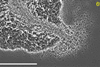
Popular science fiction is no stranger to escape pod scenarios, typically featuring characters who narrowly avoid their demise by jettisoning from a spaceship — think R2-D2 and C-3PO shooting away from a rebel spaceship in the opening of Star Wars: A New Hope. Biologists at the University of California San Diego have found that communities of bacteria feature a similar ejection capability.

Groups of bacteria known as biofilms thrive in surfaces all around us. These microscopic clusters are abundant in aquatic environments, from the slick surface of lake rocks to the slimy buildup in plumbing pipes. Biofilms also inhabit select parts of our bodies, including our skin and the surfaces of our teeth.
UC San Diego scientists from Professor Gürol Süel’s laboratory in the School of Biological Sciences documented the biofilm ejection phenomenon for the first time while studying a bacterium known as hay bacillus (Bacillus subtilis). Previous views held that biofilms facing death simply dissolved and faded away. Adding to the researchers’ surprise, they conducted a review of similar ejection capabilities across the animal kingdom and found that the only other organisms that feature similar mechanisms are jellyfish.
MICROBIOLOGY ON TAP: Get full access to all The Microbiologist articles from just £2.17 a month
“We found that at the end of their life cycles these bacterial biofilms forcefully ejected specific cells from the community,” said Süel, a professor in the Department of Molecular Biology, of the study, published July 7 in Nature Microbiology. “The biofilm senses that it is in trouble so it shoots cells out of the community like an escape pod.”
Biofilm images
The researchers, led by graduate students Todd Kwang-Tao Chou and Alejandra Dau-Martinez, employed high-resolution instruments that captured biofilm images at single-cell resolution. This allowed them to conduct unprecedented studies on the extracellular matrix, or ECM, the network of molecules that connect and support cells. Mathematical modeling with colleagues at the Universitat Pompeu Fabra (Spain), allowed the researchers to deconstruct the physics of the ejection process, which was previously hidden.
The graduate students in the Süel lab then determined that the mechanical forces behind ejection are a self-generated network of polymers known as hydrogels. Specifically, the production of a polymer comprised by poly-y-glutamic acid (y-PGA) forms a hydrogel, which can absorb a thousand times its weight in water. The swelling of y-PGA then propels interior cells through the outer layers to break free from the biofilm.

The researchers say the ejection capability allows a biofilm facing nutrient starvation or other threats to ensure that the community can survive by releasing mobile cells that have the potential to swim away and colonize a new location.
“The biofilm knows it is going to die, so it ejects some of its cells so they can survive and live to fight another day,” said Süel.
Forced rupture
After breaking down the details of the ejection process, the researchers confirmed their findings by controlling and manipulating the function through genetics and chemical reactions. Importantly, the team showed that they can force the biofilm to rupture by overproducing y-PGA.
Since bacterial biofilms are highly resistant to antibiotics, posing a rising public health threat, forcing biofilms to rupture has potential for future applications as a novel method of eliminating harmful bacterial communities without the use of drugs.

“We show that biofilms can be forced to break apart without the need for antibiotics or toxic chemicals, by simply overproducing y-PGA,” the researchers argue in their study. The results could also be useful in conceptually understanding the spread of cancer, since tumors share features with bacterial biofilms, including metastasis, in which tumors release cancer cells.
The authors of the study were: Todd Kwang-Tao Chou, Alejandra Dau-Martinez, Júlia Vicens-Figueres, Arvind Gouttumukkala, Leticia Galera-Laporta, Jordi Garcia-Ojalvo and Gürol M. Süel.
This study was supported by the: National Institute of General Medical Sciences (grant R35 GM139645), Army Research Office (grants W911NF-22-1-0107, W911NF-1-0361 and W911NF261A170), Bill and Melinda Gates Foundation (INV-067331), Ministerio de Ciencia, Innovación y Universidades and Agencia Estatal de Innovación/FEDER (Spain) (project PID2024-160263NB-I00), European Research Council Synergy (grant 101167121 (CeLEARN)) and the 2024 ICREA Academy program (project 2024 ICREA 0167, Departament de Recerca i Universitats, Generalitat de Catalunya).
No comments yet