
Spruce trees have highly effective chemical defenses against herbivores and pathogens. The phloem, the living bark tissue responsible for transporting nutrients produced in the needles to the roots, is among the chemically best-protected plant tissues. The phloem lies directly beneath the protective bark and surrounds the wood.
The phloem tissue contains protective chemical substances, particularly phenolic compounds, which can account for up to five percent of the bark’s dry weight. Nevertheless, numerous fungi—ranging from pathogens to symbionts of bark beetles—successfully colonize this well-defended tissue.
“We wanted to understand the biochemical tricks these fungi use to overcome such a hostile chemical environment, especially since some of these fungi may contribute to massive bark beetle infestations destroying European forests,” says study lead author Ruo Sun, head of the project group Metabolism of spruce tree defenses.
Fungi can metabolize spruce defense compounds
The research team investigated the metabolism of various fungi using molecular biological techniques and chemical analyses. They analyzed the metabolic products of fungi grown on real spruce bark or artificial culture media. In the process, they discovered that certain fungi produce new, previously unknown compounds—but only when exposed to the chemicals found in spruce.
The scientists cultivated large quantities of these fungi, isolated the compounds, and used high-precision methods, such as nuclear magnetic resonance (NMR) spectroscopy, to determine their exact structure. Through this process, the scientists demonstrated that while some fungi break down spruce’s toxic defense compounds, the resulting products remain toxic.
Only two species of fungi go a step further by attaching a ribose, a simple sugar with five carbon atoms, to these degradation products. This process, known as ribosylation, reduces toxicity and prevents the toxic substances from being reactivated by the metabolism of another organism. The fungus that exhibited the strongest ribosylation ability grew best on spruce bark. This suggests that this ability provides a crucial survival advantage to the fungus.
IDing the sugar
“One of the major challenges was identifying the sugar component of the molecule as ribose and not glucose or another sugar. The analytical data showed that a pentose, or a sugar with five carbon atoms, was bound. However, based on the data, we could not distinguish between ribose, xylose, and arabinose since they all have the same molecular weight. It was only through extensive nuclear magnetic resonance (NMR) analyses that we were able to confirm the presence of ribose and its exact configuration,” said co-author Baoyu Hu, a doctoral student at the institute.
In ribosylation, the sugar molecule ribose is attached to specific molecules within the cell. This small change can have significant effects on processes such as cell-to-cell communication, DNA repair, and metabolic regulation. Compared to other sugar modifications, such as glucosylation, ribosylation has been less common and less studied.
“We suspect it has been overlooked until now because most researchers assumed that detoxification involved the attachment of glucose. Identifying ribose requires chemical analyses, including NMR, to distinguish it from glucose,” explains Yoko Nakamura, a research associate in the Department of Natural Product Biosynthesis who conducted the NMR analyses.
Fungal consortia as the key to overcoming spruce defense mechanisms
Not all fungi can neutralize defense compounds that contain ribose. The scientists examined twelve fungal species associated with bark beetles, including some that are not transmitted by beetles. Only two species, Coprinellus radians and Cylindrobasidium ipidophilum, exhibited this ability. This may be because ribosylation requires a great deal of energy. The fungus must “sacrifice” ribose for detoxification, which could hinder its growth. This is why this strategy is found in only a few fungal species, where it is, however, particularly effective.
Researchers have long been familiar with one of the two ribosylating fungi, Cylindrobasidium ipidophilum, found in the tunnels of bark beetles. However, the role of this symbiont remained unclear until now. The study reveals not only the ability to neutralize the spruce’s defense mechanisms, but also the underlying mechanisms behind this detoxification.
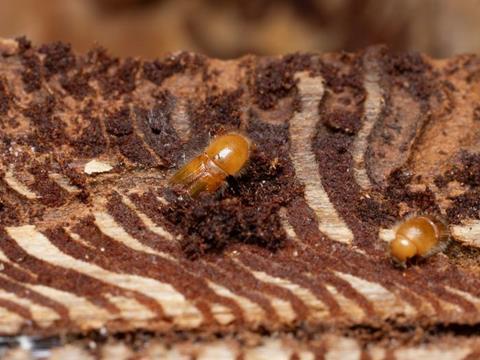
Bark beetles
By neutralizing the spruce’s defense substances, it promotes the growth of other fungi associated with bark beetles.
“If these fungi break down different parts of the spruce’s defense system, they could collectively form a consortium that overcomes the spruce’s defense mechanisms, thus holding the key to successful bark beetle colonization,” says Jonathan Gershenzon, director of the Department of Biochemistry.
MICROBIOLOGY NEWS: Register with The Microbiologist for more free articles
In future studies, the researchers plan to identify the enzyme responsible for ribosylation and determine if this ability exists in other fungal species. They also want to determine if ribosylation influences the composition of the microbiome, or the totality of microorganisms, in the bark beetles’ feeding tunnels and consequently, the beetles’ fitness. These findings could help the forestry sector develop new strategies for controlling bark beetle infestations. One possible approach would be to make specific changes to the microbial communities within spruce trees.




No comments yet