
In 2018, Sir David Attenborough was given an honorary fellowship to Applied Microbiology International in recognition of the role he’s played in raising the profile of the importance of microorganisms in the environment, as well as his contribution towards highlighting the urgent need to protect our oceans.
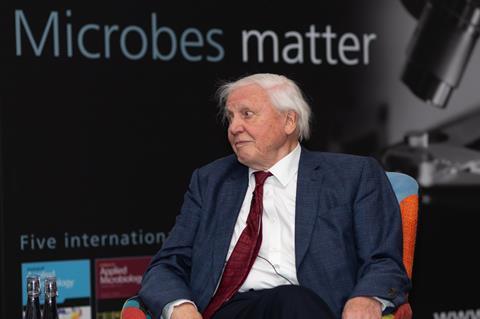
While the veteran broadcaster may be best known for ground-breaking reportage on spectacular natural phenomena and intimiate portraits of species such as gorillas and pandas, microbes were never far from view.
As Sir David Attenborough celebrates his 100th birthday today, we dig up some of his most famous quotes that celebrate the vital role that microbes and their ecosystems play on planet Earth.
The world’s ecosystems
“If a visitor from another planet were to analyse our bodies, they’d conclude that we were only 10% human. That’s because around 90% of the living cells in a human body are made up of bacteria, some of the smallest and most numerous living organisms on Earth. Yet, in spite of their abundance, we find it difficult to see any of them without the aid of a powerful electron microscope. On the head of an apparently perfectly clean pin, it is only when we magnify 10,000 times that the size of the bacteria becomes clear and we can finally see the colonies.
”There are thought to be nearly a million different types of fungi in the tropics, the vast majority still unknown to science. But one thing’s for certain. Without fungi, rainforests could not exist.”
“As the world responds to this pandemic, we must be led by the science, and the science is telling us that the destruction of nature, and encroachment of humans and industry into natural habitats, is making the emergence of new and dangerous viruses ever more likely. The finger of blame cannot be pointed at the natural world for this crisis, but in our relationship with it, and we must urgently act to create a new relationship that respects rather than exploits the wonders of nature.”
”If we and the rest of the backboned animals were to disappear overnight, the rest of the world would get on pretty well. But if they were to disappear, the land’s ecosystems would collapse. The soil would lose its fertility. Many of the plants would no longer be pollinated. Lots of animals, amphibians, reptiles, birds, mammals would have nothing to eat. And our fields and pastures would be covered with dung and carrion. These small creatures are within a few inches of our feet, wherever we go on land - but often, they’re disregarded. We would do very well to remember them.”
”In the spring, as the sun daily climbs higher in the sky, the algae start to grow. Blooms the size of the Amazon rainforest turn the seas green. Individually, the algae are tiny, but together they produce three quarters of all the oxygen in our atmosphere.”
“Every breath of air we take, every mouthful of food that we take, comes from the natural world. And if we damage the natural world, we damage ourselves.”
“The really sad thing is that scientifically, we have the answers to get all the energy we want from renewable resources. We can do that, we know how to store it, we know how to transmit it…. What we need is the engineers and the scientific engineers to work out ways in which it can done, do it, and then to organise the world, to collect energy from the sun so that what shines in the Sahara in Africa could be bought here and with the minimum loss in terms of transmission and stored for us to use. And if we did that all around the world, which is absolutely theoretically possible, the science is all there. The engineering has yet to be sorted out, but if and when we do that, then we will stop heating up the atmosphere and stop climate change. One thing that worries me about that answer is, do human beings have the common sense and the self control then to use unlimited power, which is what would come from the sun, to use it for sensible things, rather than foolish things.”
Applied Microbiology International discussion
“The living world is a unique and spectacular marvel. Billions of individuals, and millions of kinds of plants and animals …. Working together to benefit from the energy of the sun and the minerals of the earth. Leading lives that interlock in such a way that they sustain each other. We rely entirely on this finely tuned life-support machine. And it relies on its biodiversity to run smoothly. Yet the way we humans live on Earth now is sending biodiversity into a decline.”


No comments yet