
Nitrogen fertilizers are essential for crop production, but much of the nitrogen applied to agricultural soils is lost before plants can use it. These losses not only waste valuable nutrients but also contribute to environmental pollution and greenhouse gas emissions. Scientists have now discovered that adding manganese to biochar can help soil retain more nitrogen by strengthening a natural microbial process.
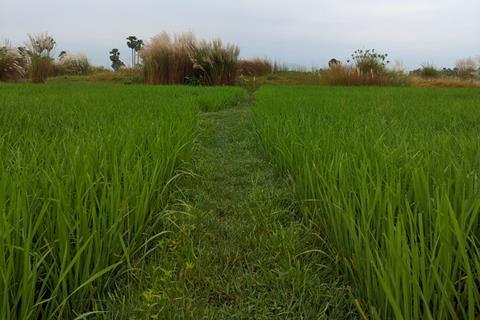
In a study published in Biochar, researchers from the Chinese Academy of Sciences and collaborating institutions demonstrated that manganese-loaded biochar increased a key nitrogen-conserving microbial process by 2.9 times compared with untreated soil, while substantially reducing emissions of nitrous oxide, a powerful greenhouse gas.
“Improving nitrogen retention is essential for making agriculture more sustainable,” said corresponding author Dan Yuan. “Our findings suggest that enhancing biochar’s ability to transfer electrons can encourage soil microorganisms to conserve nitrogen rather than allowing it to escape into the environment.”
Microbial process
The study focused on a microbial process called dissimilatory nitrate reduction to ammonium (DNRA). Unlike denitrification, which converts nitrate into gaseous nitrogen compounds that can escape from soil, DNRA transforms nitrate into ammonium, a form of nitrogen that can be retained more readily in agricultural soils.
However, DNRA requires a substantial supply of electrons, making it less competitive than denitrification under many soil conditions.
To overcome this limitation, the researchers modified wheat-straw biochar with manganese, a naturally occurring element capable of switching between different oxidation states. These manganese compounds act as electron-transfer facilitators, helping microorganisms access the electrons needed to convert nitrate into ammonium.
Striking improvements
Laboratory experiments using paddy soil revealed striking improvements. Manganese-loaded biochar increased the material’s electron exchange capacity by approximately 80% compared with unmodified biochar. The proportion of nitrate reduction directed toward DNRA increased from 2.0% in untreated soil to 10.8% following manganese-loaded biochar application.
Even more importantly, cumulative nitrous oxide emissions decreased from 17.6 to just 1.9 milligrams of nitrogen per kilogram of dry soil, representing an approximately 89% reduction under the experimental conditions.
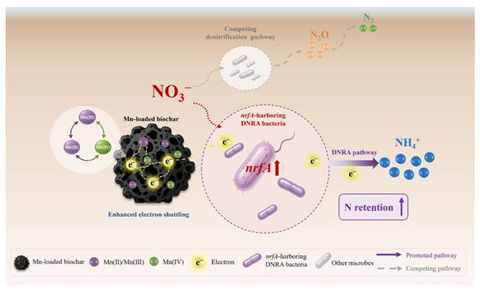
The researchers also discovered that manganese-loaded biochar changed the soil microbial community. It promoted bacteria associated with DNRA and increased expression of the nrfA gene, a key biological marker of nitrate-to-ammonium conversion.
Mobilizing carbon
Further analysis suggested that manganese helps mobilize naturally occurring soil organic carbon, providing additional electron donors without measurable carbon loss during the incubation period. Together, these effects create more favorable conditions for nitrogen-conserving microorganisms.
“Our results show that biochar can do more than simply improve soil properties,” said corresponding author Shuping Qin. “By regulating electron transfer and microbial activity, we may be able to guide soil nitrogen transformations toward pathways that better conserve nutrients.”
MICROBIOLOGY NEWS: Register with The Microbiologist for more free articles
The findings offer a promising strategy for improving fertilizer efficiency and reducing agriculture-related greenhouse gas emissions. However, the experiments were conducted under controlled laboratory conditions. Further field studies are needed to assess long-term effectiveness, environmental safety, and performance across different soil types.
By combining material engineering with soil microbiology, this research highlights a new approach to managing agricultural nitrogen through the soil’s natural microbial processes.
Topics
- Agriculture
- Asia & Oceania
- biochar
- Climate Action
- Dan Yuan
- dissimilatory nitrate reduction to ammonium
- Food Security
- Healthy Land
- Institute of Genetics and Developmental Biology
- Institute of Genetics and Developmental Biology of the Chinese Academy of Sciences
- manganese
- nitrous oxide
- Research News
- Shuping Qin
- Soil & Plant Science





No comments yet