
Biochar, a charcoal-like substance made from biomass, offers a promising pathway for storing carbon in agricultural soils, helping to offset climate change. Despite its potential, the precise mechanisms, particularly the role of diverse microbial communities, influencing its long-term effectiveness remain poorly understood.

A comprehensive analysis, published in Carbon Research, examines how biochar application impacts soil organic carbon (SOC) sequestration in Chinese croplands, shedding light on the critical interactions with soil microorganisms.
Researchers from Northwest A&F University compiled an extensive dataset from 90 prior studies conducted across China, incorporating 392 observations and over 2600 data points related to SOC and microbial characteristics.
Their meta-analysis combined quantitative data extraction, geographical mapping, and linear mixed-effects modeling to spatially predict carbon sequestration rates and explore the nuanced responses of soil microbial communities to varying biochar application rates and durations. This robust approach allowed for a broad assessment of biochar’s impact across diverse Chinese agricultural regions.
Regional carbon gains and microbial dynamics
The study determined that biochar application generally increased SOC stocks in China’s croplands, estimating a national mean cumulative SOC sequestration of 128.9 Tg C, equivalent to an annual rate of 0.42 Mg C ha⁻¹ yr⁻¹. Significant regional variations were observed, with hotspots of carbon gain concentrated in Northeast, Northwest, and Southwest China. Interestingly, the research found that microbial trophic strategies significantly influenced these carbon gains, acting as a key regulator in soil carbon cycling.
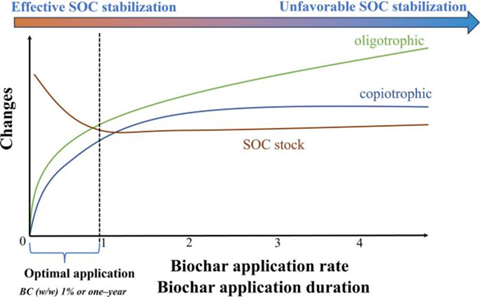
A central finding highlights a dynamic shift in microbial community composition over time and with increasing biochar application rates. Initially, biochar stimulates copiotrophic microbes that thrive in nutrient-rich environments and rapidly accumulate carbon. However, as application duration increases and biochar ages, communities tend to shift towards oligotrophic taxa. These slower-growing microbes primarily degrade recalcitrant organic matter, leading to a decline in the net carbon retention capacity of the soil ecosystem.
Towards smarter biochar management
The findings advocate for adaptive management strategies to maximize biochar’s carbon sequestration benefits. Increasing biochar application rates indefinitely does not lead to proportionally greater efficiency; higher rates beyond a certain threshold yield diminishing returns and can trigger unfavorable microbial shifts.
Instead, the research recommends a moderate biochar application strategy that captures early SOC gains while avoiding the reduced carbon-use efficiency associated with excessive inputs and prolonged application. In regions with intrinsically weaker SOC responses, such as humid, acidic coastal areas, combining biochar with other soil improvement measures like liming or nutrient co-application is suggested to enhance effectiveness.
While offering significant insights, the work acknowledges certain limitations. Projections primarily focused on a single biochar application and the top 0–15 cm soil layer. The use of phylum-level taxonomic categories might also mask some finer-scale microbial functional variations. Future research should investigate repeated application scenarios, deeper soil carbon responses, more balanced bacterial-fungal datasets, and finer taxonomic or functional resolution of microbial data to paint a more complete picture of biochar’s long-term environmental impact.
“Our analysis reveals that the true potential of biochar for carbon sequestration is intrinsically linked to the hidden world of soil microbes,” says Lei Deng, a corresponding author from Northwest A&F University. “By understanding how these tiny organisms respond to biochar, we can design more effective, region-specific strategies to lock away carbon and build healthier agricultural soils for the future.”






No comments yet