
A new study, published in Biocontaminant, has revealed that natural plant extracts can significantly lower the risks posed by human bacterial pathogens in manure amended agricultural soils. The research highlights an eco friendly strategy to protect food safety by disrupting the communication systems that bacteria use to coordinate harmful activities.
Human bacterial pathogens often enter soil through livestock manure, carrying antibiotic resistance genes, virulence factor genes, and mobile genetic elements. These biological contaminants can migrate to crops, threaten human health, and contribute to the global rise of antibiotic resistance. Developing practical, low cost, and safe interventions has been a long standing challenge.
READ MORE: Add some spice: Curcumin helps treat Mycobacterium abscessus
READ MORE: Thyme essential oil inhibits staph biofilm formation
In the new study, researchers investigated three widely studied plant derived compounds, curcumin, andrographolide, and thymol. By combining soil microcosm experiments, pure culture tests, and molecular docking analyses, the team found that all three extracts significantly reduced the abundance and risk of pathogens by interfering with quorum sensing, the chemical language bacteria use to regulate group behavior.
Silencing bacteria
“Our findings demonstrate that plant extracts can suppress harmful bacteria not by killing them directly, but by silencing their ability to communicate,” said lead author Fangjie Guo. “This communication breakdown weakens the pathogens and reduces the spread of antibiotic resistance.”
Across twelve weeks of soil incubation, the plant extracts lowered the relative abundance of human bacterial pathogens by more than twenty five percent. At the same time, antibiotic resistance genes decreased by about twenty to twenty seven percent, virulence factor genes by seven to eleven percent, and mobile genetic elements by twenty five to thirty four percent. These reductions indicate strong potential for limiting bacterial survival, pathogenicity, and gene transfer within soil communities.
The key mechanism behind this effect is quorum sensing interference. Many soil pathogens use signaling molecules, especially acyl homoserine lactones, to coordinate biofilm formation, virulence expression, and the horizontal gene transfer of resistance traits. The study found that plant extracts significantly reduced the concentration of these signaling molecules in soil and down regulated dozens of genes related to signal synthesis and reception.
“Plant extracts effectively interrupt the conversations bacteria rely on,” explained co first author Kun Lu. “Once communication collapses, the pathogens lose their ability to form stable biofilms and exchange resistance genes.”
Biofilm inhibition
Pure culture experiments confirmed that the extracts strongly inhibited biofilm formation in Pseudomonas aeruginosa and Acinetobacter baumannii, two clinically important pathogens. The extracts also reduced the secretion of virulence factors including elastase, pyocyanin, and rhamnolipid.
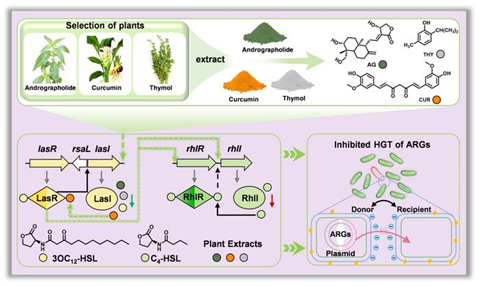
To further uncover the structural basis of these effects, the team used molecular docking to examine how plant compounds interact with LasR, a key quorum sensing receptor protein. The results showed that curcumin, andrographolide, and thymol bind strongly to LasR, often more tightly than the natural signaling molecule itself. This competitive binding likely prevents the receptor from activating downstream genes that drive pathogenic behaviors.
Senior author Meizhen Wang said, “The strong binding between plant extracts and quorum sensing proteins provides an exciting direction for developing green strategies to control soil borne microbial risks. These natural compounds are inexpensive, accessible, and environmentally friendly.”
Soil conditions
The researchers note that long term soil conditions may influence the stability and antibacterial activity of plant extracts. Future studies will explore how soil properties regulate the balance between direct antibacterial effects and quorum sensing inhibition.
This work provides important insights into how plant derived molecules can be used to reduce microbial hazards in agricultural environments and offers promising support for the development of sustainable soil remediation technologies.






No comments yet