
A new study is the first to report a shelled microbial eukaryote housing a flagellated microbial eukaryote. This shows there is much we do not know about the microbial world.
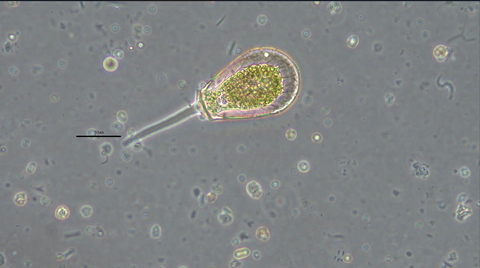
VIDEO: A testate amoeba with flagellates swimming around inside its shell. Video credit: Godwin Ani
Shelled amoeba which live in acidic environments have been studied since the 1800s, and in different parts of the world. This is because of their importance in environmental science as bioindicators of environmental and climate change, in paleontology as their shell makes good fossils with the oldest being 780 million years old, and in biology for their evolution and biodiversity.
MICROBIOLOGY NEWS: Register with The Microbiologist for more free articles
Despite extensive study of these organisms, there has been no record of any flagellate relationship - until a pair of scientists uncovered this relationship while sampling for single-cell eukaryotes at Acadia National Park, Maine, USA.
”We used single-cell transcriptomics to identify and describe this relationship because these amoeba are uncultivable (they cannot be grown in the lab and die outside their natural habitat-Sphagnum moss), making culturing and microscopy inadequate for studying them,” said first author, University of Massachusetts Amherst PhD student Godwin Ani.
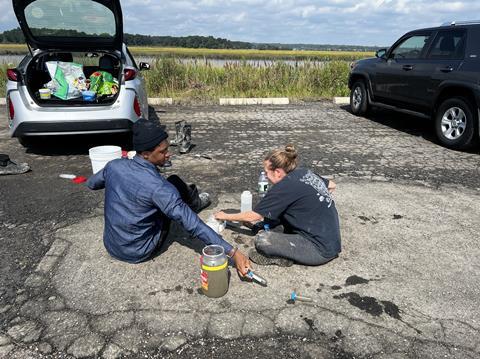
”This involves starting the sequencing process soon after their collection. We routinely take our microscopes and materials during our sampling trips, and set up a makeshift lab at a motel. We also bring back the moss in which these amoebas live back to the lab.”
Unknown microbial relationship
Overall, this discovery identifies an unknown microbial partnership in shelled amoeba, identifies an undescribed flagellate species, and shows how modern methods like single-cell sequencing can reveal microbial relationships for which traditional methods like microscopy and culturing are ill-suited. It also highlights how little we know about the hidden world of microbial eukaryotes.
“Because genomic data is currently unavailable for both this shelled amoeba and the flagellate species, subsequent research should focus on obtaining these. Acquiring this data will enable a more comprehensive characterization of their interaction and determine the mechanisms that allow the flagellate survive in the amoeba shell without being engulfed,” said Godwin.
The study was led by Godwin Ani and Laura Katz, both scientists from University of Massachusetts Amherst and Smith College, USA, and funding was provided by the National Science Foundation (NSF), USA.



No comments yet