
In the Democratic Republic of the Congo, Ebola is spreading at a frightening rate, infecting more than 10,000 people and killing nearly 5,000. Sparked by the rare Bundibugyo virus, it’s the deadliest outbreak of the disease in the nation’s history and has quickly spilled over Congo’s borders.
But there are no approved vaccines or treatments—yet.
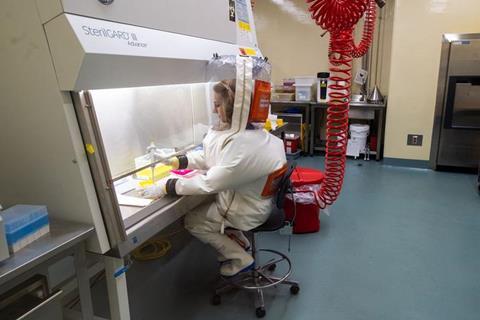
At Boston University’s National Emerging Infectious Diseases Laboratories (NEIDL), researchers are working to change that. They’ve joined an international effort to develop and test a new vaccine.
It’s part of the research hub’s broader mission to better understand and take down major threats to domestic and global health—a charge that has been given extra impetus with $57.5 million in new funding from the National Institute of Allergy and Infectious Diseases.
The award will help the biocontainment lab “develop and maintain the research resources and facilities needed to meet national, regional, and local biodefense and emerging infectious diseases research needs,” according to the National Institutes of Health (NIH).
The NEIDL’s Biosafety Level 4 (BSL-4) status—the most stringent criteria for biological containment—has enabled researchers to advance studies on Ebola, Marburg, Zika, and other priority pathogens in a highly secure and protected environment. During the COVID-19 pandemic, BU researchers illuminated the SARS-CoV-2 virus’ inner workings and weaknesses—and showed new pathways for curtailing its spread and impact. Among its current projects are studies of potential antibody and small molecule treatments for dengue, a mosquito-borne virus once effectively eradicated from the US thanks to improved living conditions, but currently sickening hundreds in Florida.
“Americans face a growing threat from new, emerging, and reemerging infectious diseases,” says Robert A. Davey, NEIDL interim director and a BU Chobanian & Avedisian School of Medicine professor of virology, immunology, and microbiology. “This award recognizes the NEIDL’s expertise and its role as a national resource, providing safe and secure high-containment facilities where our researchers work to address these threats.”
Helping Develop New Tests, Vaccines, and Medicines
The new five-year funding will directly support the NEIDL’s operations, including biosecurity systems and biosafety programs, facility maintenance, strict regulatory compliance and oversight, specialized biocontainment training, and advanced technical research support services. In 2024, the NIH awarded the lab $7.5 million to modernize its facilities and broaden the impact of its work. The NEIDL, which was completed in 2009, is just one of two national biocontainment labs in the United States.
“This award is a significant investment in the NEIDL and in the people, facilities, and expertise that make this highly specialized research possible,” says Kenneth Lutchen, BU’s vice president and associate provost for research. “It demonstrates BU’s ability to build and sustain the kind of research infrastructure needed to take on complex challenges at a national scale.
“Investments like this strengthen our capacity for ambitious, collaborative research and position BU to pursue major opportunities in the years ahead.”
Scientists at the lab have led dozens of studies into disease-causing pathogens, helping spur the development of new diagnostics, vaccines, and therapeutics designed to curb them. Recent projects have looked at how mosquitoes spread disease and how the dengue virus replicates, developed lab models to provide an early testing ground for new vaccines, and begun exploring a system that combines the strengths of messenger RNA (mRNA) vaccines and antibodies.
US Senator Ed Markey (Hon.’04) (D-Mass.) says the new grant speaks to the “important work Boston University scientists are doing” at the NEIDL. He frequently refers to Massachusetts as “the Brain State” and says the lab’s research affirms that: “The bright minds at the NEIDL are keeping all of us safer from future pandemics—we must ensure this funding continues.”
A Local and National Resource
The facility isn’t just a hub for BU researchers. It attracts scientists and healthcare companies from across the country and around the world, eager to tap into its secure investigative capabilities and expertise. The latest Ebola work, for example, is being run in conjunction with a major vaccine producer.
MICROBIOLOGY NEWS: Register with The Microbiologist for more free articles
“Massachusetts companies have access to capabilities here that they could never build on their own, and NEIDL is one of the clearest examples,” says Kendalle Burlin O’Connell, CEO and president of MassBio, a nonprofit supporting the Massachusetts’ life sciences industry. “As one of only two national labs of its kind, it gives our biotech community the high-containment facilities and expertise needed to develop vaccines, diagnostics, and treatments for emerging infectious diseases. Sustaining that infrastructure and the specialized workforce behind it keeps us ready for the next outbreak and ensures this critical research stays in the United States.”
Davey says that safeguarding the health of citizens across the globe is a powerful motivation.
“From partnering with local and national health departments to identify and characterize new threats, to working with industry partners to translate the latest treatments and cures into practice,” he says, “we’re proud to play a role in keeping Americans safe and protecting the lives of people around the world.”

No comments yet