
When pathogens leap between species, the textbook cases are terrestrial: influenza from birds, Ebola from wildlife, SARS-CoV-2 at a market.
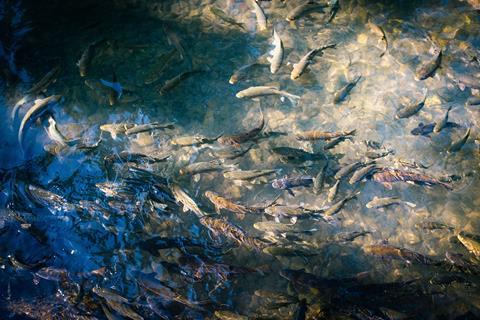
A review in The Innovation Water argues that another arena deserves equal attention — water, where the world’s fastest-growing food production sector raises billions of animals at high density, and where viruses move readily among fish, amphibians, reptiles and crustaceans.
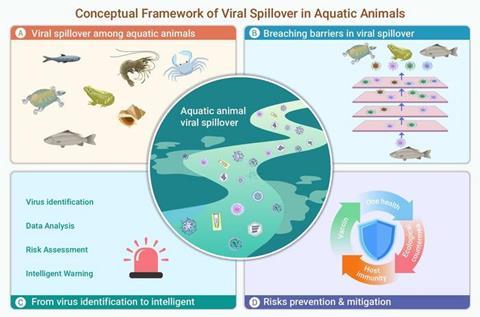
Virologists Qi-Ya Zhang, Fei Ke and Jian-Fang Gui at the Institute of Hydrobiology, Chinese Academy of Sciences, have spent decades cataloguing aquatic viruses. Their review frames “viral spillover” — cross-species transmission that establishes infection in a new host — as a frequent event in aquaculture, not a rare curiosity.
Multi-host viruses
Documented multi-host viruses include rhabdoviruses, herpesviruses, iridoviruses, tilapia lake virus, white spot syndrome virus and aquatic reoviruses, and spillover is not limited to one-virus-one-host pairs: a single virus can infect many species and cross farmed-wild boundaries.
The review’s centerpiece is the ranavirus, an iridovirus family member that has been detected in more than 170 aquatic animal species worldwide. Ranaviruses hop repeatedly among fish, amphibians and reptiles; ranavirus-associated infections have contributed to declines in some wild frog populations.
Mechanistically, work by the group and others shows that viruses from different host origins can exploit heparan sulfate on the surface of diverse aquatic animal cells — ranavirus from frogs infects giant salamanders, and salamander-origin virus infects frogs — a receptor-level flexibility that lowers one of the usual barriers to host switching.
The World Organisation for Animal Health now lists ranavirus as a notifiable pathogen, and China includes it in its national aquatic animal disease list.
Barriers to spillover
The authors distill spillover into four barriers a virus must cross: amplification and mutation within a natural host; contact with and adaptation to a new species through shared or compatible receptors; defeat of species incompatibility, immune defenses and host restriction factors; and finally a population-level epidemic threshold beyond which disease sustains transmission.
Framing the process this way, they argue, turns diffuse risk into mappable checkpoints — each a target for surveillance or intervention.
MICROBIOLOGY NEWS: Register with The Microbiologist for more free articles
Their proposed response runs on two tracks. Early warning would fuse multi-source data — pathogen detection, host movements, environmental conditions — into modeling and machine-learning platforms. Prevention would follow the One Health concept, combining pathogen suppression, vaccination and host immunity with ecological countermeasures rather than treating farms in isolation.
The review is qualitative: it maps risks and frameworks rather than quantifying which viruses are closest to jumping into new hosts or humans. The authors note that aquatic viral spillover remains “noticeably missing from global discourse” despite aquaculture supplying a large share of animal protein worldwide, and they call for strategic investment in monitoring and open data sharing. For a sector already losing substantial production to viral disease, the argument lands cleanly: catch the next spillover in the water, not after.
Topics
- Aquaculture
- Asia & Oceania
- Chinese Academy of Sciences
- Clean Water
- Emerging Threats & Epidemiology
- Fei Ke
- Food Security
- heparan sulfate
- Infection Prevention & Control
- Infectious Disease
- Institute of Hydrobiology,
- Jian-Fang Gui
- Ocean Sustainability
- Qi-Ya Zhang
- ranaviruses
- Research News
- Veterinary Medicine & Zoonoses
- viral spillover
- Virology
- Viruses






No comments yet