
Facing the environmental pollution challenges posed by uranium mining, traditional physicochemical treatment methods often encounter issues such as high costs and secondary pollution.

While microbial remediation technologies are cost-effective and environmentally friendly, their efficiency is often limited by the slow electron transfer rate of microorganisms themselves. How to break through this bottleneck to achieve efficient and sustainable uranium pollution control is a major challenge in the field of environmental science.
Recently, the research team of Professor Wenkun Zhu from Southwest University of Science and Technology made a significant breakthrough. They successfully constructed a novel, self-regenerating “bacteria-mineral” biohybrid system that can utilize light like a solar cell, greatly enhancing the purification efficiency of uranium pollution. The related research findings have been published in Science Bulletin.
The core of this system is a bacterium named Shewanella putrefaciens, which naturally possesses the ability to reduce heavy metals. The innovation of the researchers lies in utilizing the metabolic activity of the bacteria to grow a dense layer of ferrous sulfide nanoparticles in-situ on the cell surface. These tiny semiconductor mineral particles closely integrate with the bacteria, forming a naturally compatible “biohybrid”.
Solar energy converters
The study found that under light conditions, these ferrous sulfide nanoparticles act as “miniature solar energy converters”. They can absorb light energy and generate photoelectrons, which can be directly used to reduce soluble hexavalent uranium attached to the bacterial surface, converting it into relatively immobile and low-solubility tetravalent uranium precipitate, thereby achieving efficient immobilization.
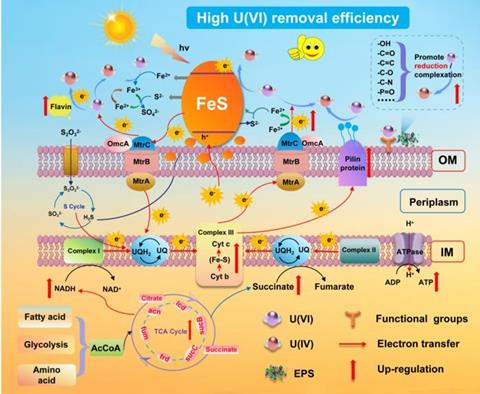
More ingeniously, this system forms an efficient “transmembrane electron channel”. Photoelectrons can not only directly reduce uranium but can also be absorbed by the bacteria, significantly enhancing their intracellular metabolic activity and energy levels.
In turn, the metabolically enhanced bacteria can produce more electrons to reduce the oxidized ferric iron back to ferrous iron during the reaction, thereby achieving self-regeneration of the ferrous sulfide active sites. This synergistic effect allows the system to maintain excellent performance even after multiple consecutive treatment cycles.
Outstanding performance
In practical application tests, this biohybrid system demonstrated outstanding performance. When treating actual uranium mine wastewater, its uranium removal rate reached 94%, far exceeding the 48% removal capability of the original bacteria. Furthermore, the toxicity of the wastewater treated by this system to crop growth was significantly reduced, demonstrating good environmental compatibility.
READ MORE: Microbial teamwork slashes uranium pollution in just 48 hours
READ MORE: Harnessing marine microbes for bioremediation: cleaning up ocean pollutants
“The significance of this work lies in the fact that it is not simply mixing mineral materials with bacteria, but creating a closely integrated and synergistic ‘life-non-life’ composite through in-situ biosynthesis”, explained one of the corresponding authors of the paper. “It provides new insights into understanding the electron transfer mechanisms in the interactions among light, minerals, and microorganisms in nature, and also offers new theoretical references and technical pathways for developing sustainable and efficient in-situ bioremediation technologies”.
Institutional profile
The Key National Defense Discipline Laboratory of Nuclear Waste and Environmental Safety at Southwest University of Science and Technology is an important base conducting cutting-edge fundamental and applied research addressing major national needs in nuclear environmental safety.
The laboratory possesses profound research expertise in areas such as radioactive pollution control, environmental radiochemistry, and radionuclide migration behavior. It is dedicated to providing scientific and technological support for solving key environmental issues in the sustainable development of nuclear energy.




No comments yet