What if fog isn’t just misty air, but a living ecosystem?

This question hung over cloud researcher Thi Thuong Thuong Cao. As a PhD student at Arizona State University, her curiosity led her from knocking on the doors of microbiologists and chemists, to sampling fog before sunrise in Pennsylvania, to hours of peering through a lab’s microscope. And she found her answer.

Low-Res_Fog-equipment

Source: Thi Thuong Thuong Cao

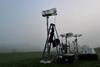
To collect samples of fog in still air, Cao worked with Derek Straub, an associate professor at Susquehanna University in Pennsylvania, where this type of fog is common near the Susquehanna River. Pictured: the fog sampling equipment set up in a foggy field in Pennsylvania.

Her ASU research team found that bacteria floating in tiny fog droplets are alive, growing and (quite helpfully) breaking down pollutants in the air.

The study, published this week in mBio, changes how we think about fog. It’s not a sterile mist, nor is it a sea of microbes in limbo. It’s a temporary water habitat for little friends that clean the air we breathe.

Living in a fog

Scientists have known for a while that bacteria drift around in the air and clouds. What they do there, however, is still somewhat of a mystery — especially in fog.

“There’s very limited knowledge about what kinds of bacteria are present in fogs, which are like clouds at the ground level,” says Cao, the paper’s lead researcher.

Cao was a PhD student in the School of Molecular Sciences during the project and has since graduated. She is now a postdoctoral researcher at Virginia Tech.

She focused on two questions: Which bacteria are present in fog? And are they active and growing inside those droplets?

Droplets are a habitat

“If they are growing, then the droplets are a habitat. That’s a mindset change,” says Ferran Garcia-Pichel, a co-author and the director of the ASU Biodesign Center for Fundamental and Applied Microbiomics.

The team found that fewer than 1% of fog droplets contain bacteria. But averaged together, they represent an astounding amount of life.

“When you take all of the droplets together, the concentration of bacteria is the same as in the ocean,” says Garcia-Pichel, also a Regents Professor in the ASU School of Life Sciences. A thimble’s worth of fog water has some 10 million bacteria.

Rising methylobacteria 

One group of bacteria stood out: methylobacteria. Samples of dry air collected before fog events contained less of these bacteria than samples collected immediately after. That suggests fog briefly boosts their numbers.

Methylobacteria eat simple carbon compounds, which include nasty chemicals like formaldehyde. Formaldehyde is a common pollutant that adds to ozone smog and harms human health.

Low-Res_Fog-field

Source: Thi Thuong Thuong Cao

A foggy field in Pennsylvania has a little secret — its suspended water droplets form a habitat for helpful bacteria that eat air toxins.

Fog samples Cao collected in the field and lab experiments showed what these bacteria are doing inside fog droplets.

“We observed them under the microscope to see that, yes, the bacteria are getting bigger and they’re dividing, so there is growth,” says Cao. “We also found that they’re using the formaldehyde as food to support their growth.”

Win-win for microbes and humans

In fact, the bacteria cleared such large amounts of formaldehyde so quickly that the researchers suspected they weren’t just eating it. At high levels, the chemical is toxic to the bacteria, so they break it down into carbon dioxide to keep the levels low. It’s a win-win for microbes and humans alike.

Studying fog, however, isn’t easy. To learn how the bacteria in the air changes over the course of hours, scientists try to sample the same air before, during and after a fog event — but wind often moves everything around.

The team solved this by studying a type of fog that forms in still air called radiation fog. When the ground cools at night, the air above it cools too, and water vapor condenses into fog close to the ground. This usually occurs in calm, humid valleys.

A foggy future

Fog matters more than we thought. It’s a real aquatic habitat that gives toxin-eating microbes a chance to clean our air. This finding could have several impacts on our lives.

For example, some communities are looking at harvesting fog as a source of drinking water. It’s often marketed as clean and safe. But this research suggests it should be purified just like other water sources.

The researchers say more studies are needed to understand whether fog’s role in cleaning the air is more beneficial to people than its potential as a water source.

“If we harvest fog, we are getting rid of our little friends in the air,” Garcia-Pichel says. “We don’t know if that’s going to make a big impact or not, but we should be considering that.”

Weather and climate

The findings may also affect how scientists understand and predict the weather and climate. In a separate project, Cao has studied bacteria as helpers in chemical reactions in clouds.

“It may be important to consider that besides driving chemical reactions, bacteria also grow inside these droplets. It can change the story — rather than just a catalyst, they have other activity there. It can change the way we model everything so far,” she says.

“It’s relatively new that people are starting to look at biological activities in clouds, so there’s still a lot which we don’t understand,” adds Pierre Herckes, a co-author and professor in the School of Molecular Sciences. “At nighttime, for example, there isn’t that much atmospheric chemistry going on. Chemistry is largely driven by the sun and by light. But if the bacteria are still doing their thing even during the nighttime, they can be important.”

What’s truly boggling is how much we still don’t know about these miniature worlds in fog and clouds. Are there different bacteria in fog depending on where it forms? What might these other bacteria eat? And how do they affect our air quality?

“The sky’s the limit, no pun intended,” Garcia-Pichel says.