
Researchers characterized the oral microbiomes of the Japanese population across time by analyzing the DNA preserved in dental calculus of human skeletal remains. The researchers compared microbial composition in dental calculus primarily from Edo-period individuals with that of modern dental calculus, and identified differences associated with time period, region, and the phylogeny of several oral bacterial species.
The findings show that dental calculus can provide new avenues for examining human history and the relationships between humans and microorganisms.
Researchers at Toho University, the University of Tokyo, Kyushu University, and collaborating institutions characterized the oral microbiomes of the Japanese population during the Edo period (1603-1868) by analyzing the DNA preserved in dental calculus from human skeletal remains. Additionally, the researchers compared microbial composition in dental calculus from ancient to modern individuals, and identified the differences associated with time period, region, and the phylogeny of several oral bacterial species.
They also conducted a phylogenetic analysis of the periodontal disease-associated archaeon Methanobrevibacter oralis (M. oralis) and found that the archaea present in the blackened teeth of Edo-period women—a process known as ohaguro—belonged to the same clade. These findings suggest that microbial DNA preserved in dental calculus can provide new evidence for examining past diet, regional variation, cultural practices, and the history of relationships between humans and microorganisms. The study was published in Scientific Reports.
Oral microbiome
The human body hosts diverse microorganisms everywhere including the mouth, gut, and skin. These microbial communities and their genetic information are collectively referred to as the microbiome. The microbiome changes in response to factors such as diet, hygiene, lifestyle, and medication, and is widely known to be associated with an individual’s health.
Oral microorganisms, in particular, are related not only to oral diseases such as cavities and periodontal disease but may also reflect the living environments and food culture the person is exposed to. However, how the oral microbiome varied across time, regions, and cultural practices among the people of Japan has not been fully understood.
In recent years, researchers have increasingly used dental calculus attached to ancient teeth to investigate past oral microorganisms. Dental calculus is mineralized dental plaque and can preserve DNA of oral microorganisms and other biological sources in the mouth at the time. DNA preserved in dental calculus can therefore serve as a valuable source of information on past lifestyles and health conditions.
Human skeletal remains
In this study, the research group collected and analyzed dental calculus samples from human skeletal remains excavated from archaeological and burial sites across Japan in Tokyo, Saitama, Yamanashi, Fukuoka, and Okinawa, primarily from the Edo period together with modern dental calculus samples.
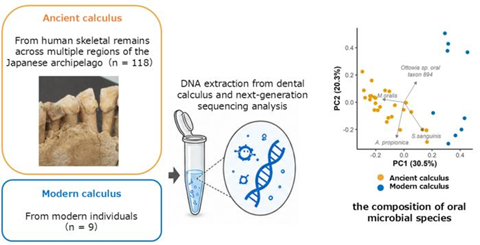
Along with previously published data of dental calculus from Jomon-period and other Edo-period individuals, the team compared the microbial composition, functional profiles, and phylogenetic relationships of microorganisms across these different time periods. Because dental calculus from human skeletal remains can be affected by contamination from soil-derived microorganisms, the analysis focused on microorganisms considered to be of oral origin using existing oral microbiome databases.
Periodontal disease-associated archaeon
The results showed that the oral microbiome preserved in dental calculus primarily from Edo-period individuals differed in composition from that of modern samples. In particular, the periodontal disease-associated archaeon Methanobrevibacter oralis (M. oralis) was frequently detected in dental calculus from Edo-period individuals. Differences in microbial composition were also observed between samples from the Honshu–Kyushu region and those from the Okinawa region, suggesting that regional living environments and dietary habits may have been associated with oral microbial composition.
The researchers also compared Jomon-period samples with samples from the Edo period and found phylogenetic differences among several oral bacterial species across time. These findings suggest that human mobility, the introduction of agriculture, dietary change, and other historical processes in Japan may have been associated not only with human populations, but also with the diversity of microorganisms that lived alongside them.
Traditional practice
The study also focused specifically on the phylogenetic distribution of the periodontal disease-associated archaeon M. oralis and examined its relationship with ohaguro, the traditional practice of tooth blackening that was widely observed during the Edo period. The analysis showed that M. oralis was divided into two major lineages, Clade A and Clade B. Furthermore, the archaea found in women with traces of ohaguro all belonged to the same clade, hinting at a possible connection between the custom and the oral microbiome.
The researchers also compared genes of M. oralis and identified lineage-specific variants in metabolic genes related to iron utilization. Because ohaguro involved the application of iron-containing and plant-derived substances to the teeth, differences in the oral chemical environment may have been associated with the distribution of particular microbial lineages. Testing this link directly would require systematic documentation of ohaguro traces alongside chemical analysis of dental calculus.
These findings demonstrate that microbial DNA preserved in dental calculus can serve as a new source of evidence for investigating past health conditions as well as diet, regional variation, cultural practices, and the history of relationships between humans and microorganisms. Future analyses of samples from broader time periods and regions, together with chemical analysis of dental calculus and archaeological information, may help reconstruct in greater detail the lifeways of people in Japan and their relationships with microorganisms.
Key points
The study reconstructed past oral microbiomes from dental calculus DNA of individuals from Japan.
Dental calculus from ancient to early modern individuals showed oral microbial compositions distinct from those of modern individuals, along with regional differences and phylogenetic differences across time periods.
Phylogenetic analysis of the periodontal disease-associated archaeon M. oralis showed that female individuals previously reported to exhibit traces of ohaguro all belonged to the same clade, hinting at a possible connection between the custom and the oral microbiome.




No comments yet