
For scientists who study the Southern Ocean, a long-standing silver lining in the gloomy forecast of climate change has been the theory of iron fertilization. As temperatures rise and glaciers in Antarctica melt, ice-trapped iron would feed blooms of microscopic algae, pulling heat-trapping carbon dioxide from the atmosphere as they grow.
There’s just one problem: The theory doesn’t hold water.
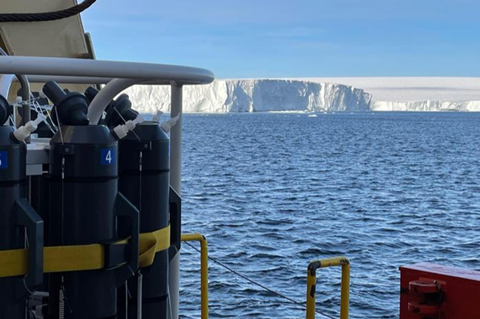
In what researchers describe as the most accurate measurement of iron inputs from a glacier in Antarctica, marine scientists from Rutgers University-New Brunswick have discovered that meltwater from an Antarctic ice shelf supplies far less iron to surrounding waters than once thought.
The findings, published in the journal Communications Earth and Environment, raise questions about the sources of iron in the Southern Ocean near Antarctica, and could significantly alter how climate change predictions are forecasted and modeled, the researchers said.
“It has been widely assumed that glacial melting underneath ice shelves contributes considerable bioavailable iron to these shelf waters, in a process of natural glacier-driven iron fertilization,” said Rob Sherrell, a professor in the Department of Marine and Coastal Sciences at the Rutgers School of Environmental and Biological Sciences and the study’s principal investigator.
Sherrell said the study modifies those assumptions by determining that the amount of iron in meltwater is several times lower than previously thought and that most of that iron comes from a different type of meltwater than is produced by ice shelves melting.
Growth of phytoplankton
Despite being shrouded in darkness for several months a year, the Antarctic waters of the Southern Ocean are a highly productive region for growth of phytoplankton – the vital food source for krill, which feed penguins, seals and whales. As phytoplankton grow, they absorb vast amounts of carbon dioxide through photosynthesis, making the region the world’s largest oceanic sink for the climate-warming gas.
Previous research into iron sources in the Southern Ocean has primarily been through simulations and computer modeling. Together with researchers from Rutgers and several universities in the United States and the United Kingdom, Sherrell, who also is a professor at the Department of Earth and Planetary Sciences at the Rutgers School of Arts and Sciences, took a different approach. In 2022, they traveled aboard a now-decommissioned U.S. icebreaker, the Nathaniel B. Palmer, to the Dotson Ice Shelf, located in the Amundsen Sea in West Antarctica, to collect melting glacial water at the source. The Amundsen Sea accounts for most of the sea level rise driven by Antarctic melting.
In the Amundsen Sea, glacial meltwater comes from beneath floating ice shelves – the seaward extensions of glaciers from the continent – and the melting is caused primarily by warm water that flows from the deep ocean into the cavities under the ice.
Cavities under the ice
At the Dotson Ice Shelf, Sherrell and his team identified where seawater enters one such cavity and where it exits after meltwater is added. They collected water samples from entry and exit points.
Back in New Jersey, Sherrell’s colleague Venkatesh Chinni, a postdoctoral scholar and lead author of the study, analyzed the samples for iron content in both its dissolved state and in suspended particles. Collaborators Jessica Fitzsimmons, a professor and chemical oceanographer, and Janelle Steffen, an assistant research scientist, both at Texas A&M University, measured the isotopic ratios to “fingerprint” and distinguish the sources. Steffen carried out initial isotopic measurements in the laboratory of Tim Conway, an associate professor at the University of South Florida.
Chinni and the team then calculated how much more iron was coming out of the cavity than went in and deduced from the isotopic data the type of melting that was responsible.
The results were surprising, Sherrell said. Total meltwater contributed about 10% of the outflowing dissolved iron, with the majority contributed by inflowing deep water (62%) and another 28% as inputs from shelf sediments.
Not from meltwater
“Roughly 90% of the dissolved iron coming out of the ice shelf cavity comes from deep waters and sediments outside the cavity, not from meltwater,” Chinni said.
READ MORE: Sediment core yields evidence of an unexpected climate feedback in Antarctica
READ MORE: Microbiologists uncover bacteria that remove toxic sulfide and use iron minerals for growth
Additionally, iron isotope ratios from the samples suggest that somewhere beneath the glacier is a liquid meltwater layer that lacks dissolved oxygen, a condition that promotes the dissolution of solid iron oxides in the bedrock, seemingly a larger source of iron than ice shelf melting, Chinni said.
Taken together, the findings challenge prevailing assumptions about iron sources in the Southern Ocean in a warming world, though additional research is needed to better understand how the subglacial processes are involved, the team said.
Surprising realization
“Our claim in this paper is that the meltwater itself carries very little iron, and that most of the iron that it does carry comes from the grinding up and dissolving of bedrock into the liquid layer between the bedrock and the ice sheet, not from the ice that is driving sea level rise,” Sherrell said.
For some colleagues, this will be a very surprising realization, he added.
Topics
- Algae
- Climate Action
- Ecology
- glacial meltwater
- iron fertilization
- Janelle Steffen
- Jessica Fitzsimmons
- Marine Science
- Ocean Sustainability
- phytoplankton
- Research News
- Rob Sherrell
- Rutgers University-New Brunswick
- Southern Ocean
- Texas A&M University
- Tim Conway
- UK & Rest of Europe
- University of South Florida
- USA & Canada
- Venkatesh Chinni





No comments yet