
A research team led by Professor Chen-yu Zhang from the School of Life Sciences, Nanjing University, China, published a comprehensive review in Volume 2, article number 31 of the journal Immunity & Inflammation on July 20, 2026.
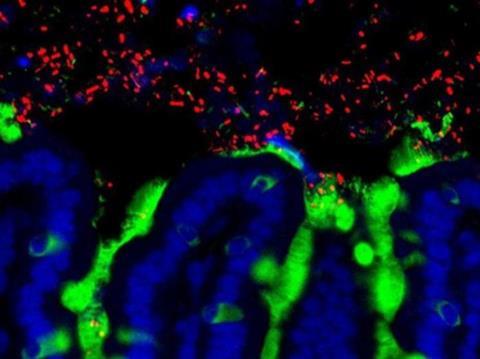
The article systematically introduces a new concept—Persistent Intracellular Extraintestinal Microbes (PIEMs)—that extends microbiome research from body surfaces into internal tissues. This framework offers fresh perspectives on long-term host–microbe relationships and the pathogenesis of complex diseases.
Microbiome research has long focused on barrier surfaces such as the gut and skin. However, a hidden population of microbes resides within internal tissues and cells. Though present in small numbers, these “invisible residents” may exert profound effects on health and disease over extended timescales.
The review defines PIEMs as a distinct category of microorganisms that persist within extraintestinal tissues or circulating cells, existing in a latent or low-replication state with specific host cell tropism and latency–reactivation dynamics. This group encompasses latent viruses, chronic intracellular bacteria, and tissue-resident parasites.
Tuning devices
Unlike the abundant gut microbiota, the significance of PIEMs lies not in quantity but in persistence, tissue localization, and regulatory capacity. The authors propose that “PIEMs act as systemic tuning devices for the human body.”
Over years or even decades, these microbes continuously release signaling molecules that subtly but profoundly calibrate physiological baselines—including immune response thresholds, vascular homeostasis, metabolic levels, and tissue repair capacity. This long-term modulation influences individual susceptibility and response patterns to infection, injury, and chronic diseases.
MICROBIOLOGY NEWS: Register with The Microbiologist for more free articles
The review uses human cytomegalovirus (HCMV) as a model to systematically illustrate PIEM mechanisms. “HCMV is an ideal model due to its high prevalence, lifelong latency, broad cell tropism, and potent host-modulating capabilities,” the authors explained.
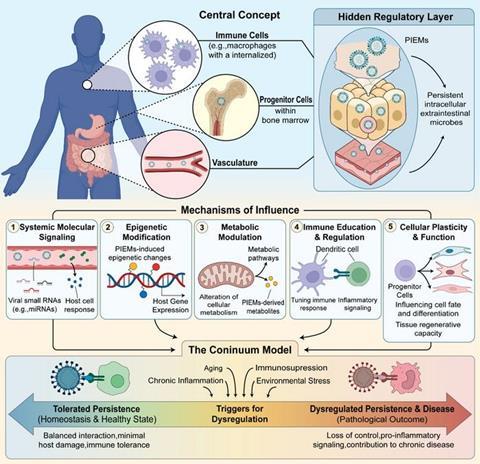
Its long-term “negotiation” with the host—through mechanisms including antigen presentation interference, T cell memory remodeling, angiogenesis modulation, and metabolic reprogramming—continuously shapes the host’s immune, vascular, and metabolic systems. This sustained interaction may represent a long-overlooked key factor in complex diseases such as autoimmunity, atherosclerosis, and cancer.
Significant challenge
A significant challenge in studying PIEMs is their low abundance and difficulty in detection. The review innovatively proposes using circulating viral miRNAs as a liquid biopsy window for monitoring PIEM activity. The key advantage is that miRNA levels reflect viral “real-time activity” rather than simply indicating past exposure, enabling non-invasive, dynamic monitoring of latency and reactivation.
Zhang’s team has already validated HCMV miRNA biomarker potential in multiple clinical scenarios, including hepatitis B treatment response prediction and auxiliary diagnosis of oral lichen planus, laying a foundation for PIEM-based precision medicine strategies.
MICROBIOLOGY ON TAP: Get full access to all The Microbiologist articles from just £2.17 a month
The PIEMs framework offers several important contributions. First, it expands microbiome research from body surfaces to internal tissues, revealing a hidden regulatory layer within the human body and significantly complementing existing microbiome concepts.
Second, it provides a new “microbial latent infection” paradigm for etiological studies of complex diseases, suggesting that PIEMs may represent a common, overlooked risk factor.
Novel biomarker
Third, it prospectively proposes circulating viral RNA as a novel biomarker for monitoring PIEM activity, guiding the development of liquid biopsy technologies and precision diagnostic tools.
Fourth, it suggests that PIEMs represented by HCMV, along with their regulatory molecules, such as miRNAs, may serve as novel drug targets, opening new approaches for prevention and treatment of complex diseases.
Looking forward, “with advances in multi-omics and artificial intelligence, PIEM research may construct a virome-driven precision medicine framework, ultimately enabling individualized risk assessment, monitoring, and intervention,” the authors highlighted.



No comments yet