
All Ebola virus articles
-
 News
NewsLow risk of global spread of Ebola disease, analysis suggests
Researchers identified and analysed all known Ebola disease cases outside Africa to assess the risk of undetected Orthoebolavirus transmission outside Africa and to put it into context with possible border and travel policies.
-
 News
NewsKey facts about Hantavirus and Ebola virus disease
Ebola and hantavirus have made headlines in recent weeks as they pose serious threats to public health. Two succinct articles provide information about each disease for clinicians.
-
 News
NewsEbola virus hides in the central nervous system, according to new research
Ebola virus can survive unnoticed in the human body for months or even years, hiding in areas with little immune surveillance like the central nervous system. Using a cerebral organoid model, researchers have gained valuable insights into the mechanisms of Ebola virus persistence.
-
 News
NewsAsk the expert: World Cup travel and Ebola risk
Luis Ostrosky, MD, division chief of infectious diseases at McGovern Medical School at UTHealth Houston and chief epidemiology officer for Memorial Hermann Health System addresses the Ebola outbreak in Congo and Uganda and how the United States could be affected through travel.
-
 News
NewsNew model could help track deadly viruses back to their source
A new predictive model could help scientists more efficiently identify the reservoirs of emerging zoonotic viruses and dangerous pathogens like Ebola that can spill over from animals into humans. It relies on detailed information collected on suspected reservoir species to identify key windows.
-
 News
NewsScientists identify nearly two dozen antiviral compounds that could treat Ebola virus
Recent advances in artificial intelligence have enabled scientists to identify nearly two dozen antiviral compounds that could potentially treat a rare species of Ebola virus (Bundibugyo virus) currently affecting the Democratic Republic of Congo.
-
 News
NewsTeam discovers gene pattern that could help doctors identify Ebola faster and more accurately
Researchers have made an important discovery that could help doctors tell Ebola apart from other infections more quickly. The overlap of response by Ebola and other pathogens had made it difficult to find markers that are truly unique to Ebola.
-
 News
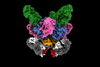
NewsNanodisc platform improves vaccine design for Ebola, HIV and more
Scientists have created a platform that allows viral surface proteins to be studied in a form that more closely resembles how they appear naturally, utilizing nanodisc technology where these proteins are embedded into particles made of lipid molecules, preserving them in a membrane-like structure.
-
 News
NewsWhat factors influence likelihood and severity of Ebola outbreaks?
Two new papers looked at factors that contribute to how Ebola outbreaks begin and how severe they become. This Q&A looks at how the results could inform public health interventions to prevent pathogen emergence or slow the spread of Ebola and other infectious diseases.
-
 News
NewsScientists reveal how deadly Marburg virus enters human cells, identify therapeutic vulnerability
Researchers found that the Marburg virus, one of the world’s deadliest pathogens, is unusually efficient at getting inside human cells. They also showed that the virus’s entry protein contains structural features that explain this efficiency and point to a strategy for blocking infection.
-
 News
NewsSix years after COVID-19’s global alarm: Is the world better prepared for the next pandemic?
Six years ago, the Director-General of the World Health Organization sounded the highest global alarm available under international law at the time, declaring the outbreak of a new coronavirus disease. As we cross this six-year mark, WHO asks: Is the world better prepared for the next pandemic?
-
 News
NewsResearchers discover how Ebola and Marburg disrupt the gastrointestinal tract
A new study sheds light on the mechanisms behind the damage caused by Ebola (EBOV) and Marburg virus (MARV) to the gastrointenstinal tract. TIt found that both viruses are capable of infecting and replicating within human gut epithelial cells and that the viruses interfere with the cells’ ability to regulate fluid secretion, mirroring the severe symptoms observed in patients.
-
 News
NewsLong Ebola: Sudan virus can persist in survivors for months, study shows
More than half of survivors of the Sudan Ebola virus still suffer serious health problems two years post-infection and the virus can persist in semen and breast milk for months after recovery, according to the first study examining the virus’s long-term effects.
-
 News
NewsBeyond health: The political effects of infectious disease outbreaks
A new study gives empirical evidence that individuals who experienced an infectious disease outbreak show significantly less trust in the political establishment.
-
 News
NewsScientists zoom in on structure of still lethal Ebola virus
The first high-resolution visualisation of the Ebola virus nucleocapsid provides detailed insights into the interactions within the nucleocapsid complex, unveiling the relationship between molecular interactions and functional regulation.
-
 News
NewsPromising antibody may prove useful against deadly Ebola virus outbreaks
New research reveals the workings of a human antibody called mAb 3A6, which may prove to be an important component for Ebola virus therapeutics.
-
 News
NewsThe hunt narrows for Ebola virus hosts
A cholesterol-trafficking receptor, Niemann-Pick C1 (NPC1), was identified for more efficient surveillance of host reservoirs of filoviruses, including Ebolaviruses. It narrows down the host species of the virus and links to the geographic information of pathogen emergence.
-
 News
NewsScientists advance nanobody technology to combat deadly Ebola virus
Researchers have developed the first nanobody-based inhibitors targeting the Ebola virus. Their small size allows them to access areas of the virus and human tissues that larger antibodies cannot.
-
 News
NewsStudy traces Ebola’s route to the skin surface
Researchers have traced a cellular route the Ebola virus uses to traverse the inner and outer layers of skin and emerge onto the skin’s surface. The study identifies new cell types within the skin that are targeted by EBOV during infection.
-
 News
NewsA new class of antivirals could help prevent future pandemics
A new study introduces a proof-of-concept for a novel class of antivirals that would target a type of enzyme essential not just to SARS, but also many RNA viruses, including Ebola and dengue, as well as cytosolic-replicating DNA viruses, including Pox viruses.